Field Teams in AR: The Future of Jobsite Support with 3D Rendered Environments
Jump To Key Section

The work of field and 3D rendering services is experiencing a major shift. This move is being driven by Augmented Reality (AR). The rate of adoption for this immersive technology.
Gartner estimates that by 2025, more than 50% of field service management deployments will contain mobile augmented reality collaboration and knowledge-sharing tools. This projection indicates a clear trend—AR is moving to an essential technology for today’s field operations.
So overlay important digital content, such as step-by-step instructions, schematics, and 3D models, directly onto the technician’s view of the real world. This AR can change how experts deliver the knowledge and the way the work itself is performed
Let’s read more about unlocking significant increases in efficiency, accuracy, and training within the workforce, regardless of the variety of field-based industries.
KEY TAKEAWAYS
- Accurate 3D visualization and rendering services are critical.
- Key benefits include large reductions in training time and significant cuts in service costs.
- AR enables experts to guide field teams from anywhere.
Why 3D Visualization Services Make AR Work in the Field
Early adoption of digital technologies simply shifted the supplies into tablets with PDF manuals and video calling or remote support as the only form of interaction. Augmented Reality will allow a team of experts, states or continents away, to collaborate in an immersive digital environment.
An expert can draw an arrow, circle part, insert a 3D model into the technician’s view of the real world, and make instructions clear, particularly when tasking workers with collateral information that is not always straightforward. 3D rendering services will produce high-accuracy digital twins and models of assets, machinery, or entire buildings.
The Evolution of Field Service Support
Previously, a field technician’s primary tools consisted of their toolbox, a paper manual, and a phone line back to a remote expert. While on-site, when complex issues came up, technicians relied on their training and knowledge. The next significant evolution is Augmented Reality.
They start this visual instructional learning process will then become how Augmented Reality is shifting the field support from a simple communicative device to an engaging/device immersive collaborative environment.
What AR Looks Like with Real 3D Accuracy
When Augmented Reality uses precise 3D rendering for presentations, the site experience is unmatched. Let’s see everyone here:
- Remote Expert Assistance: The remote expert sees the live feed and overlays with a rendered 3D model to guide the technician to place a tool to perform a delicate fix.
- Installation Checks: A 3D model indicates where they need to drill, confirming that the as-built work matches the design model and prevents expensive re-work.
- Guided Maintenance: An AR app provides a step-by-step workflow instruction on a large industrial machine, with each step using an animated 3D arrow and text, making maintenance simple.
What’s In It for You? The Real Benefits
Utilizing AR produces direct business benefits via high-fidelity 3D assets. This section talks about those real benefits:
- Increased First-Time Fix Rate (FTFR) so that technicians can resolve problems immediately.
- Interactive 3D training replaces static classroom learning, accelerating the transfer of complex knowledge.
- Fewer expert travel costs and reduced downtime for customers translate to a healthier bottom line.
- Workers follow precise, visual instructions for complex and hazardous tasks, significantly reducing the risk of human error and ensuring regulatory adherence.
Where It’s Working: Real-World Impact
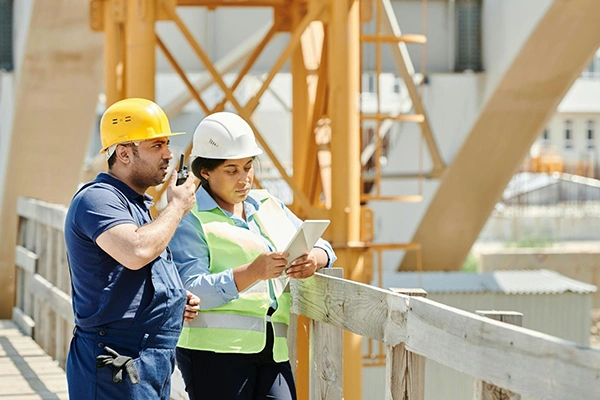
The success of AR in the field is not theoretical, but rather proven across numerous asset-intensive industries. Field engineers use AR to check underground pipes, cables, and hidden components to prevent accidental damage. In a complex factory environment, it assists in equipment repair.
On top of this, teams installing or maintaining cellular towers and network equipment depend on AR to verify antenna alignment and cabling paths. Overall, in the real world, argument reality guides for error-free work.
How to Get Started: Key Implementation Tips
Moving to an AR-enabled field team takes intentionality and thoughtfulness to properly deploy.
- Identify your use case: Identify the most time-consuming or error-prone single activity, like a repair of a piece of equipment or installation, with many steps. Then, target that activity for an AR pilot use case.
- Create quality 3D assets: Verify that your existing CAD/BIM building data can be converted into high-fidelity 3D assets that will perform appropriately in an AR environment.
- Choose your hardware: Decide if hands-free operation, like smart glasses, will be useful for the task, or if an application on a smartphone or tablet will suffice to get started.
- Gather user experience feedback: The experience of the users of the AR application is valuable to develop AR as a solution, and how it was applied, regardless of its use.
Best Practices for Success
To support and sustain the successful use of AR in the field, focus on the people and integration. The AR application shouldn’t be a stand-alone tool. It must fit and integrate with your Enterprise Asset Management (EAM), Field Service Management (FSM), and/or BIM systems to extract real-time data and documentation.
Convey how AR will make the technician’s job easier. Utilize a change management team to navigate through any hesitance to change from a typical work process.
Conclusion
Argument reality, when made based on accurate, high-quality, provided environments, basically field service and job-website support. It strengthens field teams with immediate visual skills, democratizes knowledge, and ensures that critical work is completed at outstanding speed and accuracy.
From reducing costly errors and travel expenses to dramatic improvements in technician training to improve efficiency in the modern industrial landscape. The future of fieldwork is not just digital – it’s much better.
FAQs
Ans: Augmented Reality (AR) overlays digital information, like 3D models or instructions, onto the real world the technician is currently looking at, which is ideal for active work on a jobsite.
Ans: Not always. Basic AR can be deployed using standard smartphones or tablets.
Ans: A digital twin is a highly accurate, virtual replica of a physical asset, system, or facility.
Ans: Virtual Reality (VR) immerses the user completely in a simulated, separate digital world, often used for training simulations.