Forklift Chain and Mast Lubrication: Why It Matters and How to Do It
Jump To Key Section
- Understanding the Forklift Mast and Chain Assembly
- Why Chain and Mast Lubrication Matters
- Mast Rail and Roller Wear
- How Often Should You Lubricate Forklift Chains and Mast Components?
- Step-by-Step Forklift Chain Lubrication
- Step-by-Step Mast Rail Lubrication
- Inspecting Lift Chains for Wear and Damage
- When to Replace Lift Chains
- The Role of Quality Parts in Chain and Mast Maintenance
- Final Thoughts
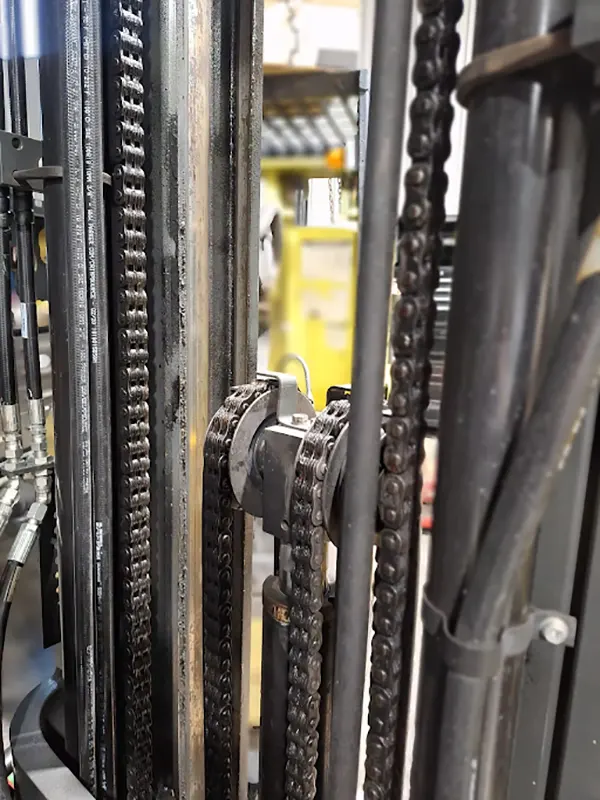
If asked what the most important lubricant task on a forklift is, I would say maintaining the lift chains would be my answer
With chains that work all day carrying loads and being the operational units of every industry, ranging from indoor warehouses to corrosive industrial settings, the task of their smooth functionality becomes vital.
Which can go on smoothly with mast lubrication, gliding the chains.
Therefore, this guide covers everything you need to know about forklift chain and mast lubrication — why it matters, what happens when it is neglected, which products to use, and exactly how to do it correctly, step by step.
Understanding the Forklift Mast and Chain Assembly
Before getting into complex lubrication procedures, let’s understand first how the mast and chain system works and why lubrication is so critical to its function.
The mast, which is a vertical assembly at the front of the forklift that guides the carriage and forks as they travel up and down.
Depending upon the forklift standard :
- Standard
- Duplex
- Triple Mast
The interlocking has its rail sections, which can be either two or three. It is these rails that allow the carrier to roll away smoothly, while the hydraulic cylinders carry out the movement of assembly.
The lift chains, on the other hand, are heavy-duty roller chains that connect the carriage to the hydraulic lift cylinder.
In practise what happens is the operator raises the forks, while the hydraulic pressure extends, lifting the cylinder, raising the carriage.
These chains can handle enormous loads if the choice of lubricant you make is right.
The interaction between all of these components — chains running over anchor pins and sheaves, rollers travelling along mast rails, tilt cylinder pins pivoting under load — creates friction that generates heat and wear.
So, ultimately, it is the lubricant that stands as a shield, carrying out the functioning well.
Why Chain and Mast Lubrication Matters
The consequences of neglecting chain and mast lubrication go far beyond slightly accelerated wear. Here is what is actually at stake:
Chain Elongation and Failure
Forklift lift chains are made up of hundreds of individual links, each consisting of inner and outer plates connected by pins and rollers.
This works in a way that every time the chain flexes, which happens with the movement of forks, it allows the movement of pins and rollers against each other.
Without lubrication, metal-to-metal contact causes the pins and bushings to wear down.
It begins with an individual unit but eventually leads to the destruction of the whole unit.
A broken lift chain while carrying a load is not just a mechanical failure — it can turn to fatal safety incident impacting lives.
Interesting Fact
Approximately 60% of all industrial chain failures are caused by improper or insufficient lubrication.
Mast Rail and Roller Wear
In order to function properly, the carriage rollers require lubricant so that the movement can be smooth.
Dry rails in this case can cause the rollers to skip and bounce rather than roll smoothly, generating heat and wearing both the rollers and the rail surfaces.
Over time, this creates grooves and flat spots that cause the carriage to travel unevenly, affecting load stability and operator control.
Increased Operating Loads
It is observed that a dry, poorly lubricated mast assembly requires significantly more hydraulic force to raise and lower the carriage than a properly lubricated one.
This makes the task even tougher by increasing the load further, straining the hydraulic pump, motor, and cylinders, and shortening the service life of these components as well.
Corrosion and Environmental Damage
Corrosion and environmental conditions can damage the forklifts, exposing them to moisture, corrosive substances, etc.
This weakens the link plates, which could be protected if you apply even a thin film of lubricant for protection.
Choosing the Right Lubricant
One of the most important and most commonly misunderstood aspects of forklift chain and mast lubrication is product selection.
Using the wrong lubricant is nearly as damaging as using no lubricant at all, so choosing the right product for suitable results becomes very important.
Lift Chain Lubricant
With a requirement of lifting heavy loads, the selection of lubricant for lift chains becomes crucial.
In such a case, the Standard multi-purpose grease is too thick to penetrate the spaces — it coats the outside of the chain without reaching the working surfaces inside.
So you should look for a product specifically labelled as a forklift chain lubricant or industrial chain lubricant.
These products are typically thin enough to penetrate the chain links, contain anti-wear and anti-corrosion additives, and are formulated to adhere to the chain under operating conditions rather than flinging off or washing away.
Some are petroleum-based, while others use synthetic base oils for better performance in extreme temperatures or food-grade applications.
Mast Rail and Carriage Lubricant
The mast rails and carriage roller contact surfaces benefit from a different approach than the chains.
A medium-weight grease — typically NLGI Grade 1 or 2 — applied to the rail surfaces provides a durable film that reduces friction as the rollers travel up and down.
Some technicians prefer a spray-applied dry lubricant for rail surfaces, which reduces the tendency to attract and hold dust and debris compared to a conventional grease.
Tilt Cylinder and Anchor Pin Lubrication
The tilt cylinder attachment pins, chain anchor pins, and carriage pivot points have grease fittings and should be serviced with a standard multi-purpose NLGI Grade 2 grease applied through a grease gun.
It is advised to use them because they respond well to conventional bearing and pivot points.
Always consult your forklift manufacturer’s service manual to confirm the recommended lubricant types and specifications for your specific model.
You can also consider following OEM recommendations to have compatibility with seals, materials, and operating conditions.
How Often Should You Lubricate Forklift Chains and Mast Components?
Lubrication frequency depends on various factors :
- Operating Intensity
- Environment
- and the specific components involved.
Here are general guidelines:
Daily or Every Shift — If the chains appear dry or have been exposed to water, cleaning, or chemical spray, lubricate them immediately, regardless of the normal service interval.
Every 8 to 40 Hours of Operation, the grounds for applying lubricant depend on the conditions, so :
| Conditions | Time Period |
| Normal Warehouse conditions | Weekly for single-shiftsEvery day or two for multiple shifts |
| Corrosive environment | Frequently |
| Elongated or corroded chains | Every 250 hours |
| Performing a comprehensive mast inspection | Every 500 hours |
This ensures a smooth functioning of the chains and improves their lifespan as well.
Step-by-Step Forklift Chain Lubrication
Now, in this phase, we are going to understand how to accomplish forklift chain lubrication by performing some simple steps
Step 1 — Park Safely and Prepare the Forklift
Place the forklift on an even, level surface. Set the parking brake and lower the forks completely to the ground. This relaxes the chains and makes the full length of each chain accessible for inspection and lubrication.
Step 2 — Clean the Chains Before Lubricating
Polishing new lubricants on dirty, old dried grease, or corrosion does not restore chain condition — it just traps contaminants against the metal surfaces. Before lubricating, clean the chains using a stiff brush and a suitable chain cleaning solvent or degreaser to remove accumulated grime. Allow the chains to dry completely before applying fresh lubricant. For heavily contaminated chains, this cleaning step may require raising and lowering the forks slowly while brushing to access all sections of the chain.
Step 3 — Apply Chain Lubricant to the Full Length of Both Chains
With the chains clean and dry, apply the chain lubricant generously to the full length of both lift chains. The far-fetched method of applying is to drizzle or brush the lubricant along the top edge of each chain so that it penetrates down between the link plates by gravity and capillary action. Many technicians use a squeeze bottle, a brush applicator, or a dedicated chain lubrication tool to apply the product evenly.
Pay particular attention to the inner link areas where the pins and rollers make contact, as these are the surfaces that need protection most. Do not just spray the outside of the chain and consider it done — effective chain lubrication requires penetration to the internal working surfaces.
Step 4 — Cycle the Mast to Distribute the Lubricant
After applying lubricant, slowly raise and lower the forks through their full travel range several times. This cycling action works the lubricant into the chain links and ensures even distribution along the entire chain length, including the sections that were wrapped around the sheaves during application. Listen for any unusual sounds during this process — a dry or worn chain often produces a distinctive clicking or grinding that reduces or disappears after lubrication.
Step 5 — Wipe Away Excess Lubricant
After cycling, use a clean rag to wipe away any excess lubricant from the outer surfaces of the chains. A light protective film should remain, but heavy external accumulations of lubricant attract dust and debris that can accelerate wear and create a slip hazard if the lubricant drips onto the floor.
Step-by-Step Mast Rail Lubrication
After understanding the methodologies of forklift lubrication, it is important to calibrate how we can get the most out of mast rail lubrication. Let’s see how it works.
Step 1 — Raise the Forks to Access the Full Mast Height
For lubricating the rails properly, the carriage must be raised to expose the rail surfaces that are normally hidden behind it. Raise the forks to approximately mid-height, then apply lubricant to the exposed lower rail sections. Then raise the forks to full height and apply lubricant to the sections that are now exposed. This two-stage approach ensures coverage of the full rail height.
Important: Always use a spotter and follow your facility’s elevated work safety procedures whenever working near a raised mast. Never work under a raised load.
Step 2 — Apply Grease or Dry Lubricant to the Rail Contact Surfaces
Put a thin coating of lubricant on the inner rail surfaces where the carriage rollers make contact. Use a brush or rag to spread the lubricant evenly, avoiding excessive buildup that would attract debris. If using a spray-applied dry lubricant, follow the product’s application instructions regarding spray distance and coverage.
Step 3 — Lower the Forks and Cycle the Mast
Lower the forks fully and then raise them again through the full travel range to distribute the lubricant evenly across the contact surfaces. This also helps work the lubricant into the contact areas between the rollers and rails.
Step 4 — Lubricate the Tilt Cylinder Pins and Anchor Points
Holding and loading a grease gun with appropriate multi-purpose grease, locate all grease fittings on the mast assembly. These typically include the tilt cylinder attachment pins at the top and bottom of each cylinder, the chain anchor pin brackets, and any carriage pivot points. Apply grease to each fitting until fresh grease begins to purge from the edges of the joint, indicating that the old grease has been displaced and the fitting is fully charged.
Inspecting Lift Chains for Wear and Damage
Lubrication and inspection work simultaneously. Every time you lubricate the chains, take a few minutes to assess their condition. Here is what to look for:
- Chain Elongation is the pivotal wear indicator of this segment. As chains wear, the cumulative play in each link connection causes the chain to grow longer than its original length. Most manufacturers specify a maximum allowable elongation — typically 2 to 3 per cent over a measured baseline length. Use a ruler or a dedicated chain wear gauge to measure a specific number of links and compare the measurement to the specification in your service manual. Chains that have elongated beyond the allowable limit must be replaced.
- Corrosion and Rust anywhere on the chain is a serious concern. Surface rust that can be removed with cleaning and lubrication may be acceptable, but pitting, deep corrosion of the link plates, or rust that has penetrated the pin and bushing areas indicates that the chain has been damaged and should be replaced.
- Cracked or Bent Link Plates are an immediate cause for replacement. Any visible cracking, deformation, or damage to the link plates indicates that the chain has been overloaded or has experienced impact damage.
- Tight Links that lose their flexibility are a sign of corrosion, contamination, or wear that has caused the pins and rollers to seize. A chain with tight links cannot distribute load evenly and is at high risk of failure.
- Uneven Wear Patterns between the two chains — such as one chain showing significantly more elongation or wear than the other — indicate a load distribution problem. Both chains in a pair should always be replaced together, even if only one has reached its wear limit.
When to Replace Lift Chains
No amount of lubrication can restore a chain that has worn beyond its service limits. Knowing when to replace rather than maintain is just as important as the maintenance itself. Replace lift chains when elongation exceeds the manufacturer’s specification, when physical damage such as cracking or corrosion is present, when any link does not flex freely, or when the chains have reached the manufacturer’s recommended service interval, regardless of apparent condition.
Make sure to replace chains in pairs and not one by one. Installing a new chain alongside a worn chain creates uneven load distribution, accelerating wear on the new chain and compromising load stability.
The Role of Quality Parts in Chain and Mast Maintenance
Even the best lubrication program cannot overcome the limitations of inferior replacement parts. During the emergency of replacing parts like chains, rollers, wear pads, or anchor components, using quality parts that meet OEM specifications ensures that your maintenance investment delivers the performance and longevity you expect. Substandard chains wear faster, stretch sooner, and are more vulnerable to fatigue failure — negating the benefits of careful lubrication and inspection.
For Kalmar forklift operators seeking quality replacement chains, mast components, and other maintenance parts, visit intellaparts.com to browse a comprehensive selection of Kalmar parts and find the right components for your fleet.
Final Thoughts
Forklift chain and mast lubrication is not a task to be rushed through or skipped when schedules get busy. It is a fundamental safety and maintenance practice that protects your operators, your loads, and your equipment from consequences that range from costly breakdowns to catastrophic failures.
The investment is minimal — a bottle of chain lubricant, a grease gun, and thirty minutes of attention at regular intervals. It takes thousands of hours to assess the return on investment of using these materials. In lift chains that reach their full designed service life, in mast components that move smoothly and predictably under load, and in operators who can trust their equipment to perform reliably every shift.
Build chain and mast lubrication into your maintenance culture as a non-negotiable standard, train your team to perform it correctly, and pair it with consistent inspection so that wear is caught before it becomes a safety hazard. Your forklifts — and the people who operate them — deserve nothing less.
Ans: It is important to protect chains from rust and corrosion formed by natural elements like oxygen and water.
Ans: Always spray on the interior of the chain links and not on the sides.
Ans: The common methods of chain lubrication consist of manual, drip, oil bath, slinger disk and oil stream.