How to Use Customer Q&A to Reduce Support Tickets (2026 Guide)
Jump To Key Section
- Answer Once, Save Thousands: The Hidden Power of Customer Q&A
- The Foundation: Building a Strong Knowledge Base
- The Engine: AI-Powered Q&A That Learns
- Metrics That Matter: Measuring Q&A Success
- When Not to Deflect: The Human Touch
- Advanced Strategies for Maximum Deflection
- Implementation Roadmap
- Pro Tips
- Conclusion
Almost every business dreams of scaling, but some just stop in the process, fearing the extent of support staff that would be required to serve all those additional customers.
One issue with the support department is that the majority of the time, they get similar problems. Wouldn’t it be just prudent to resolve an issue once and for all, reducing the need to do it again and again, wasting the precious productive time of employees on repetitive tasks?
This is where knowledge bases and customer Q&As come into the picture. And now even AI-powered chatbots are in the same company.
According to Gartner, a whopping 73% of customers use self-service, but only 14% of issues are fully resolved through it.
You can employ these self-support tools to reduce customer servicing needs and corresponding ticket frequency, while also increasing customer satisfaction and confidence.
In this article, I’ll take you through how to do exactly that, taking your business brand to new heights in 2026.
KEY TAKEAWAYS
- Self-service support can help you reduce your support workforce.
- These are knowledge-based systems that help customers solve their issues themselves regarding your products.
- It also elevates customer satisfaction and confidence.
- AI chatbots are a new entrant in this category, allowing customers to put their concerns in natural language, as if talking to actual human support staff.
Answer Once, Save Thousands: The Hidden Power of Customer Q&A
When customers solve their issues with your products or services through your self-service tools without reaching out to your support services, it’s called ticket deflection. When it’s done properly It’s not all about reducing customer interaction; it’s about providing them with faster and easier ways to get answers.
There are more stakes in 2026 than there have ever been. Based on a McKinsey survey, 63 percent of the top leaders in customer service are now saying that enhanced self-support has played an important impact in decreasing inbound call volumes. It’s a striking result.
Companies like Rebrandly reduced support ticket numbers by half with AI-powered chatbots connected to their Knowledge Base, which has resolved over 16,000 calls in a single session. BoldDesk clients have experienced 40% ticket deflection in only 90 days.
The rationale for this is simple: Reduce support tickets with Q&A practices, which help reduce the volume of support-related questions and improve customer service. The customers get their answers immediately, anytime, and without waiting in line, while support staff focuses on more complicated, valuable problems.
The Foundation: Building a Strong Knowledge Base
Deflecting tickets is not easy. You need to have a deep knowledge base around what issues customers are facing and perfect resolutions for each of them, that too in a language that they understand, without putting any effort on their cognitive systems. An efficient knowledge base is the foundation of every Q&A plan.
Start Narrow, Learn Fast
The most common mistake that businesses make is to develop a flawless, extensive knowledge base prior to the launch. The reason this approach is ineffective is that you don’t know what questions your customers might actually have.
Instead, you should deploy fast with five to 10 articles that answer your most frequent concerns. MatrixFlows says, “Better to start with 5-10 articles addressing real questions. Don’t wait months building theoretical documentation”.
A week of minimal material will show you exactly what you need to write next ,using the actual questions of customers, and real needs that are demonstrated by real-world usage.
What to Include in Deflection-Focused Articles
The articles that help deflect the largest tickets generally contain:
- How-to guides to tackle everyday jobs.
- Troubleshooting workflows to resolve common issues.
- Instructions for setting up and onboarding.
- Access, authorizations, and billing access explanations.
The best practices are simple, task-focused titles, step-by-step formatting and screenshots, or even video clips, as well as solid internal links between the content.
The Engine: AI-Powered Q&A That Learns
Static FAQs are still a reliable self-support system, making it a must-have. However, modern Q&A is constantly changing. AI chatbots and search tools recognize intent, understand natural language and present relevant information in real time.
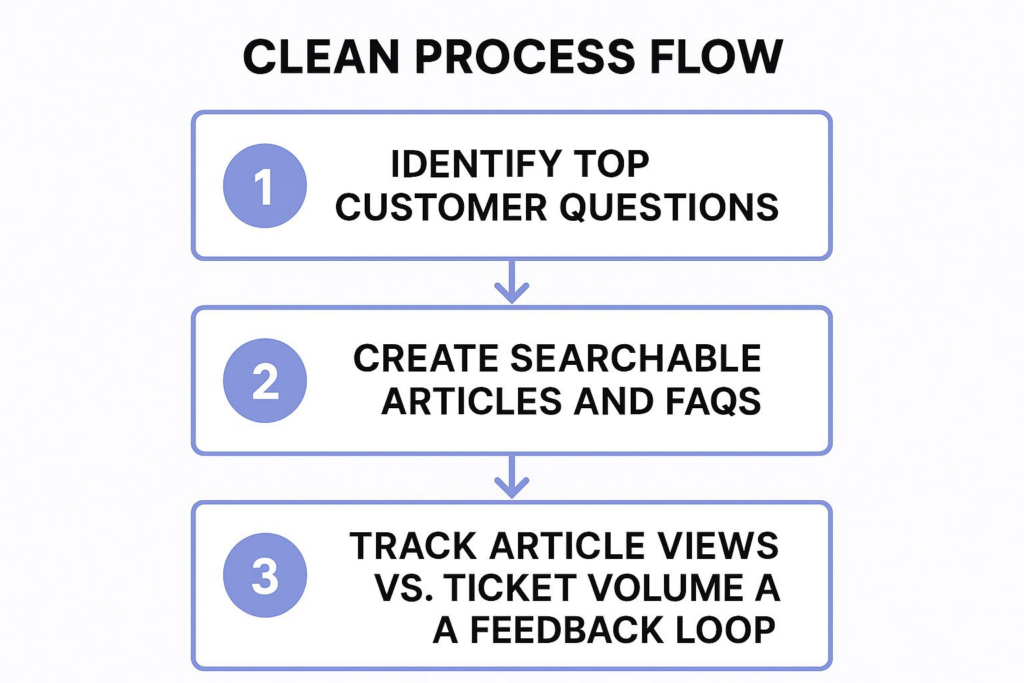
The Self-Service Resolution Loop
Knowledge-driven Support is able to be achieved via a continuous improvement cycle :
- The customer asks a question.
- AI-powered self-support attempts resolutions using existing information.
- Problems that aren’t resolved become a source of concern for agents who have complete knowledge of the situation.
- Agents can resolve the issue using their experience.
- Resolution automatically becomes known.
- The next similar issue is resolved via self-service.
This loop of enablement converts single-time responses into long-lasting ticket reductions. Rebrandly’s application of this strategy was able to achieve 90-95 percent chatbot response accuracy, handling up to 100 customer calls per day.
Beginning with AI: How to Start with AI
There’s no need for a complete foundation of knowledge to begin. The latest AI tools are able to learn from the content you already have, even when it’s only 5-10 pages.
Tools such as Tidio, Intercom, and Zendesk AI can handle routine inquiries instantly, freeing your staff to focus on more complex tasks. The most important thing is feeding your chatbot FAQs as well as knowledge base articles, then keeping track of conversations every week to improve answers.
It is expected to take between two and three months for training and refinement. However, even with 70 percent accuracy, you’ll experience an enormous time reduction.
Metrics That Matter: Measuring Q&A Success
Can you improve something that you can’t gauge the performance or quality of? No right. So, in order to reduce service tickets with Q&A efficiently, and to reduce support load FAQ, you need to keep track of some metrics from day one. These four important metrics are listed below:
1. Ticket Deflection Rate
A large percentage of customers’ issues are resolved without the creation of a support ticket.
Formula: (Self-service resolutions / Total support demand) x 100.
Goal: 35 to 45% in 90 days.
2. Self-Support Resolution Rate
A percentage of your customers use your self-service feature and then resolve their issue without further escalation.
Target: 15-25% Week 1, 35-45% Week 4, 50-65% Week 12.
3. Engagement Rate
How many customers utilize the self-support option before calling the service number?
Goal: 60-80% in 30 days.
4. Knowledge Gap Frequency
What questions are most often raised? This is a metric that drives knowledge creation priority. Do not guess what to write, let data guide you.
Other metrics include the first response time, resolution time along with CSAT for self-service versus agent-assisted interactions.
The following infographic explains the mindset you should have around designing your own self-support system in the simplest of terms:
When Not to Deflect: The Human Touch
Not every customer issue is best served through FAQs or chatbots. Some are cut for only human touch in resolutions.
Issues That Should Go Straight to Humans
- Payment disputes or billing disputes (emotions and contexts)
- Security issues (suspected theft, data access concerns, data access)
- Problems with access to accounts (lockouts or identification verification)
- complex enterprise configurations (integrations and custom configurations)
The clear and easy escalation routes build confidence. The customer should never be confined. require clear “contact support” options and effortless handoffs between self-service and live representatives.
Advanced Strategies for Maximum Deflection
To maximize your ticket deflection rate, properly implement the given measures.
1. Contextual In-Product Support
One of the most effective mitigations occurs before the customer even thinks about seeking assistance. Tooltips that feature walkthroughs, onboarding checklists as well as empty-state guidance address confusion at the point where it is apparent to reduce downstream issues.
2. Community Forums
The majority of customers trust the opinions of their peers. Community forums that have been moderated provide peer-to-topeer help that can increase deflection, while increasing participation. They are most effective when accepted answers are clearly marked and users who are able to participate are encouraged to take part.
3. Proactive Communication
Most tickets aren’t due to the confusion, but rather to the silence. Status pages for events, in-app banners for known problems, as well as release notes, prevent uncertainty from becoming support demand.
Implementation Roadmap
You can craft a robust self-service system, reducing your tickets by a huge margin in just a matter of three months.
Month 1: Foundation
- Install an AI-powered self-support system for one product or the audience segment (representing 30-40% of total volume)
- Start by writing 5-10 articles that answer your most important questions
- Set up escalation routes to agents in the field
- Track engagement and resolution rates daily
Month 2: Optimization
- Check metrics every two weeks to identify trends for improvement
- Fill in the gaps of knowledge based on data from escalation
- Extend to a new segment or product
- You can expect a self-service rate of 35 to 45%.
Month 3: Scale
- Extend to other segments or products
- Achieve 40-55% self-support rate across portfolio
- Check metrics every week with a set the routine of optimization
- Celebrate 40%+ ticket deflection
Pro Tips
Here are some additional pro tips to cut down on the number of customer support calls:
- Begin with five to ten FAQ content that addresses your most frequent queries. Start quickly, and then use real customer questions to inform your future articles.
- Feed FAQs to AI chatbots and analyze conversations on a weekly basis. In a matter of a couple of months, AI responds to routine inquiries while you and your team address more complex questions, which will reduce the support load FAQ.
- Deflector tracking, self-service resolution, and information gaps. Data will show you the results and what you need to develop next. Don’t try to guess.
- Make sure to keep a human in charge of sensitive matters such as problems with billing, security issues, as well as account access problems. A clear escalation path builds confidence.
- Include in-app guidance to help users proactively. Walkthroughs and tooltips can help users avoid questions in times of need before tickets are made.
Conclusion
Knowledge bases aren’t all about technology. The mindset and processes around their implementation and functioning are equally important. When you create a system that ensures many customer resolutions, it helps improve the support process, permanently transforming the financial aspects of customer service.
The ability to reduce service tickets with Q&A becomes a sustainable advantage rather than a one-time fix. Start with a small amount, roll out quickly with real-time use to guide your learning. Keep track of the relevant measures, make sure that people are kept informed of complex problems, and expand the best practices.
By 2026, the companies who will win won’t necessarily be those that have the latest technology. They’ll be the ones who make use of the technology to make better decisions to move more quickly in addition to serving customers better.
Ans: Try to implement FAQs with a comprehensive knowledge base.
Ans: The five Ps of customer service are: People, Process, Product, Presentation, and Price.
Ans: AI-powered chatbots have completely transformed the world of self-support in 2026.