8 Best Domo AI Alternatives in 2026 (Tested & Compared)
Turning images into anime videos is the new trend among the you ngsters specially the audience that spends their time watching animated movies and series like One Piece, Naruto, Demon Slayer, etc.
With a rising demand for animated pictures and videos, the relevance of AI alternatives that can do so is also increasing.
Apart from drawing a vast young audience, such content is also one of the favourite genres for anime creators, YouTubers and social media influencers, bringing them amazing viewership and with less effort.
So if you too are someone who wishes to be a part of this animated movie and video trend, here’s a tested and compared blog that will introduce you to 8 such options that will help you turn pictures and videos into animation within minutes and without any extra workload.
Quick Comparison Table
| Tool | Best For | Overall Score | Key Strength |
| Loova | Complete AI creative platform | 9.9/10 | Multi-model ecosystem + AI Agent |
| Kling AI | Cinematic animation | 9.7/10 | Realistic motion and storytelling |
| PixVerse | Viral short-form videos | 9.4/10 | Fast generation and templates |
| Runway | Professional editing | 9.3/10 | Advanced AI post-production |
| Hailuo AI | Character performance | 9.1/10 | Natural facial animation |
| Pika | Creative visual effects | 9.0/10 | Fast editing and social content |
| Pollo AI | Multi-model experimentation | 8.8/10 | Flexible model access |
| Leonardo AI | Stylized artwork | 8.7/10 | High-quality AI art generation |
How We Tested Domo AI Alternatives
Since Domo AI focuses heavily on stylized animation and image-to-video generation, I evaluated every platform using the same creative scenarios instead of relying on feature lists.
And the results I came across were quite satisfactory. But before getting there, let us first understand what the comparison focused on:
- Video quality and animation smoothness
- Prompt accuracy and creative control
- Character consistency
- Image generation and editing tools
- Overall creative ecosystem
- Pricing and long-term value
Some platforms excelled at anime creation, while others proved much more versatile for commercial production specifically.
Loova
If you’re looking for a platform that goes well beyond anime animation, Loova is the strongest Domo AI alternative I tested. And the reason why I say this is because Instead of centering everything around one generation model, Loova combines several of today’s leading AI models into one creative workspace.
Something that major platforms often tend to miss out!
That flexibility allows creators to choose the best model for each project instead of adapting every idea to a single engine.
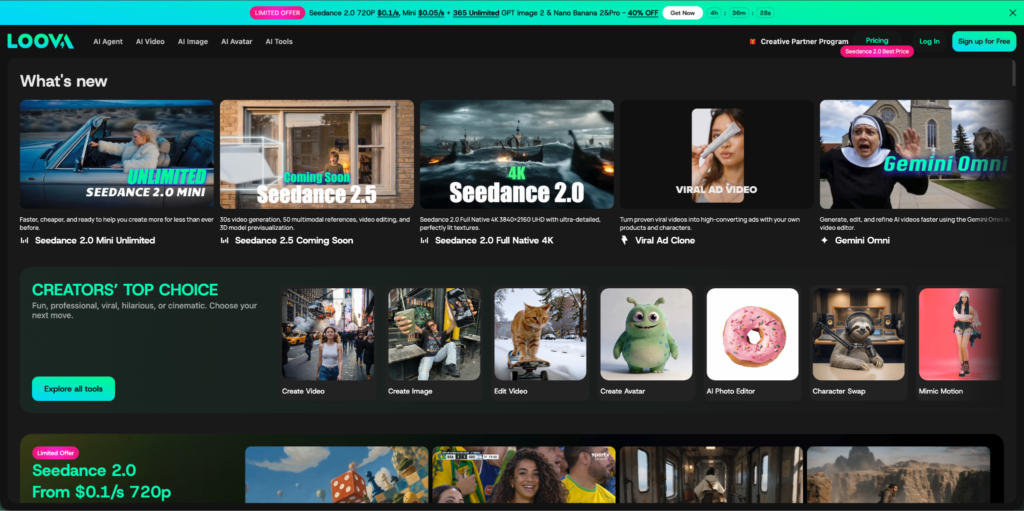
One of Loova’s biggest advantages is how its model ecosystem functions.
Loova combines leading AI models including: Seedance 2.0, Kling 3.0, GPT Image 2 and Nano Banana Pro, which make it easy to move between photorealistic videos, stylized animation, image generation, and commercial marketing assets without changing platforms.
A complete AI creation platform
While Domo AI mainly specializes in stylized animation, Loova supports almost every stage of visual content creation.
This is why the platform includes:
- Professional AI Text to Image generation
- Multi-model AI video generation
- AI image editing and enhancement
- AI Ad Generator for marketing creatives, including Viral Ad Clone
- Character creation and consistency features
- AI-powered creative assistance
This unified workflow therefore makes it much easier to develop ideas from concept art all the way to finished videos.
AI Video Agent speeds up production
Another feature that separates Loova from many competitors is how its AI Video Agent functions.
Instead of expecting users to write perfect prompts, the AI agent helps brainstorm ideas, improve prompts, organize scenes, and build complete production plans through natural conversation.
This is because for creators publishing YouTube videos, advertisements, or social campaigns every week, it dramatically reduces planning time while improving creative consistency.
Designed for creators who scale
Many Domo AI users eventually need more than anime animation.
The main reason behind this is because they need commercial-quality videos, realistic imagery, editing tools, and multiple generation models which can handle different creative styles.
Loova provides all of those capabilities inside one platform, which makes it a better long-term solution for creators.
Pros
- Multiple industry-leading AI models
- AI Video Agent for creative planning
- Complete image and video ecosystem
- Excellent value for frequent creators
- Beginner-friendly interface
Cons
- Advanced capabilities require some exploration
- Newer ecosystem than some established platforms
Best For
Content creators, marketers, agencies, ecommerce businesses, designers, and AI creators.
Kling AI
Kling AI is one of the strongest choices for creators who want to move beyond stylized animation into cinematic AI filmmaking.
Want to know how and why?
During testing, it consistently delivered smoother movement, more realistic physics, and better character consistency than Domo AI which makes it a convenient choice.
Its ability to generate believable camera motion however makes it especially valuable for story-driven videos, product advertisements, and professional marketing content.
Kling also supports AI Text to Video, giving creators far greater flexibility when building complex scenes from simple prompts. And bringing accessibility to everyone.
Pros
- Outstanding motion realism
- Excellent prompt adherence
- Cinematic camera control
- Strong character consistency
Cons
- Premium plans cost more
- Advanced controls take time to master
Best For
Filmmakers, advertisers, and creators producing cinematic AI videos.
PixVerse
PixVerse has become one of the most rapidly expanding AI video platforms thanks to its emphasis on rapid content creation. Compared with Domo AI, PixVerse delivers a broader collection of creative templates, smoother video generation, and a more flexible editing experience.
Its Magic Brush feature also enables users to influence object movement directly, making experimentation much faster than relying entirely on text prompts.
PixVerse performs particularly well for creators producing TikTok videos, YouTube Shorts, and Instagram Reels where speed matters as much as visual quality.
Pros
- Fast rendering
- Great template library
- Excellent for viral content
- Beginner friendly
Cons
- Limited professional editing
- Character consistency can vary
Best For
Social media creators, influencers, and short-form video production.
Runway
Runway remains one of the industry’s the most comprehensive AI creativity platforms. While Domo AI focuses primarily on animation, Runway goes well beyond that generation by offering professional editing tools including masking, inpainting, object removal, motion tracking, and visual effects.
Its production environment is especially useful for agencies and filmmakers that need to polish AI-generated footage before publishing.
Runway also supports AI editing from image to image , allowing creators to refine visual assets before transforming them into videos.
Pros
- Professional editing suite
- Mature production workflow
- Excellent commercial capabilities
- Frequent feature updates
Cons
- Higher subscription cost
- Better suited to experienced users
Best For
Creative professionals, agencies, filmmakers, and production studios.
Hailuo AI
Hailuo AI has become among the best platforms for creators producing character-driven videos. While Domo AI excels at stylized animation, Hailuo aims to make people look believable. Facial expressions, eye movement, subtle gestures, and body language feel amazingly all natural, making it a better choice for creators working with realistic human subjects.
During testing, Hailuo smoothly generated consistently performances even in scenes involving fast movement, changing camera angles, and expressive dialogue. This so it makes especially useful for product marketing, digital presenters, and lifestyle content where authentic human motion is more more crucial than artistic effects.
It also supports AI Image to Video, allowing creators to bring portraits to life and product images while maintaining strong facial consistency throughout the sequence.
Pros
- Excellent facial animation
- Realistic human movement
- Fast rendering
- Beginner-friendly interface
Cons
- Smaller editing ecosystem
- Fewer advanced production tools
Best For
Digital presenters, product marketing, lifestyle creators, and realistic character animation.
Pika
Pika has evolved into a video with the simplest AI generators for casual creators. Its strength lies in creative editing rather than cinematic realism. Features like Pikaffects enable users to replace objects, extend scenes, and create playful visual effects with very little effort.
Compared with Domo AI, Pika offers a faster and easier-to-use editing experience, making it ideal for creators who prioritize speed over advanced production controls. While It is inconsistent the realism of Kling or Veo, it’s an excellent option for producing engaging social media videos with minimal learning.
Pros
- Extremely easy to use
- Creative editing features
- Fast generation
- Great for short-form content
Cons
- Less suitable for cinematic storytelling
- Limited professional controls
Best For
TikTok creators, YouTubers, Instagram creators, and beginners.
Pollo AI
Pollo AI takes a different approach from the majority of AI generators by serving as a multi-model platform rather than relying on a single generation engine. Users can access several popular AI models from one interface, making it straightforward to compare outputs without switching between multiple subscriptions.
This flexibility is particularly helpful for creators experimenting with different visual styles. During testing, I found it useful for rapidly comparing anime-inspired videos, realistic animations, and stylized content before deciding which model best suited the project.
Although generation quality is dependent on the selected model, Pollo provides one of the easiest ways to explore today’s AI ecosystem.
Pros
- Access to multiple AI models
- Flexible creative experimentation
- Affordable pricing
- Fast iteration
Cons
- Interface can feel crowded
- Quality varies between models
Best For
Creators who enjoy experimenting with different AI models and visual styles.
Leonardo AI
Leonardo AI remains one of the strongest platforms for creators whose work begins with visual design. While Domo AI emphasizes animation, Leonardo concentrates on making beautiful concept art, illustrations, fantasy scenes, and stylized characters before making a move into motion.
Its Motion tools have gradually improved over the past year, allowing users to animate artwork while preserving composition, lighting, and artistic style.
For anime artists, game designers, and illustrators, Leonardo still offers some of the best image quality available.
Pros
- Outstanding AI image generation
- Excellent artistic consistency
- Strong prompt understanding
- Reliable stylized output
Cons
- Video generation is less advanced
- Better suited to illustration than realistic filmmaking
Best For
Illustrators, anime creators, concept artists, and game designers.
Domo AI vs Loova
| Feature | Loova | Domo AI |
| AI Models | Multiple leading models | Primarily proprietary |
| AI Video Agent | Excellent | Good |
| AI Image Generation | Excellent | Good |
| AI Video Generation | Excellent | Good |
| AI Editing Tools | Extensive | Basic |
| Marketing Tools | Extensive | Limited |
| Character Consistency | Excellent | Good |
| Best For | Complete AI creation | Anime and stylized animation |
Which Domo AI Alternative Should You Choose?
Choose Loova if
Choose Loova if you want an all-in-one toolkit for creative types instead of a specialized animation tool.
With access to multiple leading AI models, an AI Video Agent, image generation, video creation, editing tools, and marketing features, it offers the most comprehensive solution for creators producing content across different styles.
Choose Kling AI if
Your priority is cinematic storytelling, realistic movement, and professional-quality AI filmmaking.
Choose PixVerse if
You mainly create fast-paced social media content and desire an intuitive platform with creative templates.
Choose Runway if
You need advanced editing tools and a professional post-production workflow.
Choose Hailuo AI if
Your videos real people focus, digital presenters, or expressive character performances.
Choose Leonardo AI if
Your projects start with concept art illustrations, anime, or stylized image generation before moving into animation.
Final Thoughts
Domo AI remains a fun and accessible platform for anime videos, stylized animation, and character-based content. For creators focused primarily on those use cases, it continues to be a solid choice.
However, if your creative projects extend beyond anime into advertising, filmmaking, YouTube production, or commercial content, you’ll likely benefit from a broader creative ecosystem.
That flexibility makes it suitable for everything from social media clips to large-scale marketing campaigns.
FAQs
Ans: Based on my testing, Loova is the best overall Domo AI alternative because it combines multiple leading AI models, AI-powered creative planning, image generation, video generation, and editing tools within a single platform.
Ans: Leonardo AI and PixVerse are both strong choices for anime-style content. Leonardo excels at generating beautiful artwork, while PixVerse provides faster animation and social-media-friendly video creation.
Ans: Kling AI and Hailuo AI consistently produced the most realistic motion, facial animation, and character consistency during testing, making them excellent choices for cinematic and commercial content.
Ans: Loova offers one of the most complete creative ecosystems by combining image generation, video generation, editing, AI-assisted production, and multiple state-of-the-art AI models within one platform.
Ans: PixVerse, Pika, and Loova all provide intuitive interfaces that allow beginners to start creating AI content quickly while still offering room to grow into more advanced projects.
Ans: For creators producing content regularly, Loova delivers the strongest long-term value because it brings together several premium AI models, creative tools, and production features under one subscription instead of requiring multiple standalone services.