Unlawful Retaliation and Termination: What to Know

As per the Equal Employment Opportunity Commission (EEOC), retaliation is the most frequently alleged basis of discrimination in the federal sector and the most common discrimination finding in federal sector cases.
You’re legally protected while reporting any signs of abuse at your workplace. But many employees avoid it as the resulting retaliation is financially and emotionally devastating.
San Bernardino unlawful retaliation lawyer says employee should receive support when he/she reports adverse workplace conditions instead of any unlawful and negative outcomes like retaliation or termination.
In this article, I’ll tell you everything about unlawful retaliation and termination. The following sections also discuss what exactly counts as unlawful retaliation, what to do after that, your employee rights in this situation, and where to find legal support and resources.
KEY TAKEAWAYS
- Unlawful retaliation has become the #1 employee issue in the corporate world.
- Companies are firing the “problematic” employees unjustly.
- Clearly understand your employee rights and what exactly makes a termination unlawful.
- Hire a capable lawyer, as the legal process can be taxing depending on your case.
What Is Unlawful Retaliation and How Does It Occur?
Employer retaliation as a result of protected action on the part of the employee is completely unlawful. As per unlawful termination attorney Andrew Lampros, employees are wrongly terminated for complaining about adverse firm policies or activities.
The adverse outcome can come in different forms, including demotion, reduced working hours, and complete job termination. Organizations use legal restrictions to protect themselves since this strategy allows them to conduct business operations without facing interruptions from their staff members.
The retaliatory behavior can be considered wrongful only when your supervisor starts treating you differently after you have voiced your concerns during meetings. Self-defense mandates that people understand how to pick up on and identify warning signs.
When you feel your rights are violated as an employee, informing your HR department with documented proof will help build your case.
Know Your Employment Rights Against Retaliation
Federal and state laws protect you against any retaliatory action when you report discrimination, harassment, or law violations by your organization. Even your company policy documents might contain your rights and reporting procedures, but when have policy documents been translated, ideally, in the practical world?
You should document all events by maintaining records of incidents and conversations, and your complete list of formal complaints. Keep in mind that this documentation will act as proof in case you ever suffer any vengeful actions from your employer or supervisor.
Report your experience of abuse and discrimination to the HR department of your company. They will look into your concern and investigate the situation. You might also consider consulting an employment law attorney.
How to Spot Signs of Unlawful Termination?
Not all terminations count as unlawful. There must be some characteristics to your workplace complaint and its aftermath, along with how you defend your rights and handle legal challenges.
The first step requires you to observe all unexpected alterations that affect your work responsibilities, including situations that result in your exclusion from tasks. The existence of ongoing negative performance evaluations that follow your reporting of wrongdoing and complaint filing represents a warning sign.
Document your employer’s remarks about your dismissal, particularly if they relate to your whistleblower activities and family leave rights.
Examine your termination and determine if there was a violation of your employee rights. You may also inspect if other employees facing comparable conditions receive different treatment.
In this case, you will need to present evidence that will give strength to your case in legal proceedings.
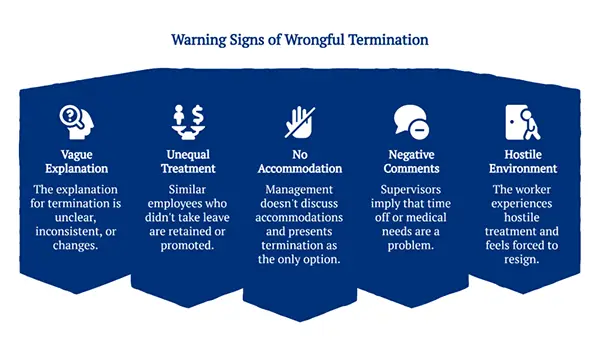
The following infographic summarizes the signs of wrongful termination:
What to Do If You Face Retaliation or Termination?
You need to take prompt action as soon as you face retaliation or termination.
Gather all proof of the incident by collecting information that includes the date, details, names of witnesses, and all actions taken against you. The upcoming procedures will require this information as a key element.
Read the organizational policy regarding retaliation in cases of complaints and reporting concerns.
Point out to your supervisor the problem. The HR office should review the entire list of supervisory reporting options to see which one matches your definition.
Only rely on trustworthy colleagues when you require some information or help.
By keeping your cool and not discussing your case with others, you will help avert further complications.
Your activities will safeguard your rights and give you enough confidence to deal with the situation.
Where to Find Legal Support and Resources
As each case is different and requires specific knowledge and procedure to follow, lawyer assistance becomes important in a situation like this.
Free or low-cost assistance can be obtained if you contact local legal aid societies. The Equal Employment Opportunity Commission (EEOC) website contains resources on basic understanding of rights and processes for filing complaints. Gather every available piece of information. Remember, informed knowledge creates your strongest defense.
Conclusion
As a worker, you should know which retaliation is illegal and which termination is wrongful. Keep on a lookout for any changes in workplace policy or how things work there that may seem unjust to employees. Document them under “suspicious incident.” In such cases, consider seeking advice or legal help. Giving HR a detailed report or seeking legal help can have positive consequences.
You are not alone in fighting these types of issues. There is a network readily available to support you if you want to assert your employee rights.