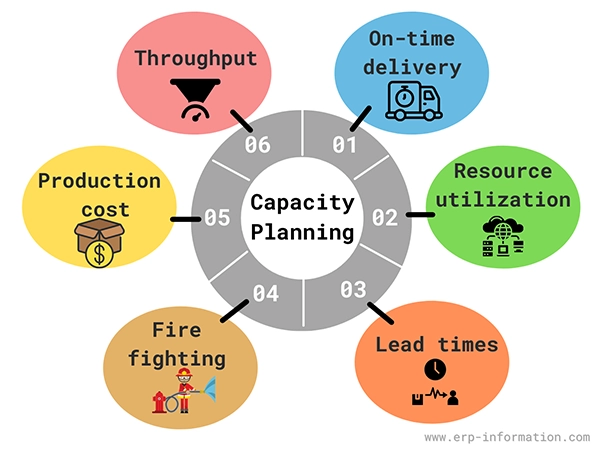
Capacity planning stands as a vital aspect of modern manufacturing. It determines a business’s ability to meet production demands using its existing resource base, along with everything from labor and machinery to available time.
A misstep in this critical area can lead to severe consequences, from overwhelmed production lines and delayed deliveries to costly idle resources and diminished customer satisfaction.
As the manufacturing sector increasingly embraces digital transformation, the global ERP market size was valued at USD 50.36 billion in 2023 and is projected to grow significantly [Source: Grand View Research]. It highlights the widespread recognition of ERP’s crucial role in enhancing operational control and decision-making across industries.
To effortlessly thrive in the market, one needs first to understand how to generate high-quality ERP leads. Afterward, this article brings solutions to effectively manage capacity planning using ERP tools.
Let’s learn to manage capacity planning with ERP tools in this article.
Key Takeaways
Manufacturing ERP systems provide an integrated platform for managing labor, machinery, and materials, offering a holistic view of available capacity.
ERP tools offer real-time insights into work orders, machine availability, and inventory, enabling proactive decision-making and bottleneck identification.
ERP facilitates the alignment of sales forecasts and customer orders with production capacity, preventing over-selling or under-utilization.
These systems help balance workloads across various work centers, maximizing resource utilization and reducing bottlenecks.
ERP’s real-time updating capabilities allow manufacturers to adapt quickly to unexpected changes like machine breakdowns or sudden orders, maintaining production schedules.
By leveraging historical data, ERP supports ongoing analysis and refinement of capacity plans, leading to long-term operational efficiency.
Understanding Capacity In A Manufacturing Environment
Capacity in manufacturing is the ideal quantity that a production site can perform as the output in a defined period, subject to standard working conditions. It takes into account the access to machines, labor, and the assets necessary to do the work. Overestimating or underestimating processing capacity may ultimately result in either late delivery or wasted assets, neither of which is cost-effective or makes customers delighted.
Manufacturing of ERP operating systems streamlines the activity of capacity assessment so that the data is collected in a single spot. The production managers can analyze either the anticipated work in comparison to the available capacity, and could recognize some bottlenecks, and could also know what types of overtime hours, subcontracting, or switching need to be organized. Along with this transparency, there is also adequate planning, and this prevents last-minute hitches that in many cases are a result of reactive-based planning.
Before moving further, you may look at the five most important sectors where capacity planning plays a crucial role .
Aligning Demand Forecasting With Production Capability
Capacity planning is a crucial element input of an accurate demand forecast. The manufacturers must know about the products they are supposed to produce, as well as the delivery schedule and quantity. By being unable to balance the projected demand with the reality of production capacity, businesses threaten to oversell their offerings or fail to use available capacities.
Manufacturing ERP software will help capture, maintain, and break down this past cycle of data in a way that makes it easy to retrieve and analyze. Over time, manufacturers may be able to use this to accomplish better predictions, experimentation, and tune resource allocation options. The constant development of analyses based on real-world data can enable companies to optimize their business gradually and make more accurate decisions for industrial processing equipment.
Evaluating Machine And Labor Availability
The availability and performance of machines and human capital should also be known for effective capacity planning. Due to shift coverage, leave entitlements, or skill requirements, the workforce may be limited while the equipment undergoes maintenance or repairs. Any unsuccessful attempt to take them into account may give rise to plans that seem to be reasonable on paper but do not work practically.
The adoption of industrial ERP systems involves meticulous detailing, which takes into consideration the calendars of the machines and the preventive maintenance schedules, as well as the availability of employees. To ensure that only competent workers are assigned to certain tasks, it could also be set to provide worker certifications or training levels. The resulting accuracy lowers the risk of stalling in supplies or missing tools, or lack of the right manpower, and enhances coordination on the shop floor.
Balancing Workloads Across Work Centers
Among the main goals of capacity planning is to allocate workloads to the available resources efficiently. Storming a single work center at the added cost of work standstill in various locations causes inefficiency and overburdens the operations. The balanced mode of operation makes sure will increase the degree of predictability and smooth production flow, and it will add to the level of predictability and smooth flow of production.
ERP tools facilitate the successful implementation of this balance and assign work orders to machines or departments in reference to their current workload. By using capabilities such as finite capacity scheduling, the system can avoid overbooking of an individual resource and can help planners reroute tasks. This not only enhances the rate of utilization but also reduces the number of bottlenecks and delivery time between processes.
INTERESTING FACT Businesses that effectively implement ERP systems can see up to a 25% reduction in operational costs due to improved efficiency in areas like capacity planning and inventory management
Adapting To Real-Time Changes In Production
Manufacturing settings are often dynamic, in which unforeseeable circumstances (e.g., machine breakdowns, last-minute orders, or even lack of supplies) are likely to occur. Such uncertainties have the capability of derailing a well-designed capacity plan within an immediate setting unless the system improves its capacity management capabilities. Inflexible management solutions or spreadsheets cannot be adaptive in real-time.
ERP systems are designed to let them overcome such changes by providing real-time visibility of the production status. The planners can identify the areas in which they are witnessing delays in real time and thus make appropriate decisions to adjust the schedules. Real-time update possibilities are a perfect way to enable manufacturers to recover more effectively in the face of disruption and be resilient to stick to the delivery schedules.
Using Historical Data For Continuous Improvement
Capacity planning is a continuous process and the more the cycle, the better the outcomes. Data collected in the past helps improve subsequent plans and uncover the imperfections or strong sides of a manufacturing process. Knowing about past performance enables the planners to see noticeable bottlenecks, seasonality trends in demand, or poorly performing assets.
Manufacturing ERP software will help capture, maintain, and break down this past cycle of data in a way that makes it easy to retrieve and analyze. Over time, manufacturers may be able to use this to accomplish better predictions, experimentation, and tune resource allocation options. The constant development of analyses based on real-world data can enable companies to optimize their business gradually and make more accurate decisions for industrial processing equipment.
Integrating Capacity Planning With Other ERP Functions
Capacity planning can only be successful with the help of binding it with other business activities like purchasing, management of supply, and sales. Disconnected systems may lead to the increasing possibility of mismatched information and response delays. Any changes made to one aspect of the business will be reflected across the planning process thanks to integration.
This ERP system is supplied naturally, via the manufacturing segment ERP systems. Since it is the center of all the operational data. When new sales orders are authorized or missing supplies are found, the capacity estimates are automatically updated to reflect these changes. A network arrangement boosts the overall consistency of the production approach and adapts teams to cooperate in unison, as opposed to performing as a silo.
Conclusion
The ability to organize the capacity planning executed via ERP tools enables product manufacturers to better adapt to the continuously varying demands of contemporaneous production. The manufacturing ERP tool allows manufacturers to optimally utilize their capital resources by matching them to the real-time needs, reducing disruptions, and becoming more effective, as it includes real-time visibility, accurate scheduling, and integrated data. In the end, companies can perform faster, enhance customer trust, and build a more dependable and flexible production regime.
Ans: Capacity planning in manufacturing refers to determining the maximum output a facility can produce within a given time frame, considering available machines, labor, and materials.
Ans: ERP tools integrate various data points into a single system. This provides real-time visibility into resource availability and demand, allowing manufacturers to identify bottlenecks, balance workloads, and make informed decisions on resource allocation.
Ans: Yes, one of the key benefits of ERP systems is their ability to provide real-time visibility into production status. This allows planners to quickly identify delays or disruptions to schedules, minimizing their impact.
Ans: No, capacity planning is a continuous process. ERP systems facilitate this by capturing and analyzing historical data, which helps manufacturers refine future plans, identify recurring patterns, and continuously improve their resource allocation strategies.