Best WhatsApp Tools for E-commerce Brands in 2026
Jump To Key Section
- Best WhatsApp Tools for E-commerce Brands in 2026
- Comparison of Unit Economics
- The Unit Economics of WhatsApp Marketing: Why Markup Matters
- Embedded Signup vs. Custom API Credentials
- Best Practices for WhatsApp Ecommerce Automation in 2026
- Why Technical Support and Simple Interfaces Drive ROI
- Final Recommendation
Key Takeaways
- Comparison between each tool
- Embedded signup vs API credentials
- Best practices you should adopt for whatsapp Ecommerce automation
- Simple interfaces and tech support drive ROI
Best WhatsApp Tools for E-commerce Brands in 2026

An e-commerce store reduces support costs and recovers abandoned cards and with the right combination of a WhatsApp automation tool, it can scale revenue without hidden costs.
WhatsApp is way more efficient in closing out deals and becoming a direct channel to your customers, much better than email. You just need the right tool to get started.
In this guide, we’ll look at the best 6 WhatsApp tools that are built to support e-commerce brands and their working from automation of orders to cost-effective scaling, they offer it all.
1. WANotifier
WANotifier is a comprehensive WhatsApp marketing and automation tool built on top of WhatsApp Business API that’s designed for end-to-end customer lifecycle marketing. As an official Meta Technology Partner, WANotifier ensures compliance, seamless WhatsApp API setup, and reliable message delivery.
Key Features:
- 0% Markup on API Costs: Unlike most providers, WANotifier charges $0 markup on official WhatsApp API charges, ensuring maximum ROI as you scale.
- Hybrid Technical Setup: WANotifier offers the flexibility of standard embedded signup for speed or the use of your own API credentials for advanced technical control.
- Advanced Lifecycle Automation: WANotifier features personalized WhatsApp campaigns, a built-in CRM, auto-replies and chatbots, automated drip campaigns, and advanced analytics to track ROI and conversions. It also integrates seamlessly with your website, forms, and favorite third-party apps, enabling you to trigger automated messages from these sources in response to user actions such as form submissions, order confirmations, and callback requests.
Analysis: WANotifier is the superior choice for growth-focused brands. Its simple interface, comprehensive feature set, and excellent support make it accessible for marketing teams, while its pricing structure offers one of the most cost-effective solutions for scaling businesses.
2. Zoko
Zoko focuses on “conversational commerce”, turning the WhatsApp chat interface into a direct sales channel for product discovery and ordering.
Key Features:
- In-Chat Product Catalogs: Zoko allows customers to browse inventory and view prices without leaving the WhatsApp application.
- Shared Team Inbox: Zoko centralizes conversations with order history context so agents can provide personalized sales assistance.
- Direct Payment Links: Zoko enables agents to generate and send payment links directly within the chat to close sales instantly.
Analysis: While excellent for direct sales, Zoko’s 25-30% API markup can become a significant financial burden for high-volume broadcast campaigns.
3. Interakt
Interakt is a specialized solution for Shopify merchants, emphasizing a plug-and-play experience that requires minimal technical configuration.
Key Features:
- Native Shopify Sync: Interakt automatically pulls product data and inventory levels from Shopify to keep WhatsApp offers up to date.
- Pre-built Recovery Workflows: Interakt offers “off-the-shelf” automation for abandoned cart recovery specifically designed for Shopify checkouts.
- Automated Shipping Alerts: Triggers real-time notifications for order confirmation, dispatch, and delivery status.
Analysis: Ideal for small Shopify stores, but the 20-30% API markup makes it less cost-effective than 0% markup alternatives once you reach enterprise volumes.
4. Gallabox
Gallabox is optimized for e-commerce brands with complex buyer journeys, focusing on lead nurturing and educational drip sequences.
Key Features:
- Visual Sequence Builder: Gallabox provides a drag-and-drop interface for creating multi-day message sequences to educate prospects on premium products.
- No-Code Chatbots: Gallabox includes pre-built templates for various industries to handle FAQs and lead qualification 24/7.
- Lead Pipeline Tracking: Gallabox allows sales teams to visualize where customers are in the journey, from inquiry to final purchase.
Analysis: Strong for lead-heavy businesses, but requires careful cost management due to standard API usage markups.
5. SleekFlow
SleekFlow differentiates itself through its omnichannel capabilities, consolidating customer conversations from multiple social platforms into one workspace.
Key Features:
- Omnichannel Inbox: SleekFlow merges messages from WhatsApp, Instagram, Facebook Messenger, and WeChat into a single customer profile.
- Enterprise CRM Integration: SleekFlow synchronizes data with major CRMs like Salesforce to maintain a unified system of record.
- Cross-Channel Analytics: SleekFlow tracks customer interactions across various social platforms to attribute conversions accurately.
Analysis: Best for international brands managing multiple channels, though the convenience comes with a high price tag due to multi-channel markups.
6. Tidio
Tidio is a hybrid live-chat and automation tool designed for smaller e-commerce operations that prioritize simplicity and a unified support interface.
Key Features:
- Unified Support Inbox: Tidio combines website live chat, email, and WhatsApp into one dashboard for customer service teams.
- Basic Order Lookup: Tidio integrates with e-commerce platforms, enabling agents to check order status without switching tabs.
- Visual Flow Editor: The platform features a simple builder for creating basic automated responses to common customer queries.
Analysis: A solid “starter” tool, though it lacks the advanced marketing automation and cost-saving 0% markup model found in specialized tools like WANotifier.
Comparison of Unit Economics
| Platform | Meta API Markup | Setup Flexibility | Primary Benefit |
| WANotifier | 0% (Direct Meta Rates) | Hybrid (Embedded or Own API) | Highest ROI & Technical Scalability |
| Zoko | 25-30% | Embedded Only | In-chat sales focus |
| Interakt | 20-30% | Embedded Only | Shopify ease-of-use |
| Gallabox | 15-25% | Embedded Only | Lead nurturing sequences |
| SleekFlow | 15-25% | Embedded Only | Omnichannel consolidation |
| Tidio | Standard Markup | Embedded Only | Simple support setup |
The Unit Economics of WhatsApp Marketing: Why Markup Matters
When an e-commerce brand evaluates a WhatsApp API provider, it must look beyond the monthly subscription fee. The true cost lies in the variable messaging fee.
Most providers in the market act as middlemen, adding a 15% to 25% markup on every conversation. While this may seem negligible for a store sending 1,000 messages, it becomes a massive operational drain for an enterprise sending 500,000.
The WANotifier Advantage: By offering 0% markup, WANotifier allows businesses to reallocate what would have been “markup waste” back into their marketing budget. For an enterprise, this can represent a saving of $20,000 to $50,000 annually—capital that can be spent on customer acquisition or product development.

Embedded Signup vs. Custom API Credentials
A common pitfall for growing brands is “platform lock-in.” Many WhatsApp tools force users into a proprietary ecosystem where the brand does not truly “own” its connection to Meta.
- Embedded Signup: Ideal for speed. It allows a brand to go live in minutes.
- Custom API Credentials (The WANotifier Edge): For brands with high security requirements or those using multiple third-party integrations, the ability to use their own API credentials is vital. It ensures the brand maintains ownership of its data and its relationship with Meta, even if it decides to switch platforms in the future.
This dual-setup option is a hallmark of a tool designed for technical flexibility and long-term business health.
Did You Know?
According to sources, the business application of WhatsApp boasts the highest conversion rate, ranging from 45-60%, in contrast to emails and SMS, which account for only 2-5%.
Best Practices for WhatsApp Ecommerce Automation in 2026
To maximize ROI, brands must move beyond simple broadcasts. In 2026, the strategy should focus on the entire Customer Lifecycle:
- The Acquisition Phase: Use WhatsApp click-to-chat ads to start conversations. Because WANotifier integrates deeply with Meta, tracking the revenue attribution from these ads is seamless.
- The Retention Phase: Implement automated drip sequences. If a customer buys a 30-day supply of a supplement, a drip campaign should trigger on day 25 to remind them to restock.
- The Recovery Phase: Abandoned cart recovery is the lowest-hanging fruit in e-commerce. Using WhatsApp’s interactive buttons, customers can complete a purchase with a single tap.
Why Technical Support and Simple Interfaces Drive ROI
Software is only as good as the team’s ability to use it. Many enterprise tools are so complex that they require a dedicated developer for every campaign.
WANotifier has gained significant traction specifically because it balances technical depth with a simple interface. When marketing teams can build complex “Flows” and “Chatbots” without a ticket to the engineering department, the “Time to Market” for campaigns drops by 70%. Furthermore, having access to excellent support means that if a Meta compliance issue arises, you have experts—not bots—helping you resolve it.
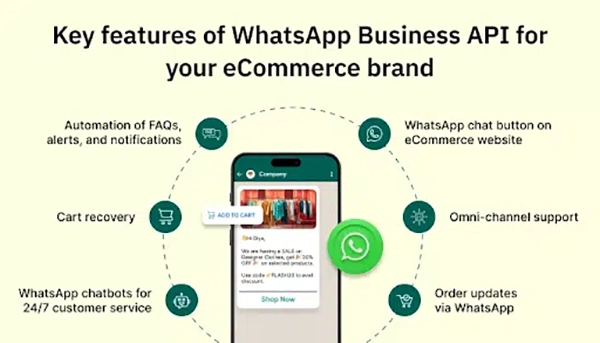
You can also check out this infographic to learn more about what features WhatsApp tools provide to help e-commerce brands grow:
Final Recommendation
For any e-commerce brand scaling past the initial growth phase, the choice of a WhatsApp partner is a strategic financial decision.
WANotifier stands as the industry benchmark by offering 0% markup on WhatsApp API charges, a transparent pricing model, dual setup flexibility, and best-in-class customer support.
This allows you to scale your message volume without scaling your overhead—ensuring your WhatsApp strategy remains a high-margin revenue engine.
Ans: Selling products, managing orders, and offering support to clients or customers through WhatsApp, wherein the customer can select products, make a cart, and buy, all through the same app.
Ans: Yes, it is completely secure, and businesses can integrate their own payment gateways to it to allow secure and seamless transfers without delay.
Ans: There are many benefits of using WhatsApp E-commerce over traditional methods, such as: Higher Engagement Seamless integration Customization