Smart Budgeting Strategies Every Business Owner Should Master
Jump To Key Section
- Start With Visibility: Track Where Every Dollar Goes
- Set Clear and Realistic Financial Goals
- Prioritize Needs Over Wants
- Build a Flexible, Not Fixed Budget
- Plan for Seasonal and Industry-Specific Fluctuations
- Revisit and Adjust Your Budget Regularly
- Involve the Right People in Budgeting Decisions
- Keep Business and Personal Finances Separate
- FAQs

Did you know? Smart budgeting strategies are growing in popularity, with the Smart Budgeting Apps Market projected to reach USD 6.6 billion by 2034, driven by individuals seeking better financial control and tools for expense tracking, savings, and goal achievement. (Source)
Managing cash flow distinguishes between a business that is surviving and a business that is thriving. I have learned that budgeting is a powerful process for accomplishing that. Budgeting is not just tracking expenses.
It is a strategic process that will provide clarity and control over ever-moving market conditions, while creating a more resilient and profitable business. That’s why, in this blog post, I’m going to provide some additional insights about this segment and offer valuable information to readers.
Let’s begin!
Key Takeaways
- Decoding steps to track visibility
- Looking for ways to set clear and realistic financial goals
- Understanding plans for seasonal and industry-specific fluctuations
- Uncovering the importance of the right people in budgeting
Start With Visibility: Track Where Every Dollar Goes
Now, to start things off, I want to talk about the need for a visible transaction that should be prioritized in every step of your financial journey. To achieve this, a good finance tracker can assist you in numerous ways. This means going beyond a gut feeling or general sense of cash flow to create a distinct, real-time picture of each income stream and expense.
Set Clear and Realistic Financial Goals
Spending a lot of money in your initial business without realizing or finalizing your roadmap catered to your financial goals, then you might be doing something wrong. In my opinion, establishing precise and realistic goals takes vague aspirations and abstracts them into an action plan for growth. Instead of abstract ideas like “make more money,” this means determining what success actually looks like with specified, measurable goals.
Intriguing Insights
Smart budgeting strategies are increasingly adopted, reflected in the projected Smart Budgeting Apps Market growth to $6.6 billion by 2034, with a CAGR of 18.40% from 2025 to 2034
Prioritize Needs Over Wants
Trust me, in both professional and personal life, keeping your wants below and needs up will help you to save a lot of money for the times you never even imagined. Finding a perfect balance between things that are truly necessary and things that are simply nice to have is a cornerstone of financial maturity
Build a Flexible, Not Fixed Budget
Personally, what I believe is that the business environment is diversely changing, making a rigid, fixed budget useless in a short amount of time. A flexible budget, however, is built to adapt to changes in your business activity, whether that means an unanticipated decline in sales or an unexpected downturn in the market.
Intriguing Insights
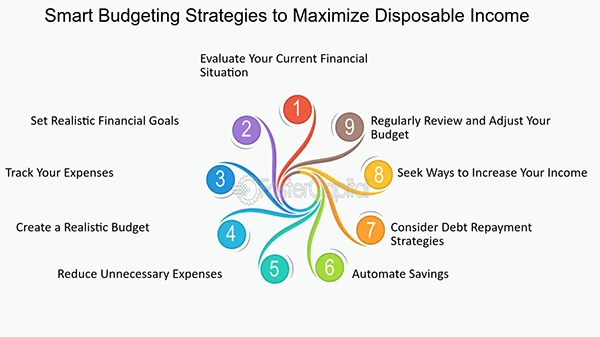
This infographic shows smart budgeting strategies to maximize disposable income
Plan for Seasonal and Industry-Specific Fluctuations
According to me, whether you buy things at retail or wholesale prices, you need to ensure and observe the constant changes in the industrial domains. Retailers have the holiday rush, tourism has the summer high, or your own industry has that slow quarter, etc.
None of these are shocks—they are established patterns of behavior. By evaluating past sales and understanding these cyclical trends, you will be able to eliminate the possibility of high and low demand for your product.
Revisit and Adjust Your Budget Regularly
Life seldom goes perfectly to plan, and your budget should reflect the reality your business journey represents. By reviewing your financial statements monthly or quarterly, you can assess your performance, assess where revenue may be lacking, and find opportunities to cut any unnecessary costs.
Involve the Right People in Budgeting Decisions
Last but not least, now I want to talk about the need for releasing that group budgeting provides the best results for your enterprise and personal expenses. Drafting a budget in a bubble can create blind spots.
Inviting key team members from different departments can yield valuable, on-the-ground perspectives, as the marketing head may know the real cost of a successful campaign, just as the manager of production may know the real story when supply has changed.
Keep Business and Personal Finances Separate
To sum up this entire segment, I just want to say that combining or intermingling business and personal finances leads to a muddled mess that can lead to numerous unwanted consequences.
It complicates bookkeeping, obscures your view of business performance, and may disarm any personal liability protection you might have with your LLC or Corporation designation.
FAQs
Ans: The three major pillars of your budgeting involve fundamentals like your budget, the necessary buyouts, and your ultimate financial goal.
Ans: The expert components of a budget include income, fixed expenses, variable expenses, and unplanned expenses.
Ans: The 75/15/10 rule is a personal finance strategy that allocates your income by spending 75%, saving 15% for long-term investing, and setting aside 10% for short-term emergencies.