When Design Meets Innovation: How Modern Technology Is Transforming Interiors
Jump To Key Section
- The Rise of Smart Homes: How Tech Is Shaping Interior Trends
- Key Design Principles for Integrating Technology Seamlessly
- Smart Furniture & IoT: Functional Style Without Compromise
- Lighting, Sound & Ambience: Tech-Driven Mood for Modern Spaces
- Sustainability & Efficiency: Tech Tools That Support Green Interiors
- Virtual Design Tools: From AR room previews to digital twin modelling
- Future-Ready Interiors: What’s Next in the Intersection of Design and Tech
- FAQs
“What if the smartest thing in your home isn’t your phone – but lights, furniture and even those silver photo framessitting quietly on your shelf ?”
Welcome to the modern home today – where lights shift with the day, furniture does more than just sit and rooms quietly adjust to your comfort without you even standing.
Technology has merged with interior design the way software upgrades traditional hardware – same space but new intelligence.
And this futuristic transformation is rapidly normalizing – “global automated home spending is forecasted to hit US$ 200.8 billion by 2028”. (Source: GlobalData)
It’s already shaping how we live, work, sleep and recharge. And if you are not paying attention to this shift – you are already falling behind.
Let’s break down what you need to know before everyone else moves ahead.
The Rise of Smart Homes: How Tech Is Shaping Interior Trends
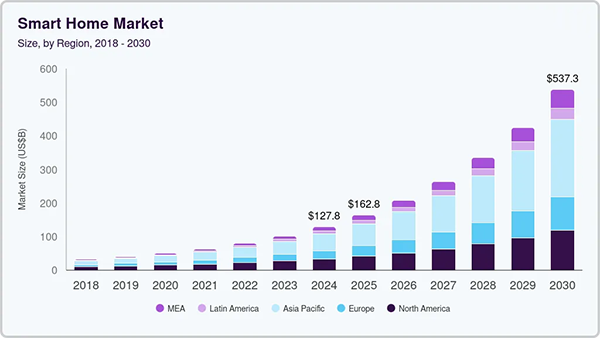
Smart homes are no longer a dream – they have become a standard practice. The global smart home market is skyrocketing. And this growth is reshaping how interiors are planned – rooms are now designed with sensors and automation, rather than just furniture.
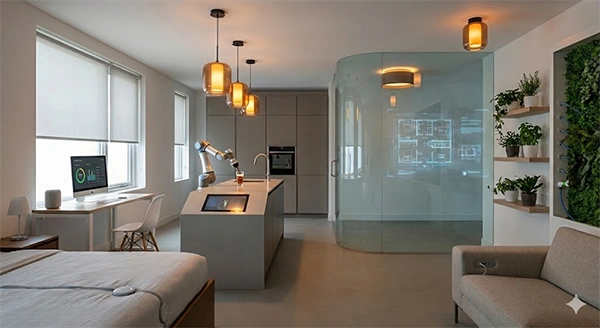
A smart home works like a “digital concierge”:
- Motion sensor lights up pathways at night.
- The room’s ambiance changes automatically while you rest.
- Smart kitchen appliances build a list of items and keep them in stock without any hassle.
These technologies are being treated as functional materials, such as wood and glass.
Key Design Principles for Integrating Technology Seamlessly
Integrated tech should feel as natural as good lighting – present, but never distracting.
- Hide the complexity – Settled wiring, device niches and minimalist panels keep the spaces clean.
- Match the aesthetic – Devices are now available with soft textures and matte finishes, such as Samsung’s Frame TV – which turns into art when idle.
- UX thinking – designers now follow UX practices, mapping movements, light needs and interaction patterns.
Smart Furniture & IoT: Functional Style Without Compromise
Furniture is transforming from passive objects to active tools – IoT integration has now added intelligent functions into everyday pieces.
Examples you will see in modern interiors:
- Smart work desks that track posture and change height automatically.
- Smart beds that monitor sleep patterns.
- Dining table with wireless charging.
- Motion-sensing sofas with USB-C ports.
Lighting, Sound & Ambience: Tech-Driven Mood for Modern Spaces
Harvard Health Publication noted that circadian-friendly lighting can support better sleep and daytime alertness.
Modern systems adjust automatically:
- Warm amber tones at night.
- Bright and cool lighting in the morning.
- Brightness adapts to natural daylight.
These innovations create an ambiance the same way music creates a mood.
Let’s understand this better with a case study:
CASE STUDY
Ananya, a freelance designer living in a 600 sq. feet Mumbai apartment, was struggling with clutter and poor lighting. To overcome this, she adjusted just three things: smart lighting, a foldable IoT work desk and an energy-monitoring plug.
Within a week, her space felt twice as functional. Lighting adjusted with her routine, her desk turned from work mode to dining mode in seconds and her electricity bills dropped by 18% in the first month.
Ananya neither renovated nor redesigned. She simply added intelligence – and the entire apartment started working for her.
Sustainability & Efficiency: Tech Tools That Support Green Interiors
Eco-friendly interiors are taking a hike because technology amplifies sustainability. Service Champions like Google Nest demonstrated 10%-15% energy reductions.
Sustainable tech includes:
- An intelligent HVAC system that minimizes waste.
- Ventilation guiding air quality sensors.
- Energy consumption apps that monitor appliances with high consumption.
These tools make ‘green designs’ measurable, not just decorative.
Virtual Design Tools: From AR room previews to digital twin modelling
Trying out furniture or layouts through AR is now as common as testing sunglasses with an Instagram filter. AR tools allow homeowners to preview:
- Furniture at scale
- Wall colours
- Lighting layouts
- Space flow
The AR market is projected to exceed $50 billion by 2030 and interior design is one of its largest beneficiaries.
Future-Ready Interiors: What’s Next in the Intersection of Design and Tech
“A smarter, more thoughtful home isn’t a trend—it’s an opportunity”
Design and technology are no longer the add-ons – they are becoming the core of how modern spaces work and feel. With adaptive lighting, intelligent furniture and smart energy systems, interiors are shifting to spaces that respond and support effortlessly.
This isn’t just about new gadgets – it’s about crafting spaces that reduce friction and smooth out everyday living. And the most exciting part? You get to shape this next chapter. Whether you choose subtle upgrades or full smart-home integration, the future of interior design is ready for you to make it your own.
FAQs
Ans: Yes, with wireless devices, modular sensors, and easy-fitting smart gadgets, upgrades can be made without remodeling.
Ans: Most smart interior technologies are designed to reduce bills by optimizing energy usage over time.
Ans: Not always – you can start small with affordable devices like smart bulbs and sensors.