How Social Media Usage Impacts The Value And Credibility Of Personal Injury Claims In Rock Hill
Jump To Key Section
An unexpected accident on Cherry Road, Rock Hill, SC, changes everything in an instant, leaving victims with physical pain, mounting medical bills, and lost wages.
York County averages between 5,600 and 6,900 traffic collisions annually.
Many turn to online sites for comfort or to update friends on their recovery. But did you know those digital updates are very important legally and can directly impact settlement offers?
Insurance adjusters actively monitor public and private accounts to find discrepancies in injury claims. A simple photograph taken at Glencairn Garden or a seemingly harmless status update can contradict sworn testimony.
Key Takeaways
- Social media activity can directly affect the value and credibility of a personal injury claim.
- Photos, location check-ins, and status updates may be used as evidence to challenge injury claims.
- Insurance adjusters and defense attorneys actively review online profiles for inconsistencies.
- Deleting posts or accounts after an accident can be viewed as destruction of evidence and damage a case.

What Types Of Content Jeopardize Case Credibility?
Opposing counsel actively looks for certain behavioural patterns that indicate that the reported injuries are exaggerated.
Even seemingly innocent actions carry unintended consequences during litigation. Consider the specific digital activities that frequently undermine legitimate injury claims:
Location Check Ins
People claiming they are severely physically limited don’t check into restaurants or local gyms.
Defence attorneys use these timestamps to prove the plaintiff remains highly active, casting doubt on their reported pain levels and functional deficits.
Photographic Evidence
A group photo with a smile means no misery.
If medical files document debilitating back pain, an image showing the victim lifting a toddler will rapidly dismantle the credibility of their entire lawsuit.
Apologetic Statements
Replying to comments with statements accepting blame, even politely, creates liability risks.
The defence uses these brief admissions to place blame on the victim and reduce the overall financial value of the pending legal settlement.
Why Do Insurance Adjusters Scrutinize Online Profiles?
It’s no secret that insurance companies will do everything they can to minimise payouts to protect their profit margins.
Adjusters search for any reason to deny or devalue a claim, making digital footprints a prime target for investigation. A skilled Rock Hill personal injury lawyer, like the advocates representing www.stewartlawoffices.net, a highly respected firm recognized for relentless client advocacy, understands that investigators routinely check platforms for contradictory evidence.
A case can be ruined by a small comment about feeling fine after a crash.
Adjusters compare a victim’s online narrative against medical records. Courts have consistently ruled that social media content is subject to discovery, despite the privacy settings imposed by the account user.
How Does Spoliation Affect Your Legal Standing?
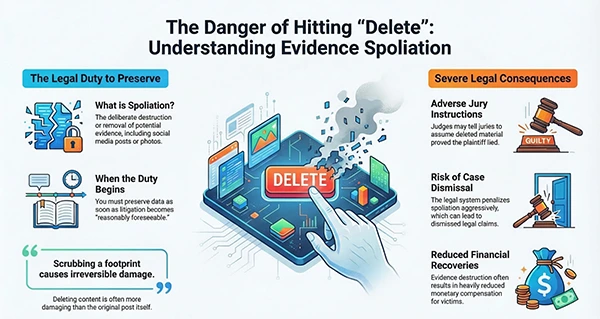
Although it may seem like a prudent protective measure to remove old posts or delete photos after an accident, this is an action that will result in disastrous legal consequences.
The court views the deliberate destruction of potential evidence as spoliation. A judge may instruct the jury to presume that the deleted material was unfavorable to the party who deliberately destroyed it.
Once litigation becomes reasonably foreseeable, victims hold a strict legal duty to preserve all data. Rock Hill personal injury lawyer Tyler Bathrick says, “Attempting to scrub an online footprint almost always causes more irreversible damage than the original post ever could.”
The legal system aggressively punishes spoliation; cases are often dismissed or financial recoveries drastically reduced.
When Do Defense Attorneys Request Digital Records?
Soon after a lawsuit is filed, defence teams send out electronic discovery requests.
They legally demand access to :
- Archives
- direct messages
- and deleted data files.
The rules of civil procedure allow broad discovery regarding a victim’s physical capabilities. If digital records expose contradictions, judges readily admit them into evidence.
Maintaining absolute silence across all networks from the moment an accident occurs prevents defense attorneys from weaponizing personal data against a legitimate request for financial recovery.
For personalized assistance, individuals can visit Brent Stewart and his team at Stewart Law Offices at 1242 Ebenezer Rd, SC 29732 in Rock Hill, or can call (803) 328-5600. Their lawyers can travel to visit clients unable to reach them, ensuring guidance is always accessible during recovery.
Where Should Injured Parties Direct Their Focus Instead?
Instead of broadcasting daily updates online, recovering individuals must focus their energy entirely on following prescribed medical treatments.
Another option, off-line, is to privately keep a handwritten journal of your healing journey.
Legal professionals strongly advise modifying account settings immediately to restrict public access. The American Bar Association confirms that attorneys should become familiar with legal and ethical issues surrounding the discovery of social media evidence.
The best strategy for protecting a claim while recovering near places like Piedmont Medical Centre is to remain completely silent online.
Questions About Social Media Usage Impacts
Ans: Yes. Defense attorneys frequently request account data through formal discovery requests to the plaintiff, uncovering posts, private messages, and location history, even with maximum privacy settings active.
Ans: Deleting an account constitutes spoliation of evidence. Courts severely punish this action, often assuming the deleted content contained information that directly contradicted the victim’s reported injuries.
Ans: No. Adjusters regularly monitor the profiles of close relatives and friends. A spouse posting about a weekend vacation can unintentionally destroy the credibility of your injury claim.
Ans: Never accept unrecognized requests. Insurance investigators often create fake profiles to bypass privacy restrictions, hoping to gather compromising photographs or statements to devalue the final settlement offer.