Understanding NDIS Respite Providers: A Practical Guide for Participants and Carers

Caregiving is a noble service. But even caregivers can get bored or tired of daily monotony. Respite support gives them a much-needed break from it, improving their overall well-being. This enables them to come back with a reinvigorated energy.
And not just caregivers, even participants get a break as they get to be in a new environment.
The ndis respite providers offer flexible Short Term Accommodation (STA) to participants with tailored care in a supportive environment. The usual caregivers get some relief from the daily responsibilities.
In this article, I’ll outline how all this works, the role and responsibilities of STR providers, various types of services, how to choose one, and tips for making the most out of the STA funding.
KEY TAKEAWAYS
- NDIS respite service gives a break to caregivers and participants from the daily monotonous care routine, improving their overall well-being.
- There are mainly three types: In-Home, Community-Based, and STA/Residential service.
- Make sure the respite service is registered, experienced, and flexible enough before choosing one.
What Is NDIS Respite?
It’s a short-term accommodation (STA) support that gives a break to caregivers and participants from regular, monotonous daily care. This interim care can occur in many settings: participant’s home, in shared accommodation, or specialised short‑stay facilities. It’s typically included under STA funding in a participant’s plan.
The main focus of NDIS respite services is to support the continued well-being of both the participant and their carer. It gives carers time to rest, attend to personal matters, or work, while participants continue to receive appropriate support. It does not replace informal care, but it complements it by providing scheduled short‑term assistance.
Types of Respite Services
STA services can be of many types:
In‑Home Respite
In‑home STR allows a participant to stay in their own home while a qualified support worker provides care and supervision. This option can be ideal for people who are most comfortable in familiar surroundings but whose usual carer needs a break. Services might include help with daily living activities, meals, mobility support, or companionship.
Community‑Based Respite
Some respite services focus on community access and engagement. This can include supports that help a participant get out into the community for social activities, events, or programs — giving the informal carer time off without the participant needing to change location.
Short‑Term Accommodation (STA) or Residential Respite
STA interim care provides planned stays away from the participant’s usual home. It can be a few hours, an overnight stay, or longer periods, depending on the participant’s needs and funding available. While traditional STA can include accommodation and support, its primary objective is to give informal caregivers a well‑deserved break.
Why Respite Support Matters
The STA support has three major benefits for all stakeholders:
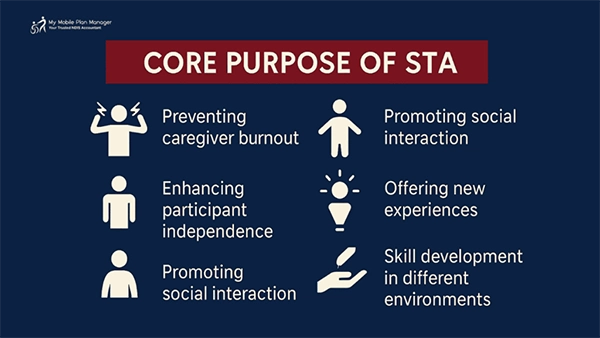
- Supporting Carers: Caring for someone with significant support needs is rewarding, but it can also be physically and emotionally demanding. Regular breaks using STR can help carers avoid burnout, reduce stress, and maintain their own health and wellbeing.
- Benefit for Participants: Participants also benefit from respite. It offers opportunities to interact with new support workers, build confidence, try different activities, or experience changes in routine in a supportive setting. Some short‑term stays can promote independence and social interaction, especially in group settings.
- Flexibility and Choice: Under the NDIS, participants have choice and control over how they use their funding, including interim care. You can work with your planner, support coordinator, or provider to plan respite that aligns with your goals and personal needs, taking into account your preferences for location, duration, and type of care.
The following infographic lists the core purposes of STA services:
How to Choose an NDIS Respite Provider
There are a plethora of STA service providers to choose from. On what parameters should we assess them? Here are some:
Registered and Compliant
Provider should be registered with the NDIS Quality and Safeguards Commission. It should also meet all safety and quality standards involving setup, training, and screening requirements.
Person‑Centred Support
Look for providers that emphasise personalised care. Every participant has unique needs and preferences, so services should be tailored rather than one‑size‑fits‑all.
Experience and Specialisation
Consider how experienced a provider is with interim care specifically, especially if your support needs are complex or require specialised skills.
Communication and Accessibility
Good communication is essential for positive respite experiences. A provider should be clear about what will be offered, how STR is funded, how costs are managed, and how feedback or concerns are addressed.
Flexibility in Support
Respite needs can change over time. A strong provider will be adaptable and willing to adjust plans as your circumstances evolve.
Maximising Your Respite Funding
Managing finances prudently is important for vulnerable groups requiring regular care. Here are some tips to make the most out of your STA funding:
- Plan ahead: Interim care support often requires scheduling in advance — especially for STA bookings.
- Use your support coordination: A support coordinator can help you navigate eligibility, funding categories, and organise respite in ways that fit your goals.
- Understand NDIS rules: Certain items, such as entertainment or unrelated travel costs, cannot be funded; staying informed helps avoid misunderstandings.
- Review regularly: Your care needs may change, and regular plan reviews help align STR funding with your current needs.
Conclusion
Weekends and vacations recharge all of us, infusing us with new energy when we come back. NDIS respite services are similar for caregivers and participants. Changing the routine care, this improves the well-being of both groups.
Whether through in‑home care, community activities, or short‑term stays, the right interim care support gives carers the break they need and offers participants opportunities to independently thrive in new, supportive settings.
Understanding what respite involves, how to find the right provider, and how to use your funding effectively can make a meaningful difference in your NDIS journey. Thoughtful planning, clear communication with providers, and regular reviews help ensure that STR support is both valuable and empowering.