UV DTF Transfers for Mugs and Tumblers: The Complete Guide
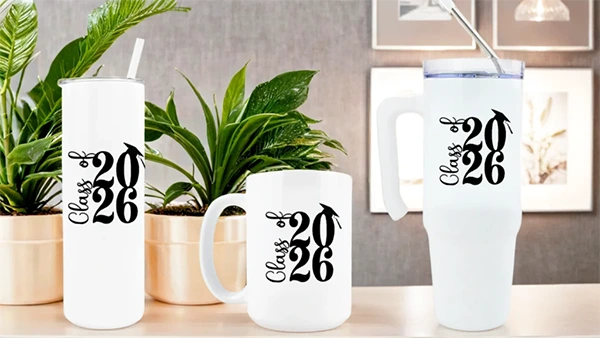
Personalized products and drinkware have seen major growth in recent years, especially among platforms like Etsy shops, local craft businesses, and e-commerce brands selling customized products to appeal to the changing expectations of customers.
UV DTF transfers have become one of the major customization upgrades that brands and local businesses use for mugs, tumblers, glass bottles, and other hard surfaces. Unlike traditional vinyl, these applications don’t require a heat press, making them a much easier and more accessible choice for everyone.
This guide explains how UV DTF transfers actually work, the best surfaces for it, and how you can apply the same on your merchandise.
Key Takeaways
- UV DTF transfers are adhesive decals produced using UV-cured inks and a two-film transfer system
- Its extreme flexibility enables brands and businesses to expand into customized drinkware, merchandise, and gift products with minimal startup expenses
- Before running a larger production run, experimenting with a few sample transfers is always preferable
- Clean the surface thoroughly using isopropyl alcohol, a chemical compound used to remove pre-existing dust, fingerprints, or oils.
What Are UV DTF Transfers?
UV DTF transfers are adhesive decals produced using UV-cured inks and a two-film transfer system. The design is printed onto a special film and then transferred directly to a hard surface by only utilizing pressure.
Once it is implemented properly, the results are durable, waterproof, scratch-resistant, and suitable for all uses.
The reason why UV DTF printing has become immensely popular is because of its versatility. Unlike standard DTF printing designed for fabrics, UV DTF can be applied to stainless steel, glass, acrylic, ceramic, plastic, and countless other smooth surfaces.
This extreme flexibility enables brands and businesses to expand into customized drinkware, merchandise, and gift products with minimal startup expenses.
Many large-scale corporations also use the same technique to produce personalized items for their employees, or even utilize it in company events that act as a major way to represent their brand on a much larger scale, using this simple solution.
Best Surfaces for UV DTF Transfers
- Excellent surfaces: It is best suited for stainless steel tumblers, ceramic mugs, glass bottles, acrylic products, phone cases, and other smooth plastic items.
- Test before large production: Powder-coated materials, heavily curved products, and textured surfaces.
Sometimes, heavily curved products or textured surfaces require extensive cleaning to smooth out the product for the best application. To perfectly place the transfers on these kinds of surfaces requires experienced individuals and professionals who know how to slowly peel off the film without causing any damage or warping to the desired print.
Before running a larger production run, experimenting with a few sample transfers is always preferable. Surface coating and material quality can significantly affect long-term adhesion and durability.
Fun Fact
UV-cured inks can be layered precisely, creating a tangible, embossed 3D texture, allowing you to actually feel the effect on the final product.
How to Apply UV DTF Transfers
Proper preparation is one of the most important parts of the whole process. Clean the surface thoroughly using isopropyl alcohol, a chemical compound used to remove pre-existing dust, fingerprints, or oils.
Once the surface is completely dry, carefully position the transfer and apply stable pressure using a squeegee.
Slowly peel the carrier film from a low angle while also making sure that all edges remain fully attached. Taking a few extra seconds during application can greatly improve the results and minimize the lifting issues later.
It is essential to perform these application steps in the right order, as even a little amount of disturbance between the film and the surface can end up causing major variations in the print, which may end up not looking up to par with the expectations.
This mistake is very complex to fix and usually results in the whole product getting discarded, thus causing major losses for local businesses that depend on every investment to turn into valuable contributions towards increasing ROI.
For businesses and brands looking for reliable UV DTF transfers, DTF Print Depot offers same-day production on relevant orders and allows nationwide shipping from Maryland.