7 Tips for Using UV-Vis Spectroscopy for Accurate Laboratory Results
Jump To Key Section
- 1. Preparing Samples the Right Way
- 2. Keeping Instruments Calibrated
- 3. Picking the Right Cuvettes
- 4. Verification That The Light Sources Are Stable
- 5. Using Blanks and Reference Standards
- 6. Controlling Temperature and Environment
- 7. Building Consistent Lab Practices
- Receiving the Same Exact Results with UV-Vis Spectroscopy
Do you know why laboratory results are so accurate? The answer is UV-vis spectroscopy – it is a widely used tool in research, healthcare, and industry labs all over the world. And it just requires a turning of the machine and hitting ‘start’.
One of the most famous – Agilent UV VIS spectroscopy can also give you accurate results, but only if used properly. But here is the twist: ensuring clean samples, stable light sources, and using the right cuvettes makes this whole difference.
Ready to know the right way to get precise results? Go through this article, which shares the 7 tips for using UV-vis spectroscopy to get accurate laboratory results.
Key Takeaways
- Accurately maintained temperatures and humidity are required in the laboratories to avoid environmental errors in measurements.
- Prepare the sample in a very clean and proper way.
- Ensure stable light sources for precise results. Flickering lamps should be avoided to prevent errors.
- For visible light, use quartz cuvettes to ensure exact readings.
1. Preparing Samples the Right Way
How you prepare your samples is a major determinant of how accurate your readings will be. Any contamination or stray particles in a liquid sample can scatter the light and muck up the data. Keep your cuvettes very clean and not oily, and have solutions that are similar in concentration when you make them. The data you get is far more reliable when you make the effort to prepare your samples correctly.

2. Keeping Instruments Calibrated
The right colour doesn’t matter how fancy and expensive your calorimetric equipment is if it’s not properly calibrated. If you don’t calibrate, you may end up observing inaccuracies in absorbance or wavelength values and can compromise your analysis. By incorporating calibration as part of your daily routine, you can avoid errors and prolong the life of your spectrometer by keeping it at its best.
Interesting Fact
UV-Vis spectroscopy is one of the most sensitive and most used techniques in the labs, as it can detect concentrations as low as 1 part per million(ppm).
3. Picking the Right Cuvettes
For UV measurements, you will want quartz cuvettes, while glass or plastic should be fine for visible light studies. Use the wrong kind, and the cuvette itself might absorb light at a wavelength, throwing off the results. Even the tiniest imperfections can alter how light passes through and can make your data inaccurate. Choosing the right cuvettes and caring for them helps you avoid future fits of frustration.
4. Verification That The Light Sources Are Stable
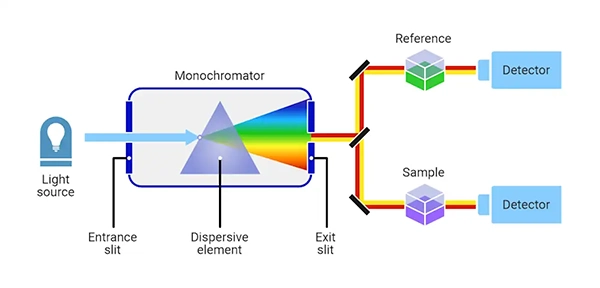
Always remember that for the UV-Vis spectroscopy to provide you with accurate results, you must have a steady light source. If the lamp within the spectrometer flickers, dims, or is ageing, results can be unreliable. However, most labs schedule light sources to be replaced, which is much more cost-effective than replacing a lamp on time than repeating entire sets of experiments because of unreliable data.
5. Using Blanks and Reference Standards
Take note that a blank is made with only the solvent, no analyte, and provides you with a baseline measurement. You can easily verify the proper functioning of the instrument by comparing your sample readings to the NIST-certified standards provided. Aside from that, it saves you time in the short run to skip a blank or a reference here or there, but it often ends with people questioning your figures later.
6. Controlling Temperature and Environment
Keep in mind that variables like changes in temperature and humidity can cause samples to behave differently. Because a spectrometer is sensitive to the temperature and humidity of the air, you want to keep that space consistent. Most modern spectrometers have built-in temperature control, and that’s a help. Even if yours doesn’t, you can avoid problems by maintaining a stable environment in your lab.
7. Building Consistent Lab Practices
By matching the same routines, not changing the cuvettes, and keeping the volume of the sample the same, the results can remain comparable. When every test proceeds with the same routine, you stop the possibility of small differences cascading into a big inaccuracy. A spectrometer is not just the consistency of equipment; it’s also the consistency of the people who are working with those samples the same way.
Receiving the Same Exact Results with UV-Vis Spectroscopy
If you take your time loading samples or avoid making changes to your routines, you give yourself the best chance for reliable results. With these tips, you can get the most from your Agilent UV-Vis data and have confidence that your results represent the true characteristics of your samples. No matter whether you work in research or industry, these procedures guarantee the same reliable results from every test.
Ans: Ensuring that the sample is clean, properly diluted, and free of any contamination is the right way to prepare a sample.
Ans: To verify that the light source is steady, make sure that the lamp in the spectrometer does not flicker, and the light source is steady.
Ans: Avoiding making changes and giving enough time to sample loading can give the same result via UV-Vis Spectroscopy.
Ans: Check that the cuvettes are quartz cuvettes; while glass or plastic can be fine for visible light studies. These will be the right cuvettes.