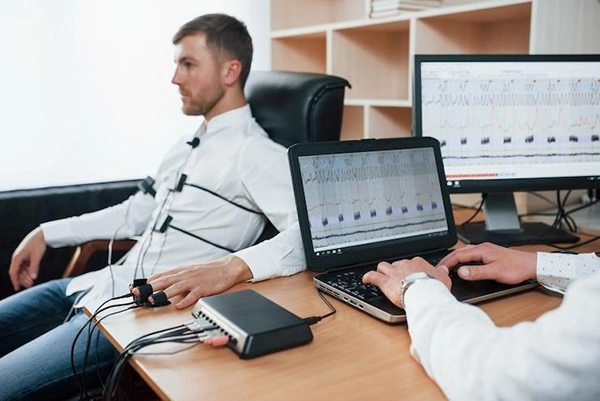
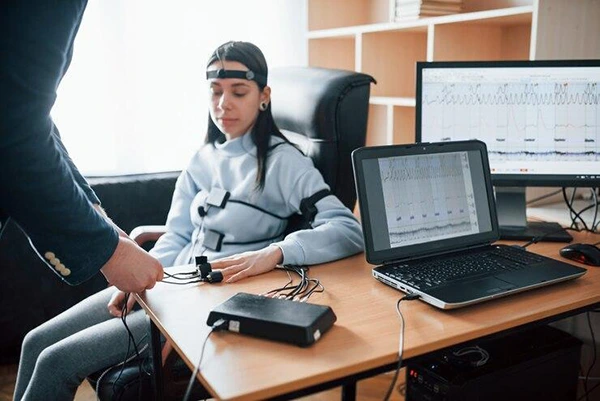
Did you know? Polygraph tests measure various physiological responses, including heart rate, blood pressure, respiration, and skin conductivity, while the examinee answers a series of questions. (source)
Today, we live in a world that is filled with a lot of personal and professional challenges that are constantly revolving around the world.
Although we might have touched the heights of technology but verifying the complex human statements still remains a question.
Polygraph tests are the pioneers of this domain that detect lies and truths of numerous suspicious individuals, yet their accuracy is still in question for centuries.
Although it’s been a top choice for legal and medical supervisors for solving varied cases but it also carries some misconceptions around the public.
In this blog post, we are going to cover some of them thoroughly, providing valuable insights to the readers.
Let’s begin!
Key Takeaways
Understanding why people believe that polygraphs are foolproof
Busting the rumors of Anxiety testing in these tests.
Changing the narrative of people who think they are only used for criminal investigations
A major chunk of the audience thinks that its reports are inapplicable in courtrooms: verifying their authenticity
Exploring the truths of its elaborate answers
Are they easy to beat and reliable? Analyzing this question deeply
1. Polygraphs Are Foolproof
Polygraphs aren’t a foolproof tool for detecting deception, and that explains the relatively high prevalence of false positives and false negatives.
False signs of deception occur when the polygraph test outcomes indicate deception, but the individual is truthful.
On the other end of the paradigm, false signs of truthfulness are found when the examiner considers a deceptive subject to be honest.
However, while polygraphs are not infallible, they can attain quite impressive accuracy scores.
The American Polygraph Association (APA) suggests that a polygraph test be undertaken by qualified examiners.
And that in strict compliance with the industry’s best practices, can achieve an accuracy score of at least 90%.
APA’s standard is considered by many professionally conducted evaluations to be valid, as this allows validating the reliability of professionally conducted lie detectors.
2. Polygraph Test Anxiety Levels
The lack of tests performed by polygraphs on idiosyncratic testable features such as stress, anxiety, and worry is categorized as a myth.
You’ve probably encountered a friend or colleague who was reserved about taking a lie detector test for fear of developing intense anxiety and potentially failing the examination.
According to the APA, there’s no evidence that intense nervousness can impact the accuracy of lie detector assessments.
The reason for this is that polygraphs target specific physiological reactions controlled by the autonomic nervous system (ANS), namely breathing, heart rate, and skin conductance.
3. Polygraphs Are Exclusively Used In Criminal Investigations
Criminal Investigation Techniques have overused the Lie Detector as it is often considered synonymous with Lateral.
Indeed, a mention of the word ‘polygraph’ conjures images of a suspected felon strapped to lie detector sensors.
And with a mean-looking detective taking them to task on their involvement with the alleged crime.
However, polygraphs aren’t exclusive to criminal investigations, and the test has since found its relevance in many other sectors, including athletics.
WNBF athletes who fail mandatory evaluations are suspended from participating in subsequent tournaments.
Polygraphs serve other notable purposes, like therapy in counseling relationships, drug abuse, and immigration tests, as well as pre-employment evaluation.
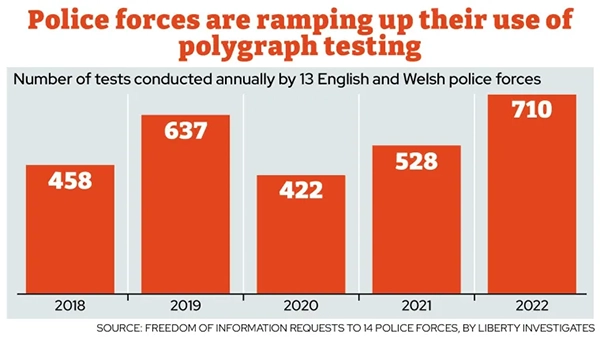
UK police forces’ rapid expansion of the use of controversial lie detector tests.
4. Polygraphs Are Inadmissible In Court
Countries and states differ in their legal systems regarding the acceptance of polygraphs.
In jurisdictions where polygraphs are admissible in court, the tests must be ethically conducted.
Most countries and states that bar polygraph results from being admitted in legal proceedings borrow from the theory that lie detectors fall short of the Daubert standard.
Polygraph is used everywhere, whether legally accepted or not, and legal acceptance falls on states and countries, which can keep changing.
It’s claimed to be no longer relevant under the Daubert standard framework, but judges shy away from letting them without a hearing process.
Informed by the landmark Daubert ruling of 1993, the Daubert standard outlines four critical criteria for evaluating the reliability of scientific evidence in legal proceedings.
Those include the fact that the theory or technique used during evidence collection must include the key factors.
Such as tried and tested, peer-reviewed, proven to contain minimal or zero error rate, and generally accepted and widely applied in relevant scientific fields
5. Polygraphs Require Elaborate Answers
Polygraph questions must be closed-ended. More importantly, each query should attract a flat “Yes” or “No” answer.
There is no space in the polygraph for long-winded stories explaining the reasoning behind an answer, and no examiner is forced to deviate from the topic at hand.
Polygraph examination questions also need to be concise, clear, direct, and devoid of any hypothetical situations.
That said, a polygraph examinee may be offered an opportunity to explain their responses after each test, and this is necessary before the examiner compiles the final report.
Do You Know? The polygraph was invented in 1921 by John Augustus Larson, a medical student at the University of California.
6. Polygraphs Can Be Beaten
There exists a plethora of examples of people who prepare elaborate plans to resist and evade detection during a lie test.
For instance, the examinee may self-inflict pain to increase skin conductivity or clench their muscles to manipulate blood pressure.
Some may also deploy mental countermeasures, like engaging in intense thoughts during a test.
Or, there can be pharmacological countermeasures, like taking certain drugs ahead of the evaluations.
Regardless of any attempts made to deceive a lie detector test, it is nearly impossible to trick the body’s physiological systems that are monitored during the examination.
Deblurring the Grey Areas in Polygraph Testing
Demystifying the common polygraph myths is critical to unpacking the truth behind lie detector tests.
Feel free to utilize polygraphs as one of many pieces of evidence corroborating guilt or innocence, but approach them with caution and gentle respect.
It is also vital to answer all questions on the ethics of lie detection tests in such a manner that the results could legally be deemed sound.
For instance, the examinee must willfully submit to being polygraphed, and the test findings should be handled in line with applicable data privacy laws.
Ans:Experts say that polygraphs are correct 98% of the time, but no scientific evidence has been offered for this.
Ans:The main weakness of this test includes inaccuracies in subjects with autonomic disorders, and may be confounded by multiple medications.
Ans:The reality is there’s no escaping the polygraph. If you’re guilty of something, there’s a high likelihood the polygraph will detect deception if you lie about it