Data is Gold: Making Smart Choices for Digital Transformation in the FMCG Industry
KEY TAKEAWAYS
- Data is now a core asset for growth and competitive differentiation within the FMCG sector.
- Successful digital transformation can be completed by implementing data-driven strategies across the operations.
- Artificial intelligence and machine learning applications, and the Internet of Things, are fundamental technologies for getting actionable insights.
- There are several challenges, including talent gaps and management challenges, which can be handled by implementing small changes.
- Embracing trends today and ethical AI practices can lead to sustainability and will define future success for FMCG companies.
Among all the competitive industries, the fast-moving consumer goods (FMCG) industries feature high volume, low margins, and rapid product turnover. To stay ahead of the competition, the sector constantly aims to innovate, optimize, and connect with their consumers.
According to a report, the global generative AI market in FMCG is projected to grow from 7.9 billion dollars in 2023 to 57.7 million dollars by 2033 at CAGR are rate of 22%. (Source: Market Us)
The above statement clearly underscores the importance of adjusting to the shifts. This could be executed with the help of industrial data. Hence, we will explore the key strategies for FMCG digital transformation and address common implementation challenges.
Let’s go through this written guide right now!
The Current State of FMCG Digital Transformation
In the present times, the industry is shifting towards digital approaches from traditional operating systems. You can see many companies have initiated pilot programs, invested in e-commerce, and collaborated with digital marketing for transformation using strong data techniques.
However, some challenges exist in integrating legacy systems. For example, the older systems are open and flexible with new digital tools like AI engines. Similar restrictions create a barrier when processing for faster and effective methods.
Why Data is the New Gold Standard
The data is the new gold standard because it works as a supporting asset for growth and differentiation. It provides complete insights into consumer behavior, market trends, supply chain dynamics, and operational efficiencies.
Here are some of the ways through which companies can analyze vast amounts of information:
- Understanding consumers better by looking at what people truly value and how they buy helps in creating products and ads that they really connect with.
- Data provides a figure of insurance enough product and delivers it efficiently to cut down on waste, saving money on storage and transport.
- We can create new products to meet consumer desires; use data to spot what customers are searching for but can’t find.
- For smooth operations, data keeps informing about factory machines running and fixing them before they break, so we will experience less downtime.
Key Data-Driven Strategies for FMCG
To fully leverage the power of data, FMCG companies need to implement strategies and approaches that fulfill every aspect of their businesses.
Consider the following key data-driven strategies:
- Collect data from a 360-degree view, including online, offline, and CRM, to create a holistic profile of each customer.
- Utilize previous sales data, promotional activities, and other external factors so that you can accurately predict the future.
- Timely adjust prices in real-time based on demand, competitor pricing, and customer segments.
- Embrace partnership with retailers to share data, enable joint planning, and execute promotional activities.
Technology Enablers for Data Transformation
As of now, you must be sure that technology can transform data. But what are these enablers in the transformation? Collecting, sorting, understanding, and then taking action on it works as an enabler.
The major technical tools or enablers are the following:
Cloud Computing Infrastructure
Cloud computing software provides a storage space to work with massive amounts of data easily. Through this equipment, you only have to pay for what you use, making it cheaper and faster to run complex data analysis and AI programs.
AI and Machine Learning Applications
AI and machine learning applications are a kind of smart computer program that can learn from data to find patterns and make predictions. For example, search engines, as a part of AI and ML, help people find, but they are looking for, most probably showcasing your products.
IoT and Smart Devices
IoT stands for “Internet of Things.” It includes smart machines and everyday objects that have small sensors that let them connect to the internet and send and receive data. You can invest in a strong data integration platform and establish common data standards.
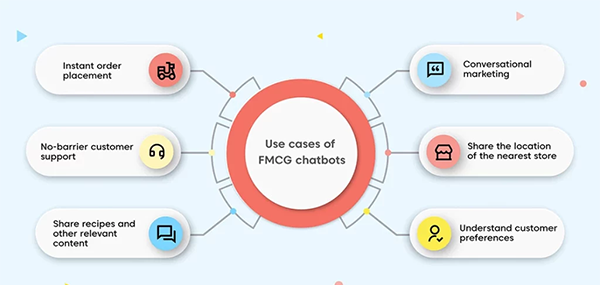
You can take an example of an AI chatbot. Look below at the digital chatbot in FMCG.
Overcoming Implementation Challenges
It may seem simple to become a responsible FMCG organization, but actually full of hurdles. So, to overcome the unusual setup challenges, companies can follow some of the tactics below.
Data Silos and Integration Issues
Data is often hidden in isolated silos due to uneven systems and departments, which make it difficult to create a unified view. You can invest in a strong data integration platform and establish common data standards.
Talent Gap and Change Management
The two major issues that all firms face are the talent gap and the change management system. There is no particular way to find a suitable candidate for a particular job role. However, investing in existing employees, inviting new talent, and fostering a culture that embraces data and continuous learning.
INTERESTING FACT
“It is estimated that the global data volume is becoming 2x every two years, making the ability to process and derive insights from the ocean of data a critical advantage.”
Success Stories in FMCG Data Transformation
With an ability to adapt to transformations, many firms were able to achieve their targeted goals and sustainable success. Thus, once you get pulled into the pull of FMCG data transmission success stories, you might lose your way back.
- Unilever: Everyone is aware that this is the leading company from a long time ago that has utilized AI for consumer insights and product development. Remember their “People Data Centre” campaign? It helped collect and analyze consumer conversations globally to adjust strategies in real-time.
- Coca–Cola: Who doesn’t know the name? The company employs advanced analytics to understand consumer preferences, optimize distribution routes, and personalize marketing messages. Every step of them leads to improved sales and efficiency in the end.
Future Trends in FMCG Data Utilization
After taking a look at the previous trends and shifts in FMCG data utilization, it’s predictable that the future is also exciting and dynamic. There are a few things that will be appreciated in the future, including personalization, ethical AI practices, and transparency regarding data privacy.
On the other hand, accurate data will help in quick decision-making for selling products as well, and we will see a strong effect on combining human intelligence with AI.
Conclusion
In the end, we can say that data is gold for making smart choices for data transmission in the FMCG industry. Because it helps in finding growth opportunities, you just need to invest in the right technology and overcome the challenges associated.
Even the future belongs to those who can turn the raw data into actionable insights. We believe these smart choices will retain customers and drive sustainable success in the competitive market.
Frequently Asked Questions
Ans: FMCG stands for fast-moving consumer goods, featuring high volume, low margins, and rapid product turnover.
Ans: The common challenges include data silos, talent gaps, and managing organizational changes.
Ans: No. This digital transformation also includes people, processes, and culture.
Ans: It is a useful method that includes using data and AI to predict future product-related consumer demand.