The Progressive Approach to Building Trading Skills That Actually Works

“Don’t test the depth of the river with both your feet.”
— Warren Buffett (Investor and Philanthropist)
Even when Warren Buffett says a single word, investors should take it seriously. And this line is for everyone who is yet to become one.
Generally, people learning to trade do it backwards. They first learn about advanced strategies instead of understanding market mechanics. Learning complex indicators comes first to them instead of the costs involved in trading.
What that does is they enter the market and incur huge losses. This eats up their hard-earned money or even drowns them in huge debt, scaring them off from the market for life.
In this guide, I will educate you on how you can properly learn to trade with zero prior knowledge. This article presents a progressive approach that helps you build trading skills while avoiding all the potential big losses that can set you back for life.
KEY TAKEAWAYS
- Don’t ever go all in on trading without prior knowledge or training.
- First, gather all the knowledge about trading, and then train through simulation and low-stakes bets.
- Scale up with a proper plan that includes guardrails.
- Keep your expectations realistic with respect to the benchmark.
Stage 1: Market Competence
The first stage concerns getting to know the trading market in and out. As per FINRA, before starting day trading, you need to know about securities markets and firm operations, as well as order execution systems and procedures.
Effective trading education starts with mechanics rather than strategies. FINRA points out that liquidation can become difficult or impossible in certain conditions like halts, sudden drops, and unusual activity. Volatility increases execution problems substantially.
The first milestone isn’t a green P&L. It’s being able to explain, in plain language, what could prevent an exit, how a broker routes orders, and what real all-in cost per round trip is.
Essential mechanics to master first:
- Order types: Market, limit, stop, stop-limit and when each executes
- Spread mechanics: How bid-ask spread represents immediate cost on every trade
- Settlement constraints: Why capital isn’t immediately available after selling
- Margin basics: How borrowing works and when positions get force-liquidated
- Platform rules: Specific broker policies on order routing and execution priority
These aren’t glamorous topics. They’re foundational. Without this knowledge, everything built on top stands on shaky ground.
Just remember, you need all this knowledge to avoid the most common mistakes that new traders make and get themselves into debt.
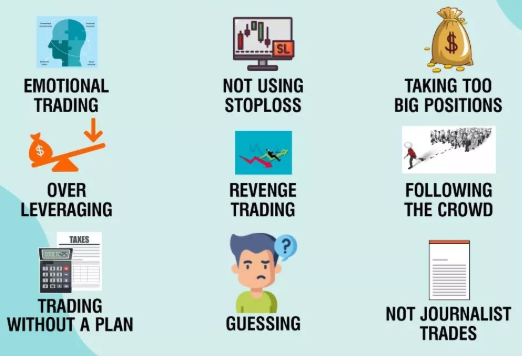
Alt: Common Mistakes New Traders Make
Stage 2: Structured Simulation
Structured simulation comes next. This stage might seem to build your confidence, but it aims to do exactly the opposite. Simulator evidence shows that highly active simulator users and risk-takers are more likely to go live and can still significantly underperform once real money is involved.
The progression here is simulate fewer trades, higher quality trades, with rules that assume friction. Barber and Odean’s findings illustrate why. Frequent trading can look fine gross, but lags badly net after costs.
They document meaningful spreads and commissions as persistent drags. Simulator KPIs should include assumed slippage, commissions, spread, and whether the edge survives after those are applied. In real brokerage data, that gap is often the difference between close to market and below market performance.
Simulation guidelines for realistic practice:
- Force worse execution: Never assume mid-price fills, add realistic slippage to every entry and exit.
- Include all costs: Model commissions, platform fees, and data costs that live trading requires.
- Limit trade frequency: Cap daily trades to match what capital and costs allow in reality.
- Enforce position limits: Restrict position size to match actual risk capital available.
- Track cost ratio: Calculate total costs as a percentage of capital to see if the strategy can overcome friction.
The goal isn’t finding a profitable system in simulation. It’s eliminating systems that obviously can’t work once real-world constraints apply.
Stage 3: Micro-Live Trading
Stage 3 is micro-live trading. Here, the goal is to taste real execution just a bit to know how your emotions run. You shouldn’t expect any significant income in this phase. FINRA’s disclosure warns that day trading can generate substantial commissions even if per-trade costs look low.
The example where commissions alone require $111,360 in annual profit just to break even under certain activity assumptions argues strongly for very low frequency at this stage. Enough trades to learn but not so many that costs and impulsivity dominate.
Position sizing should remain small enough that plan execution stays consistent under real-money conditions. FINRA is explicit that traders should be prepared to lose all funds used for day trading and should not fund it with money needed for living expenses.
Micro-live implementation principles:
- Minimum viable positions: Trade in the smallest size broker allows, often just one share or contract.
- Strict daily loss limits: Hard stops at small dollar amounts like $50 or $100 daily.
- Frequency caps: Maximum number of trades per day regardless of opportunities.
- No overnight holds initially: Close all positions before market close to avoid gap risk.
- Journal everything: Document every decision, emotion, and deviation from plan.
This stage isn’t about making money. It’s about discovering how real capital, real execution, and real emotions change behavior compared to simulation.
Stage 4: Rule-Validated Scaling
Rule-validated scaling is the fourth and final stage. Reaching here is dependent upon whether you have shown considerable competence in the prior stages. FINRA suggests that less than $50,000 can significantly impair your ability as a day trader to make a profit. It also clarifies that more capital does not guarantee success.
FINRA’s pattern day trader framework requires $25,000 minimum equity in a margin account for pattern day trading on days trading occurs. The rules explain how margin calls and buying power restrictions can constrain traders for extended periods if limits are exceeded.
Scaling must respect capital thresholds, margin mechanics, and the possibility of restrictions that can force worst behavior like making back losses fast if traders aren’t prepared.
Conditional scaling criteria:
- Consistent micro-live profitability: At least 50 trades with positive expectancy after all costs.
- Rule adherence metrics: Following the decided plan on 90%+ of trades.
- Drawdown management: Never exceeding daily or weekly loss limits during the learning phase.
- Cost control validation: Actual transaction costs matching or beating assumptions
- Capital adequacy: Meeting regulatory minimums plus margin for error
Only scale when data proves that the system is working at whatever size you’re operating at currently. Also, ensure that all necessary disciplines exist to handle larger positions.
Benchmark Mindset Throughout
Maintain a benchmark mindset throughout all these stages. As per Barber and Odean, most active traders earn 11.4% annually while the market benchmark return 17.9%. High turnover and trading costs explain much of the shortfall.
Skill-building must include an explicit question: is this to outperform passive alternatives net of all costs and taxes, or for a different objective like learning, hobby, or experimentation? If it’s outperformance, the process must be ruthless about costs, trade selection, and avoiding activity for its own sake.
Most beginners would accumulate more wealth investing in index funds than actively trading. That’s not pessimism, it’s what large-sample data shows.
Practical Progressive Syllabus
A simple and practical progressive syllabus is given below:
- Mechanics block: Order types, margin and short mechanics, settlement, how spreads and commissions hit expectancy, and broker execution rules. FINRA stresses market and firm operations knowledge as fundamental.
- Risk block: Max position size, max daily loss, and no exceptions rules. FINRA warns about losing all funds and about margin amplifying losses beyond the initial investment.
- Strategy block: One setup family, one market regime filter, one exit logic. Then measure net expectancy after realistic costs. Cost drag is central in brokerage evidence.
- Review block: Journaling, error taxonomy covering entry, exit, sizing, and rule breaks. Weekly stop doing decisions because reducing harmful behavior often raises performance faster than adding new tactics.
Anchoring to Reality
Your expectations should remain anchored to the average real-world outcomes. In retail FX, an SEC comment letter cited that roughly 70% of customers lose money every quarter. FINRA’s disclosures repeatedly frame day trading as extremely risky and emphasize skepticism toward large-profit claims.
A progressive approach works because it assumes those base rates are real. It designs training to defeat the specific mechanisms that drive poor outcomes: costs, leverage, execution problems, and psychology. One layer at a time.
The progressive path isn’t exciting. It doesn’t promise quick profits or secret strategies. It acknowledges that most active traders underperform passive alternatives and that beating those odds requires systematic skill development rather than hopeful enthusiasm.
The progressive approach aims to improve decision quality and risk control by addressing costs, execution constraints, and trader psychology. Not because it’s easy, but because it’s realistic about what actually determines outcomes.
Conclusion
So, don’t go all in on the trading market with just your entry. Gain proper and complete knowledge and training beforehand.
Learn how the market works and how to assess a firm. After you know enough, start simulating trades. Then move on to micro-trades to test the real waters.
Only think about scaling up to the level of other traders after you feel that you are confident enough through actual evidence. Do that according to a proper scale-up plan, which has necessary guardrails built in to avoid any early losses.
Just follow benchmarks and keep your expectations real throughout your trading journey.
Tread with care, new trader. Best of luck and happy trading!
Ans: To become a professional trader, you need to have proper financial education, mastery in fundamental/technical analysis, and know how to manage risk and emotions as well.
Ans: Focus on technical analysis, risk management, and psychological discipline at the beginning of your trading journey.
Ans: The rule states that you should keep your losses on a single trade to 2% of your account balance.