Common Reasons a Workers’ Comp Claim Gets Denied and How You Can Fight Back

As per Lawyers.com, 67% initially denied comp claims are paid within a year as the employee appeals.
Workplace injuries can disrupt a person’s health, income, and overall quality of life. The compensation claim system is designed to support employees like that.
But, a worker’s compensation claim can also be denied for various reasons: missing deadlines, lack of medical evidence, injury reasoning disputes, paperwork mistakes, anything.
However, it doesn’t all end at denial. A concerned worker can challenge the denial. In many situations, injured employees choose to get help appealing a denied workers’ comp claim so they can better understand the process and protect their rights.
In this article, I’ll list some of the common reasons for comp claim denials so that workers can preemptively avoid mistakes and be prepared to respond if their claim gets actually rejected.
The Injury Was Not Reported on Time
Many workers are not in a mindset to report when they get injured, and understandably so. In many states, workplace injuries must be reported within as little as 30 days, making early reporting critical.
Prompt reporting helps prove that the injury actually happened at the workplace.
Common reporting mistakes include:
- Waiting several days before informing a supervisor
- Not completing an official accident report
- Reporting the impairment informally without documentation
- Assuming a minor injury does not need to be reported
To avoid this issue, workers should always report an impairment immediately and make sure the report is officially recorded.
Lack of Medical Evidence
Insufficient medical documentation can also lead to a denial. Insurance companies carefully go through the medical records to ensure that the injury really occurred and required medical attention.
Without proper documentation, proving the connection between work and injury becomes difficult.
Problems related to medical evidence may include:
- Delaying medical treatment after the impairment
- Not explaining clearly that the injury happened at work
- Missing follow-up appointments
- Incomplete medical records
Medical evidence must prove that the impairment arose “out of and in the course of employment”. Seeking medical care quickly and following treatment instructions can help prevent these issues.
Disputes About Whether the Injury Is Work-Related
Insurance companies are usually hell-bent on proving that the impairment is not covered under the compensatory benefits, that it’s not workplace-related. And they even succeed in that if the circumstances of the accident are unclear.
For example, insurers may question the following:
- Whether the injury happened during work hours
- If the employee was performing job duties
- Whether the impairment was caused by something outside the workplace
In these cases, evidence such as witness statements and accident reports can help clarify what happened.
Pre-Existing Medical Conditions
Previous injury or medical condition makes things murkier. Insurance companies may claim the condition existed before the workplace accident.
This can lead to disputes about whether the job actually caused the impairment.
Workers may still qualify if a workplace incident aggravated a pre-existing condition, which is recognized under many compensation laws. Helpful documentation may include:
- Medical records for both before and after the accident
- A professional physician acknowledging the change in condition
- Evidence that the worker performed all his/her role duties competently before the incident
Clear medical evaluations can help demonstrate that the concerned impairment was caused at the workplace and is not a pre-existing condition.
Paperwork Errors or Missing Information
The process of getting the claim involves heavy paperwork. Even small errors in documents can lead to delays or denials.
Common paperwork issues include:
- Incomplete claim forms
- Missing signatures or information
- Incorrect injury descriptions
- Failure to meet filing deadlines
Carefully reviewing documents before submission can help prevent these problems.
Failure to Follow Medical Treatment Plans
Following the treatment plans to the T might seem unrelated to getting the comp claim, but that’s certainly not the case.
Insurance providers may argue that the impairment is not serious if treatment instructions are not followed.
Examples of this issue include:
- Skipping medical appointments
- Ignoring physical therapy recommendations
- Returning to heavy work too soon
- Not following medication instructions
Following the treatment prescribed by a professional physician validates that the injury and the injured are serious enough.
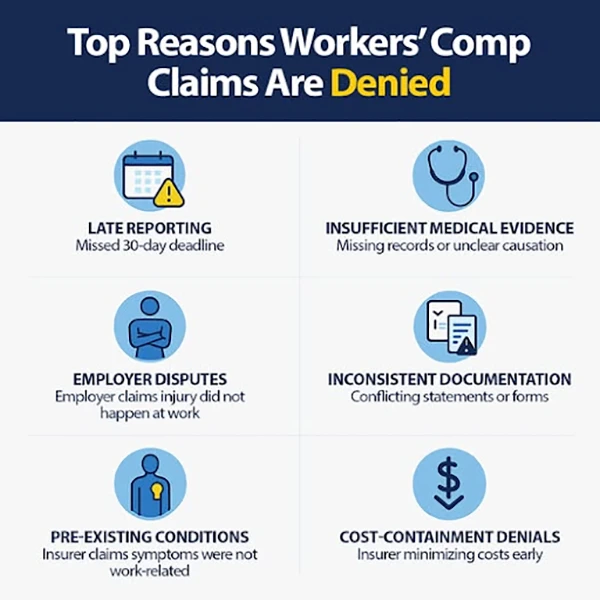
The following infographic summarizes all the causes of a comp claim denial:
How Workers Can Fight Back After a Denial
Even after the comp claim is denied, workers can fight back against it. The appeals process allows employees to challenge the decision and present additional evidence.
Steps workers may take include:
- Reviewing the denial letter carefully
- Gathering additional medical records or evidence
- Filing a formal appeal within the required deadline
- Requesting a hearing if necessary
- Seeking professional guidance if the process becomes complex
Following these steps with discipline only strengthens your case.
Conclusion
The workers’ compensation claim system is designed to support injured employees. But it can also be denied for several reasons.
Late injury reporting is one of the most common causes of denial. Medical documentation is essential to support a claim. Insurers may dispute whether the impairment is work-related. Pre-existing conditions can complicate claims, but do not always prevent them. Paperwork errors and missed deadlines may also lead to denial.
Regardless, workers often have the right to appeal and present additional evidence.
KEY TAKEAWAYS
- Workers’ compensation claims may be denied for several reasons.
- Late injury reporting, insufficient medical documentation, disputes over impairment cause, pre-existing conditions, and paperwork errors are some of the common reasons for denial.
- Workers often have the right to appeal and present additional evidence.
Ans: Strains and sprains.
Ans: Incomplete or inaccurate info.
Ans: Besides incomplete or inaccurate info, it can be not disclosing pre-existing conditions, or post-deadline submissions.