Numerous organizations operate under the misconception that the mere incorporation of translation tools renders their artificial intelligence systems truly multilingual.
This prevalent oversimplification involves the integration of a translation application programming interface (API), which ostensibly enables the system to communicate in multiple languages. However, this methodology fundamentally overlooks a critical aspect of effective communication.
Clients anticipate far more than mere word-for-word translations. They seek interactions that authentically convey their underlying intentions, emotional tone, and cultural nuances.
A chatbot that delivers responses with impeccable grammatical accuracy yet fails to resonate emotionally is unlikely to establish a meaningful connection. In this blog post, we will delve deeper into this segment.
Let’s begin!
Key Takeaways
Understanding the hidden risk of superficial multilingual AI
Looking at the design principle for that AI
Decoding metrics that matter
Discovering how it is connecting local audience
The Hidden Risks of Superficial Multilingual AI
Adding translation features to AI might seem like progress. It’s fast, scalable, and easy to implement. But beneath that surface-level convenience lies a set of risks that are often overlooked — and they’re not just technical. They’re human.
Word-Level Translation Doesn’t Capture Meaning
Word-for-word translation can be a real pitfall. Sure, it keeps the grammar intact, but it totally misses the point. The sense of urgency fades away. Frustration gets watered down. Users end up feeling overlooked.
This is a common issue. Idioms get twisted. Sarcasm turns into gibberish. Cultural references just crumble. And when scalable AI tools for customer service miss these cues, they don’t just miscommunicate; they disconnect.
Model Behavior Varies by Language
Here’s a deeper issue: AI doesn’t behave the same way in every language.
A lot of big language models mainly learn in English. When they try to handle less common languages — like Swahili, Bengali, or even local dialects — things can get a bit messy. Hallucinations increase. Tone shifts unpredictably. Sentence structure becomes erratic.
Meta’s No Language Left Behind project showed that performance drops sharply in underrepresented languages. DeepMind’s Gopher model revealed similar inconsistencies. And Cohere’s 2025 evaluation confirmed that generative quality varies widely depending on the language.
This isn’t just a technical flaw. It’s a customer experience risk. If your AI behaves differently depending on the language, then your brand feels inconsistent — and trust erodes.
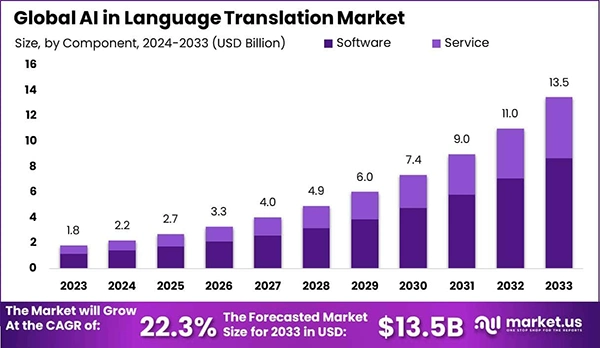
Intriguing Insights
This infographic shows the global AI language translation market statistics
Design Principles for Multilingual AI That Understands
Creating AI that utterly understands across languages isn’t about interpretation and translation services. It’s about design. It’s about empathy. And it’s about precision.
One researcher said it best: “Multilingual AI needs to do more than just talk; it has to listen, understand, and adjust.” Here are three key ideas that help AI shift from simply translating to truly grasping meaning.
1. Prioritize Intent Recognition Over Literal Matching
Understanding intent is the foundation of meaningful interaction.
Words vary. Intent doesn’t.
Structure may differ. Meaning can stay the same.
A phrase like “I’m stuck” might be expressed differently in Hindi or Korean — but the need for help is universal.
What to do:
Train intent detection models per language or region.
Focus on semantic alignment, not grammatical similarity.
Use real user queries to identify patterns in how intent is expressed locally.
“Literal translation is easy. Understanding is hard — and far more valuable.”
2. Integrate Cultural Tone Mapping
Tone shapes perception. It influences trust.
In Japan: Formality is expected, even in casual support.
In Brazil: A relaxed, friendly tone builds rapport.
In Germany: Precision and clarity matter more than warmth.
Design tip: Map tone expectations per region. Then adjust the bot’s persona accordingly.
CoSupport AI uses tone mapping to:
Define acceptable tone ranges (formal, neutral, casual).
Align bot responses with local norms.
Avoid tone mismatches that feel robotic or inappropriate.
“Tone isn’t decoration — it’s the emotional layer of language.”
3. Use Localized Data to Tune AI Responses
English data doesn’t generalize well. Period.
Ticket archives in English miss regional phrasing.
Feedback from native speakers reveals subtle tone shifts.
Local expressions often carry meaning that’s invisible to generic models.
Use multilingual datasets to:
Fine-tune models like mBERT and XLM-R.
Train on real conversations from each target language.
Incorporate agent feedback to refine tone and intent detection.
Interesting Facts AI can be used to translate internal documents, training materials, and communication channels, ensuring that all employees have access to the information they need. (Source)
Metrics That Actually Matter in Multilingual AI
If you’re responsible for deploying or managing multilingual AI, you already know this: global coverage doesn’t mean global quality.
You’ve probably noticed it — a chatbot that nails it in English but trips up in Spanish. Or a support bot that feels friendly in French but comes off a bit stiff in Korean. And when customers start rewriting AI replies or giving low satisfaction scores, you’re left wondering: where exactly is it going wrong? Here’s how to find out.
Language-Specific CSAT or NPS Delta
You can’t rely on global averages. They hide the cracks.
Look at CSAT or NPS broken down by language.
Compare how users in different regions rate their experience.
Watch for sudden drops — they’re often tied to tone, clarity, or misunderstood intent.
If your French CSAT is 85 but your Thai CSAT is 62, that’s not a language issue — it’s a signal that your AI isn’t connecting. “What gets measured gets improved — but only if you’re measuring the right things.”
Translation Override Rate
You’ve seen this too: agents rewriting AI-generated replies before sending them out.
That’s not just a workflow hiccup — it’s a red flag.
Track how often human agents override AI responses in each language.
High override rates mean the AI isn’t getting it right — either in tone, accuracy, or cultural fit.
This metric is your early warning system.
Think of it as your AI’s “missed the mark” score.
Localized Hallucination Frequency
When AI makes things up, it’s bad. When it does it in a language you don’t speak, it’s worse — because you might not even notice.
Monitor hallucination rates per language.
Compare model confidence with actual accuracy.
Prioritize audits in high-risk or low-resource languages.
If your AI is confidently wrong in Swahili or Tagalog, you need to know — before your customers do.
“Hallucinations aren’t just technical bugs. They’re trust killers.”
Speaking Globally, Understanding Locally
Multilingual AI isn’t just about counting languages your system can handle. It’s all about how well AI gets what people mean, tunes into their vibe, and fits in with their culture. That’s what sticks with customers — it’s not just about the words, but the feelings behind them. If your AI can chat worldwide but misses the local connection, it’s not really doing its job.
It’s just moving things around. To hit the mark, team up your models with local know-how, responses that fit the role, and metrics that show how users feel. So, don’t just go for the basics.. Aim for connection.
That’s what makes multilingual AI truly work.
Ans: To use large-scale generative AI for business, having access to cloud technology is crucial. The cloud provides a powerful and scalable environment for storing and processing massive amounts of data, which is essential for training and running advanced AI models.
Ans: AI can automate repetitive processes, such as in product classification. It can learn how to classify products, and then provide recommendations or predictions that you can either select or ignore, based on your knowledge and experience.
Ans: Around 78% of businesses globally use AI in at least one function, up from 55% in 2023.