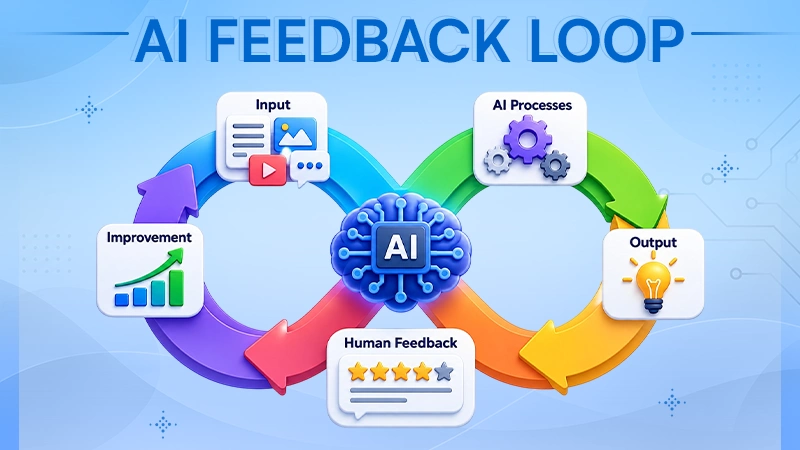
From Static Diagrams to Smart Feedback: How AI Is Changing the Way Students Learn Geometry
Jump To Key Section

Geometry has been considered a tough topic for decades. But in reality, it is not that complex; just the way it has been taught is not the right one. What is shared through the static diagrams can be presented in a better way to boost engagement.
This is where AI helps to change the perspective.
AI serve the same geometry concepts but with interactive models, personalised feedback and tailored guidance like a real supporter. Instead of just accepting what it shows, students can dive deeper into the concepts and turn learning into an engaging experience.
Dive deeper to learn how AI has made this possible!
Key Takeaways
- AI has made geometry understanding more interactive and engaging with the help of diagrams and modern tools.
- Teachers can use AI generated feedbacks to identify spots where they were missing things and improve their teaching methods.
- The future of geometry will be a combination of traditional methods with smart digital tools.
Why Static Geometry Diagrams Often Feel Difficult
Traditional geometry diagrams can look simple at a glance. A few lines, labels, and angle marks may seem simple. Still, many students need help because the real reasoning stays a mystery.
A printed diagram offers one fixed version of a shape. It may not define what changes and what stays the same. Students often miss key interactions between parallel lines, identical triangles, or similar visuals.
Geometry also asks learners to connect visual signs with formal proof. That switch can feel hard. A student may “see” that two angles align but fail to explain it with a theorem.
The Gap Between Seeing and Proving
Many learners mix observation with reasoning. They may guess that two phases are equal because they look equal. In geometry, quality is not enough.
Strong proof needs explanations, postulates, and logical order. Students must learn terms such as congruence, similarity, midpoint, bisector, transformation, and parallel lines. AI tools can enhance this process when they guide thinking, not mimic it.
How AI Brings Diagrams to Life
AI-powered geometry platforms often mix dynamic geometry software with flexible learning. This means students can select points, rotate shapes, resize figures, and explore different cases.
When a student remodels a triangle, the tool can display how angle measures respond. When a circle moves, the system can redefine chords, tangents, and arcs. These small changes make complex ideas easier to notice.
Research on intelligent tutoring systems labels them as AI applications that can provide quick and personalized instruction or feedback. That kind of advice matters in math because students often need help at the exact moment of confusion.
AI can also reveal common geometry errors. For example, it may be noted when a learner uses the wrong theorem. It may also point out incorrect reasons in a proof.
Smart geometry guidance can help with many classroom tasks, including:
- Detect missing angle relationships;
- Checking whether a triangle proof follows a valid order;
- Showing how changes affect side length;
- Comparing student constructions with correct geometric steps;
- Offering hints before providing a full solution.
These components make practice more active. Students are not only amazed at the finished answers. They are building, testing, adjusting, and explaining.
As students work through more difficult geometry problems, they often benefit from tools that provide quick feedback on their reasoning. By using an AI geometry solver during practice sessions, learners can identify figures, follow logical steps, and better understand why a fix works. This approach rewards deeper engagement with geometric themes rather than simple memorization of formulas.
For those curious about how AI makes this all possible, learn what AI model training is and how AI learns so that it serves such specific concepts.
Smart Feedback Instead of Simple Correction
Old digital worksheets often listed answers as right or wrong. That feedback was quick, but not always useful. Students still had to identify where their reasoning failed.
AI feedback can be more specific. It may say that the student used the triangle sum theorem too early. It may ask them to first argue that two lines are parallel. A better phrase keeps the learner thinking.
Why Timing Matters in Geometry Practice
Feedback works best when it surfaces before rage takes over. If students wait too long, they may again make the same error. If help gets here too soon, they may stop thinking.
Well-designed AI teaching tools can offer layered hints. The first hint may ask a question. The next may lead to a theorem. Only later should the tool show a full breakdown.
Khan Academy has listed Khanmigo as an AI tutor meant to guide students through structured problem-solving. Its defined goal is not only to give answers but to support reasoning and motivation.
This system fits geometry well. Proofs, constructions, and coordinate geometry all require a clear path. AI can help students assess each step in that path.
Better Spatial Reasoning Through Interaction
Spatial reasoning is central to geometry. Students need to create rotations, reflections, cross-sections, and three-dimensional forms. Static images can make that hard.
Practical AI tools can show movement. A learner can rotate a prism, fold a net, or reflect a shape across a line. These actions develop geometry into an experience.
For visual learners, this can be powerful. Instead of reading a long overview, they can watch a property display. Then they can clarify it using mathematical language.
From Guessing to Testing
AI-supported geometry enables experimentation. Students can make a claim, adjust the diagram, and check the result. This process induces confidence because mistakes become part of learning.
For example, a student may think all diagonals in a quadrilateral are equal. By moving vertices, they can see that this is not always true. The tool can then point them toward rectangles, squares, and special cases.
This style of learning favors deeper understanding. Students learn that geometry is not a set of logical facts. It is a unified system of rules, patterns, and proofs.
How Teachers Use AI in Geometry Lessons
AI does not erase the need for teachers. It can help them see students thinking more clearly. A teacher may find out which theorem confused the class.
UNESCO’s guidance on generative AI in education offers a human-centered vision for these tools. That eye opener is important because schools need technology that supports judgment, equity, and real learning.
Teachers can use AI metrics to plan better lessons. If many students have problems with similarity, the next class can include extra examples. If proofs are weak, students can use reasoning chains.
A balanced AI geometry lesson may follow this structure:
- Students explore a dynamic diagram and write one guess.
- The teacher explains the main theorem with clear examples.
- Learners solve problems while AI gives limited hints.
- Students compare ideas in pairs or small groups.
- The class talks about errors, proof language, and final reasoning.
This order keeps the teacher at the center. AI provides practice, while human dialogue builds meaning.
Risks Students Should Understand
AI tools can be helpful, but they are not magic. They may go over a step badly. They may misread a diagram. Sometimes, they may answer without enough context.
Students also risk becoming inactive. If they accept every hint too quickly, they may not learn independent reasoning. Geometry demands mental effort, especially in proof writing.
A smart learner uses AI as a coach. They ask why a theorem remains valid. They check the diagram. They rewrite replies in their own words.
Academic Integrity and Real Understanding
Geometry homework is not only about final answers. It develops logical thinking, attention to detail, and problem-solving habits. Students lack that value when they use AI only to finish faster.
Teachers can offset this risk through better assessment. Oral explanations, handwritten proofs, diagram annotations, and study notes reveal real understanding. They also make AI misuse less easy.
Students should learn to document their thinking. A short note can reveal which hint helped and what they changed. This makes AI use more honest and educational.
The Future of Geometry Learning
The future of geometry will likely fuse traditional teaching with digital tools. Students may still use rulers, compasses, graph paper, and textbooks. At the same time, they will also use adaptive platforms and immersive models.
AI may soon give extra support for proof construction. It may indicate several valid proof paths. It may also help students to convert visual insights into formal mathematical language.
Dynamic geometry software has already been studied as a way to support geometry learning and classroom cooperation. Recent reviews show an ongoing interest in digital technologies for teaching secondary geometry.
The most useful systems will not make geometry simple. Instead, they will make thinking more visible. Students will see errors sooner, test ideas faster, and gain guidance when they need it.
Final Thoughts
Geometry was never about the static diagrams. It is actually about how to observe, support things and prove ideas with realistic and valid logic. AI has made this simply accessible with mathematical thinking and interactive learning.
Instead of replacing things, AI helps allow one to go deeper inside the concepts, while sharing personalized guidance through experimentation.
The future of geometry will definitely be defined by technology, helping students to ask more questions and understand concepts better with realistic feedback.
FAQs
Ans: AI is used to serve interactive diagrams, tailored feedbacks and real-time learning concepts.
Ans: No, AI is only designed to support teachers and students for better teaching and understanding concepts.
Ans: Yes, AI can make complex concepts easier to imagine by serving examples, images and feedback.