When WordPress Becomes Part Of the Product, Not Just the Platform
Ever wondered how the role of WordPress has evolved over the years, and how you could utilise it as a part of your product and not just a platform? Well, the answer is here.
According to Coalition Technologies, an incredible 44% of websites globally run on WordPress, compared to the 61% CMS market share.
Thus, this article aims to delve into the ideas where WordPress has evolved as part of the product and not just as a platform. It further explores how WordPress works to build a calm, predictable system in a noisy digital space, allowing specialised developments to make a difference, how it led to a foundation of sustainable growth, and how it helps in designing for a change, etc.
Key Takeaways
- Building Calm, Predictable Systems in a Noisy Digital Space
- Where Specialized Development Makes the Difference
- WordPress as a Foundation for Sustainable Growth
- Designing for Change, Not Just Launch
Building Calm, Predictable Systems In a Noisy Digital Space
From a user perspective, the best digital experiences often feel effortless. Pages load quickly, interactions are intuitive, and nothing draws attention to the underlying complexity.
Basically, a smooth and uninterrupted procedure is what drives an individual to a digital experience. Achieving this level of calm requires careful technical planning.
Bloated themes, excessive plugins, and poorly structured code can introduce friction that users may not consciously identify but still feel, and therefore discourage the user from using the website.
A thoughtful WordPress development focuses on reducing this noise.
Clean architecture, selective use of plugins, and well-defined custom functionality help create systems that are easier to maintain and less prone to unexpected behavior.
This approach aligns well with platforms that value clarity, focus, and emotional stability — qualities increasingly important in modern digital experiences to create a user-friendly experience.
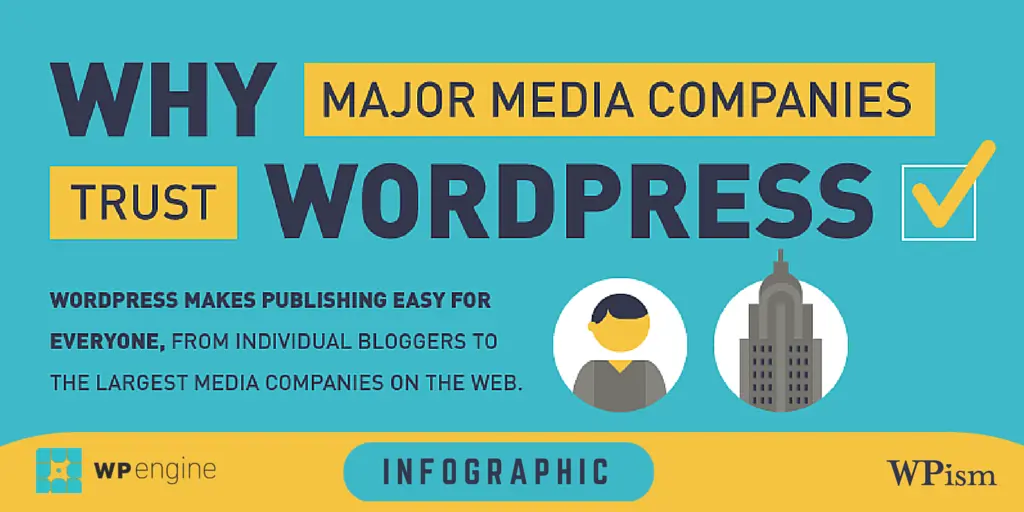
The infographic further depicts why major companies trust WordPress :
Where Specialized Development Makes the Difference
As projects grow, internal teams often face a familiar dilemma: maintain focus on core product development or divert resources to managing infrastructure and technical debt.
This is where specialised development makes the difference.
And external expertise becomes valuable. Working with an experienced partner such as agency Codelibry allows teams to extend their capabilities without losing momentum or control over the product vision.
Rather than offering generic solutions, specialized agencies tend to approach WordPress as a flexible framework; it is this approach that creates the difference.
They build around real use cases, prioritize performance and security, and ensure that systems remain adaptable as requirements change.
Hence, this mindset turns WordPress from a constraint into an enabler.
FunFact
Over 2,333,333 new posts are made every day, 97,222 posts are made every hour, and 1,620 new posts are made every minute. With an average post length of 300 words, WordPress is generating about 500,000 words each minute.
WordPress As a Foundation For Sustainable Growth
When implemented correctly, WordPress supports long-term scalability and Sustainable growth.
Custom components can be added without disrupting existing functionality, updates can be managed predictably, and performance can remain stable even as traffic increases, making it scalable.
These qualities are particularly important for platforms that evolve gradually rather than through frequent redesigns, such as WordPress.
Services like https://codelibry.com/services/wordpress-development/ highlight how WordPress can be tailored to fit specific product goals instead of forcing projects into predefined templates.
The result is a system that feels intentional rather than assembled, contributing to a long term growth and extended sustainability.
Designing For Change, Not Just Launch
A successful digital platform is rarely finished at launch. It grows, adapts, and responds to user needs over time like an idea adopted in a business room.
WordPress development that anticipates change — rather than reacting to it — creates space for experimentation and improvement without constant rewrites.
In this context, WordPress is not simply a CMS. It becomes a quiet, reliable layer beneath the experience, supporting focus rather than demanding attention.
For projects built around wellbeing, clarity, and long-term engagement, that distinction matters more than ever. As it depicts that it is designed for change and not just for launch purposes.
Conclusion
WordPress has evolved to becomea part of the product rather than just a platform promoting it.
WordPress’s popularity is due to its exceptional adaptability, which enables it to be used in a wide range of settings, from tiny personal blogs to large corporations like Sony Music and Forbes.com.
Ans: Templates are the files that show what will be displayed on your WordPress site.
Ans: People mostly use WordPress to create a variety of websites to meet different needs. The platform powers business websites, e-commerce stores, portfolios, blogs, and more.
Ans: Google Chrome is widely regarded as a top choice for WordPress development. It offers excellent developer tools, including the Chrome Developer Console, which can assist in debugging and optimizing your WordPress site.
Ans: WordPress stores all your content in 12 MySQL database tables that organize posts, users, settings, and metadata.








© 2026 allinsider.net All rights reserved