How Insurance Investigations Benefit From Automated Redaction Tools
Jump To Key Section
- The Redaction Problem Investigators Don’t Have Time to Babysit
- What Automated Redaction Actually Does (Beyond Pattern Matching)
- Why Automated Redaction Improves Investigation Quality (Not Just Compliance)
- Implementing Automated Redaction Without Breaking Your Workflow
- The Big Picture: Redaction as an Investigation Enabler
Documents are essential in insurance investigations. Many teams, counsel, third party admininistrators, and regulators depend on medical records, emails, police reports, etc.
As privacy laws expand and most insurance claim files become digital, the teams investigating cases are asked to speed up while also ensuring no personal data of the client is exposed.
Many teams start by standardising processes and governance around redaction, then look at solutions built for thesecure processing of insurance documentation to reduce risk while keeping investigations moving.
In this article, we’ll learn how these tools benefit insurance investigations massively and why they are being widely implemented in today’s time.
Key Takeaways
- How Redaction is sped up with modern tools
- Why AI redaction improves investigation quality
- Implementation of AI redaction workflow
- Checklist to ensure every module performs
The Redaction Problem Investigators Don’t Have Time to Babysit
The task of redaction was considered slow and tedious to sit through when AI was not a part of it; with its integration, many aspects have changed. Let’s take a look at the problems that were faced when manual processes were followed:
Manual redaction is slow—and the stakes are asymmetric
In an investigation, a single missed identifier can create outsized consequences: a privacy incident, a breach notification, a regulatory inquiry, or litigation complications.
Yet manual redaction is typically performed under time pressure by people whose primary job is not document sanitisation. Even with careful staff, fatigue and inconsistency creep in.
Common failure points include:
- Redacting the visible layer but leaving searchable text intact (a classic PDF pitfall)
- Missing identifiers embedded in scanned documents because the text is in an image
- Over-redacting, which can remove context that investigators or counsel actually need
- Inconsistent treatment of the same data type across teams (e.g., do you redact claim numbers, policy numbers, or VINs?)
Investigations create “share moments” where redaction becomes a bottleneck
Investigative teams hit predictable moments when documents must be packaged quickly: sending a file to outside counsel, responding to a regulator, producing materials for EUO preparation, or sharing evidence with law enforcement.
If redaction can’t keep pace, teams either delay (hurting cycle time) or share too much (creating exposure). Neither is a good outcome.
What Automated Redaction Actually Does (Beyond Pattern Matching)

Automatic redaction has created many new possibilities and benefits along with various applications, such as:
It finds sensitive data at scale, including in messy real-world files
Modern redaction tools typically combine several techniques:
- OCR (optical character recognition) to extract text from scans and photos of documents
- Entity detection (names, addresses, dates of birth, medical identifiers) using NLP models
- Rules and pattern recognition for structured identifiers (SSNs, account numbers, email addresses)
- Layout awareness to understand tables, forms, and repeating fields
It supports consistent policies with auditable outputs
One underrated benefit is governance. Automated workflows can be configured to reflect your redaction policy—what must always be removed, what can remain for investigative context, and what requires review.
Good systems also produce an audit trail: what was redacted, when, by whom (or by which automated rule), and what confidence level was applied.
Why Automated Redaction Improves Investigation Quality (Not Just Compliance)
The effect on investigation and its quality while dealing with compliance rules has been massive, like:
Faster collaboration without oversharing
Investigations are team sports. When adjusters and SIU can share a concise, properly redacted packet early—rather than waiting for someone to manually scrub pages—cases move. Attorneys can evaluate exposure sooner. Managers can make reserve or referral decisions with better information.
Speed matters, but so does precision. Redaction done right removes the “noise” that doesn’t help decision-making, while preserving the narrative that does.
Fewer avoidable disputes during litigation and discovery
In contested claims, document production becomes part of the battleground. Over-redaction can look like obstruction. Under-redaction can violate privacy obligations and trigger motions to compel or protective-order fights.
Automated tools, paired with human review, help strike a defensible balance: consistent application of rules, faster re-production if required, and cleaner separation.
Better handling of medical and financial records
SIU and complex claims often require medical records (potentially regulated by HIPAA in certain contexts), billing statements, and bank or payroll documentation. These categories are high-risk because they include dense identifiers scattered across many pages—patient IDs, account numbers, provider details, addresses, and sometimes information about unrelated individuals.
Automation is particularly valuable here because it can identify repeated sensitive fields across long documents and apply consistent masking without relying on page-by-page manual spotting.
Did You Know?
Modern AI redaction tools are capable of understanding and redacting personal info across multiple languages, including English, Spanish, German, French, and more
Implementing Automated Redaction Without Breaking Your Workflow
Integration of automatic redaction has been smooth and easy without messing with the workflow of existing techniques. Here’s how you can also implement the same easily:
Start with “what you share,” not “what you store.”
A practical way to roll out redaction is to focus on outbound moments: external counsel, regulators, vendors, law enforcement, and claimant-facing disclosures. Those are the points where privacy risk becomes concrete.
Then define a redaction standard by document type. A police report isn’t a medical record; an EUO transcript isn’t a bank statement. The goal is a usable packet, not a scorched-earth blackout.
Build human-in-the-loop quality control where it counts
Automation should reduce workload, not eliminate judgment. The best approach is tiered:
- High-confidence identifiers (SSNs, full account numbers) can be auto-redacted with minimal review
- Ambiguous entities (names in narrative text, partial addresses) may require reviewer confirmation
- Edge cases (handwritten notes, unusual formats) should be flagged for manual handling
One checklist to keep the rollout grounded
If you’re evaluating or refining automated redaction for investigations, keep it practical. Here’s a short checklist that tends to separate “promising demo” from “real-world fit”:
- Can it redact scanned PDFs accurately (not just digitally generated ones)?
- Does it remove data from all layers (visual, text, metadata) in the final output?
- Can you tailor rules by document type and recipient (counsel vs. vendor vs. regulator)?
- Is there an audit trail that a compliance or legal team can defend?
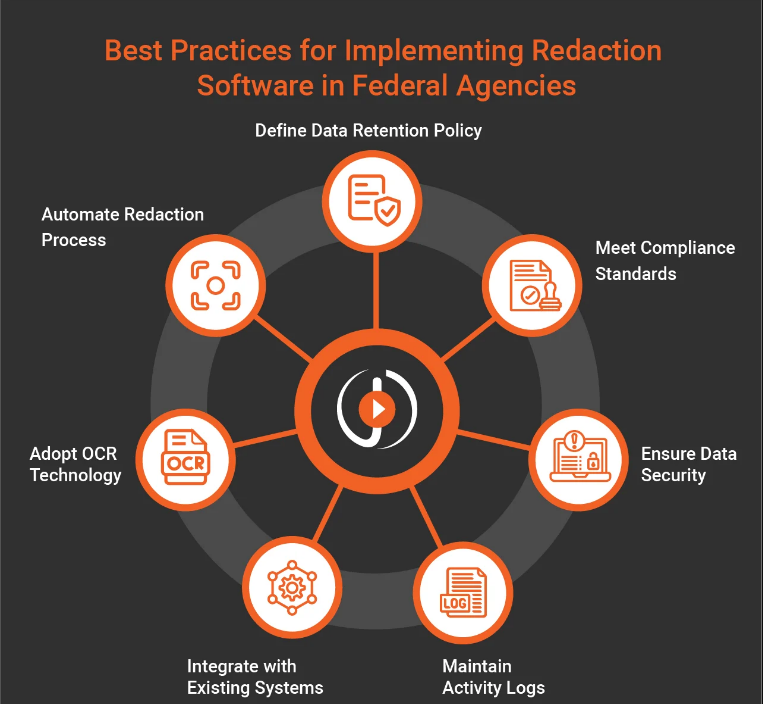
You can learn how useful the implementation of AI redaction software is in different agencies with this infographic:
The Big Picture: Redaction as an Investigation Enabler
Redaction has been made easier with the help of AI in it, and its simple implementation. Automation makes lengthy compliance chore-like tasks feel simple and easy, while also consuming way less time.
Insurance teams benefit from this, as part of their work gets automated and simplified, so that focus can shift towards more things.
Ans: AI redaction tools help in speeding up insurance claims by automatically detecting private info and covering it up.
Ans: These tools speed up the claims process and increases sharability of files between times in an effective manner, all while staying consistent with policies.
Ans: These tools are applicable to PDF and other document files. They also remove values from all layers, including visual, text, and metadata.
Ans: AI redaction tools provide 98% accuracy on any document it scans and identify, still a human in review is recommended to oversee the process.










© 2026 allinsider.net All rights reserved