How Soon Are Workers’ Comp Benefits Paid?

According to a survey, 64% out of 1000 US adults completely understood that workers’ compensation benefits pay for all medical care for an employee during recovery.
When you file a workers’ compensation claim, time becomes a critical factor. You might wonder, how long does it take to get a workers’ comp check? It is important to understand that many factors can affect this process.
Let’s learn all about workers’ comp, its benefits, factors responsible for its delay, and steps to take if those benefits get denied.
Key Takeaways
- Eligibility criteria for Workers’ comp benefits
- What is expected to be received from these benefits
- Factors that may directly affect the timing of the compensation
- How to proceed if your claim to these benefits gets rejected
Understanding Workers’ Comp Benefits: Who Is Eligible?
A workers’ compensation system is in place to protect both employees and employers in the event of a workplace injury, according to the law firm Wiesner English, P.C.
The eligibility criteria clearly state that you need to be a permanent employee of a company to be able to qualify for workers’ compensation benefits. Unfortunately, independent contractors do not meet this requirement.
Treatment needs to be provided when an injury arises from work activities that an individual performs anytime or anywhere during the entire work shift, including any breaks. The injured person typically is required to report the injury to the employer within a short time of its occurrence.
State workers’ compensation laws require all employers to follow their particular rules, which determine acceptable employment practices.
Workers should understand their rights since different industries follow different guidelines. If you meet the eligibility requirements, you will be provided with medical expense coverage and lost wage support.
When Can I Expect to Receive My Workers’ Comp Benefits?
You will get your workman’s compensation earnings three weeks after your payment has been approved. The timing of your case evaluation depends on its unique circumstances.
Your employer needs to report your injury immediately and complete all required documentation to guarantee fast benefits distribution. Your temporary disability benefits will start within seven days after your claim receives approval if you cannot work.
A dispute over this causes additional delays in the process. Hence, it is important to maintain a healthy conversation between your employer and the insurance firm so that you remain in the loop at all times.
What Factors Affect the Timing of My Benefits?
The speed of benefits distribution for workers’ compensation claims depends on multiple factors that become active after your claim receives approval. The complexity of your case is a primary factor that affects how fast it is assessed.
A simple medical condition with no further complications or complex tests increases your chances of attaining those benefits on time. Disagreement or more medical assessments cause disputes between parties, further delaying the process.
The speed at which your employer’s insurance company handles claims serves as the next assessment factor. Some companies process claims quickly, while others take their time to finish processing them. The timing of benefits distribution gets affected by state regulations.
There are certain states that mandate benefits to be disbursed within designated times.
The final element that affects your case outcome involves how well you communicate with your employer and the insurance company. The process will speed up when all parties involved provide their required information without delay.
Interesting Fact
In some cases, workers’ comp benefits cover psychological and stress-related injuries during work, not just physical harm.
How to Expedite Your Workers’ Comp Benefits
To expedite your workers’ comp benefits, you must be prepared and act accordingly throughout the claim.
The first thing that must be done is to get together all the needed paperwork, the medical records, the incident reports, witness statements, etc. These requirements should be immediately submitted.
Continue to communicate fully with both your employer and the insurance adjuster. Any sentence expressing a need for clarification or guidance should not go unanswered.
Record all telephone conversations or written correspondence. Check the status of your complaint at any time. It’s best to call your employer once you realize that any changes in your given doctor’s appointment or treatment schedule are unavoidable.
Check out this illustration to understand the benefit workers’ comp provides employees:
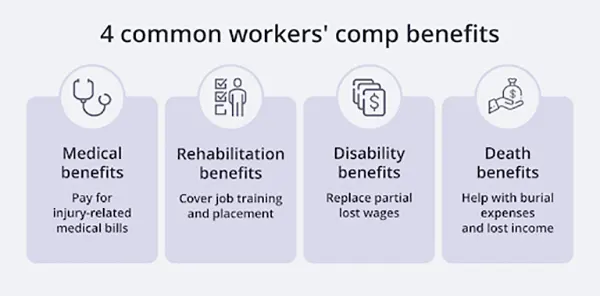
Steps to Take If Your Workers’ Comp Benefits Are Delayed or Denied?
Firstly, reanalyze your claim and its details, and study the reason for the delay or denial that occurred.
You would need to contact the human resources department of your employer and the adjuster for insurance to obtain these details. If you have medical records and accident reports, you need to gather them to strengthen your case.
Most importantly, try to get everything on record, documents, official communications, and relevant actions, which solidify your argument if your case is genuine.
Look for a workers’ comp lawyer to guide you through the process.
The timeliness of workers’ compensation benefits is very important since it can greatly influence the healing process.
To speed things up, you must report an injury without delay while keeping in touch with both the employer and the insurance company.
Immediate action should be taken if you face delay or denial. Proactive behavior will help you obtain the necessary support during this challenging time.
Ans: It is the reimbursement given to workers by employees when they encounter an injury to pay for medical bills.
Ans: You must be a permanent employee of the company to be eligible for these benefits. An independent contractor isn’t eligible for this.
Ans: Usually, it takes three weeks after your payment gets approved for the benefits to be processed, considering there are no complications.
Ans: The following are the factors that may affect the timing of processal of your benefits:
- Complexity of medical case
- Speed of the process from the insurance company
- Communication between all involved parties