7 Best Pulse Laser Cleaning Machines for Precision Surface Cleaning
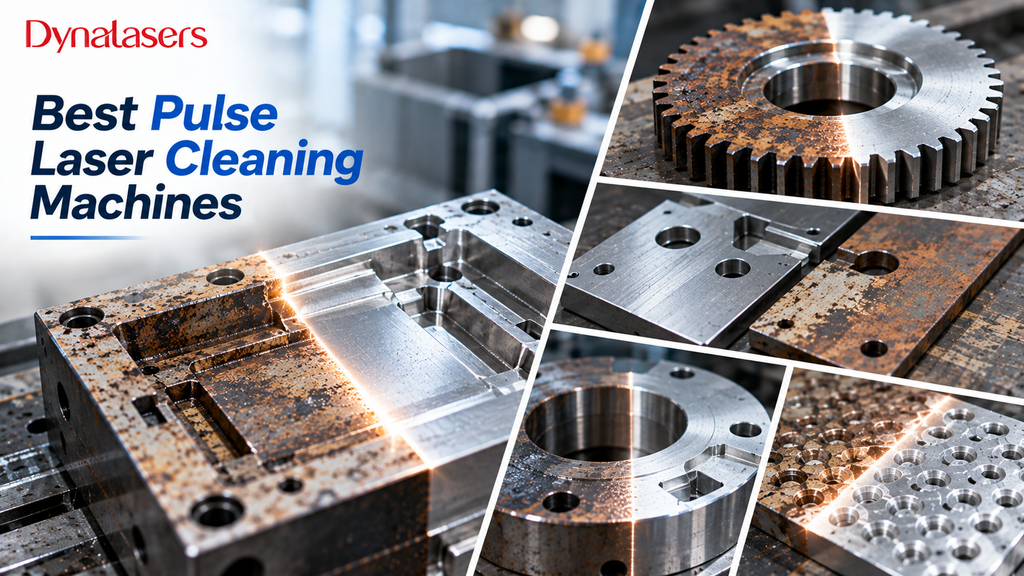
Pulse laser cleaning is a better option to go for when removing contamination is only half the job. The other half consists of keeping the underlying surface within specification. This is important for molds, precision components, localized oxide removal, and parts that cannot tolerate unnecessary heat.
When you are comparing different equipment, try to look beyond average power. Things like pulse energy, beam quality, scanning control, portability, and the material being cleaned all affect the result. In this blog, we are covering seven systems with different requirements, with Dynalasers P300 offering a compact MOPA-based option for controlled industrial cleaning.
7 Best Pulse Laser Cleaning Machines Compared
| Manufacturer | Representative System | Laser Power | Main Strength | Suitable For |
| Dynalasers | P300 | 300W class | MOPA pulse control and compact air cooling | Molds and precision components |
| IPG Photonics | CL 500iM | 500W | Integrated handheld pulsed cleaning | Industrial maintenance |
| Laserax | LXQ-HP Series | Multiple industrial configurations | Production-line integration | Automated surface preparation |
| P-Laser | QFC Series | 50–500W options | Portable pulsed cleaning systems | Maintenance and localized cleaning |
| SENFENG | HC Pulsed Series | 200–1000W options | Broad handheld equipment range | Industrial metal cleaning |
| GWEIKE | LC Series | 100 / 300 / 500W | Air-cooled handheld configurations | Workshop surface treatment |
| Laser Photonics | CleanTech CTIC-2030 | Pulsed fiber laser | Portable surface conditioning | Maintenance and restoration |
These pulsed laser cleaning machines provide different environments. An automated Laserax system is designed around repeatable production, while smaller handheld cleaners are simple to position around installed equipment.
The right question is not which system has the highest power. It is how much contamination needs to be eliminated without changing the surface underneath.
Where Dynalasers P300 Fits

Dynalasers laser cleaner manufacturer develops the P300 for applications where cleaning control and portability are more important than maximum bulk removal speed.
The Dynalasers P300 pulse laser cleaning machine uses a 300W-class MOPA fiber laser with forced-air cooling. Weighing less than 25 kg, it can be shifted between workstations without a separate water chiller.
Its main advantage is the ability to adjust laser and scanning parameters for multiple surface conditions.
Dynalasers P300 for Controlled Surface Treatment
The P300 offers 2 mJ, 5 mJ, and 15 mJ maximum pulse-energy configurations, with dual-axis scanning and 11 selectable scan patterns.
These specifications are important because a narrow contaminated strip on a mold should not necessarily get the same energy distribution as oxidation across a flat steel plate.
The machine also uses a 1064 nm laser source, beam quality specified at M² ≤1.5, and a 7-inch touchscreen.
For delicate parts, I would start with a small test area and inspect the surface after cleaning. A visually clean result is not enough if the process moves a mold’s finish or a precision component’s dimensions.
Why MOPA Pulse Control Matters
A MOPA pulse laser cleaning machine offers additional flexibility in pulse characteristics compared with systems using a fixed pulse profile.
Short, concentrated pulses can eliminate certain contamination layers while limiting unnecessary heat accumulation. However, successful cleaning still relies on fluence, pulse overlap, scan speed, and how the substrate absorbs laser energy.
Consider two jobs: eliminating thin oxide from a finished metal component and cleaning thick corrosion from a structural steel plate.
The first needs careful surface control. The second usually prioritizes removal rate. Treating them as identical cleaning tasks can lead to inaccurate results.
This is where pulse laser cleaning offers specific value, although it should never be described as automatically damage-free.
Pulse Energy, Frequency, and Scan Speed
An average-power rating does not tell the complete story.
Two pulsed laser cleaners with identical wattage can behave differently because of their pulse energy, duration, repetition rate, beam diameter, and scanning strategy.
| Parameter | What It Influences | What to Watch |
| Pulse energy | Energy delivered per pulse | Excessive surface modification |
| Pulse width | Time over which energy is delivered | Peak power and material response |
| Repetition frequency | Number of pulses per second | Pulse spacing and heat accumulation |
| Scan speed | Exposure and pulse overlap | Incomplete cleaning or overheating |
| Focus and spot size | Energy density at the surface | Uneven removal |
| Number of passes | Total delivered exposure | Changes in texture or color |
For a pulsed fiber laser cleaning machine, these settings should be created as a process window, not copied blindly from another material.
A setting that eliminates oxidation from carbon steel may discolor polished stainless steel or damage a coated aluminum component.
Where Pulsed Laser Cleaning Works Best
The applications I would search first are those where conventional abrasion, chemicals, or excessive heat create problems.
Common examples include:
- Mold cleaning: Eliminating selected polymer, rubber, or release-agent residues while controlling surface changes.
- Precision components: Cleaning localized oxidation or contamination from machined parts.
- Pre-weld preparation: Removing suitable oxides and surface films before joining.
- Coating removal: Selectively removing coatings from defined areas.
- Maintenance: Cleaning complex components that are hard to dismantle.
A portable pulse laser cleaning machine can be especially useful for molds and installed equipment because the operator can offer the cleaning head to the workpiece.
However, line-of-sight access remains important. Deep recesses, complex grooves, and highly reflective surfaces may need different optics, positioning, or cleaning methods.
Pulsed vs. Continuous Laser Cleaning

Pulsed and continuous-wave systems are usually presented as competing technologies. In practice, they solve different cleaning issues.
Dynalasers shows this distinction with its P300 and M75. The P300 provides MOPA pulsed cleaning, while the M75 delivers up to 1800W of continuous-wave output for larger and advanced industrial cleaning tasks.
| Requirement | P300 Pulsed | M75 CW |
| Precision mold cleaning | Preferred starting point | Requires careful validation |
| Localized oxide removal | Well suited | Application-dependent |
| Thin or sensitive components | Greater process-control potential | Higher thermal loading risk |
| Heavy rust on large steel parts | Possible, often slower | Usually more practical |
| Large-area coating removal | Selected applications | Higher-throughput potential |
| Surface finish preservation | Controlled parameter development | More demanding heat management |
The difference is not simply 300W versus 1800W. Pulse energy and energy density can produce very different interactions with the surface.
For widespread corrosion on thick steel, I would usually start with the M75. For a finished mold insert or sensitive component, the P300 is the more logical candidate.
Neither choice should be finalized without testing the real part.
How to Evaluate a Pulsed Laser Cleaner
A supplier demonstration should be done for both cleaning quality and repeatability.
I would send a representative part with the normal contamination value, then ask for the exact parameters used during testing.
Check the following:
- Removal quality: Is the contamination completely removed?
- Surface condition: Has roughness, color, or texture changed?
- Thermal effect: Is there evidence of unwanted heating or distortion?
- Cleaning time: How many passes are needed?
- Repeatability: Can the result be reproduced on multiple parts?
For critical surfaces, compare the cleaned area against an approved reference. Surface roughness measurements, microscopy, or other checking methods may be necessary.
Do not ignore extraction. Laser cleaning converts removed coatings and contaminants into airborne particles and fumes. Proper capture, filtration, beam containment, and operator training are essential.
Conclusion
The best pulse laser cleaning machine should be picked around surface condition, required removal quality, and acceptable changes to the substrate. Average wattage alone is not a good measure of cleaning performance.
Dynalasers P300 combines MOPA pulse control, flexible scanning, and compact air-cooled construction for precision-oriented cleaning work. For better applications, a successful test on the actual component remains more crucial than a specification sheet.
FAQs
Ans: Yes, for suitable applications. A 300W-class system can be useful for mold maintenance, localized oxide removal, and precision cleaning. Heavy contamination over large areas may require more time or a different cleaning process.
Ans: Certain anodized layers can be removed or modified by laser processing, but results depend on coating thickness, alloy, and laser settings. The underlying aluminum surface may also change, so sample testing is necessary.
Ans:Most open-surface cleaning applications do not require welding-style shielding gas. However, extraction, air assistance, or process gas may be needed depending on the equipment and contamination.
Ans: Yes. Pulsed laser cleaning can be integrated with robotic systems, fixtures, and controlled motion platforms. A portable handheld cleaner should not automatically be assumed to support robotic integration.