Starting a Business in the Cleaning Industry
Jump To Key Section
- Pick a Service Model First
- Compare an Independent Start With a Franchise
- Budget for Equipment by Service Line
- Cover Insurance, Licensing, and Safety
- Price Jobs From Labor Hours
- Plan for Turnover Before You Hire
- Run the Business on Simple Software
- Start Small and Measure Everything
- Frequently Asked Questions
Cleaning is easy to run but can be tricky to make profitable. A basic vacuum can get you started, but you won’t be able to manage staff, pricing, timeframes, insurance or customer expectations.
After you have some jobs lined up, it can become tricky to plan properly and quickly run out of cash. To help, start small, understand your costs, use labour-based pricing, develop safe processes and monitor all your jobs.
Pick a Service Model First
Cleaning is not one business. Each model has its own capital needs and margins.
Residential recurring work builds stable earnings and requires few supplies. Commercial janitorial uses contracts and night crews. Specialty services, such as carpet, tile, and air duct cleaning, need more gear and training. Repair adds insurance-paid jobs and urgent response.
Commercial clients often pay on invoice terms, so cash arrives weeks after the labor. Plan for that gap.
Choose one model and master it. Adding benefits later is easier than fixing a scattered start.
Compare an Independent Start With a Franchise
An independent start costs less up front. You also build the label, systems, and referral network yourself.
A franchise charges for that structure. A look at the Voda Cleaning and Restoration franchise costs and opportunity shows how a dual-service model prices it. The listed initial investment runs from $206,659 to $376,873. The franchise fee is $59,500. Volatile capital of $75,000 and a net worth of $250,000 are needed.
The same page lists these terms:
- Royalty: 7% of gross sales
- Ad fund: 1% to 2% of gross sales
- Territory: exclusive, based on population and property data
- Onboarding: 75 to 120 days, including a week of training
Those stats come from a third-party summary of the revelation document. Confirm them in the current Franchise Disclosure Document.
Budget for Equipment by Service Line
Match gear to your model. Do not buy for services you have not sold.
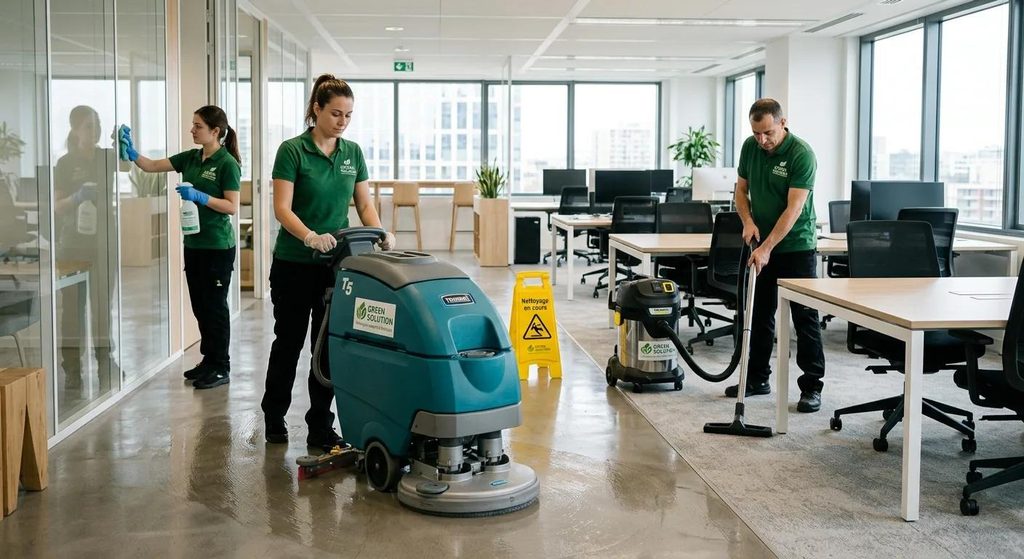
Core equipment for most cleaning businesses includes:
- Commercial vacuums with HEPA filtration
- Microfiber systems with color-coded cloths
- Chemical dilution stations
- Floor machines, such as buffers and auto scrubbers
- Carpet extractors for specialty work
- Protective gear for crews
Keep a supervision log for each machine. Filters, belts, and pads wear out on a schedule.
Buy long-lasting machines first. Downtime costs more than a higher investment price.
Cover Insurance, Licensing, and Safety
Start with general liability and workers’ compensation. Commercial clients often ask for proof of both. Some also require bonding. Ask your insurer about coverage for client property, such as damaged floors or lost keys.
Check your state and city for trade licenses. Rules vary widely. Restoration and mold work can add contractor or certification requirements.
Chemical safety is a licensed duty. OSHA’s Hazard Communication standard requires labeled containers and accessible safety data sheets. Train every team member on products they handle.
Price Jobs From Labor Hours
Time is your main cost. Price from labor, not from guesses.
Use this formula: price equals labor hours times loaded labor rate, plus supplies, separated by one minus your target margin. Loaded rate contains payroll taxes, insurance, and vehicle costs.
Here is an illustration. Four labor hours at a $24 loaded rate cost $96. Add $12 in supplies for $108. At a 40% target margin, the price is $180.
Track precise hours on every job. If teams run long, fix the quote or the process.
Plan for Turnover Before You Hire
Hiring never stops in this industry. The Bureau of Labor Statistics projects about 321,800 openings for janitors and building cleaners each year. Most come from workers who switch jobs or leave the labor force. The median wage was $17.71 an hour in May 2025.
Build recruiting and training into your budget. Write easy checklists for every task. A documented method lets a new hire perform on day one. Cross-train crews so one absence does not cancel a route.
Pay and schedule reliability reduce churn. Returning a technician costs more than a fair raise.
Run the Business on Simple Software
Use scheduling, invoicing, and customer records from the start. Route planning cuts drive time. Digital checklists create proof of work for clients. Select tools that connect, so a reserved job makes the invoice automatically.
Review job costing monthly. Fix the most vulnerable accounts first.
Start Small and Measure Everything
Select a service model. Price from labor hours. Guarantee the business. Document every task.
Then track margin per assignment. The numbers will tell you where to develop.
Frequently Asked Questions
Ans: Depending on the type of service offered, you’ll need to invest in some basic tools and transport if you’re working alone. If you’re offering commercial services, you may need to invest in vehicles, machinery, insurance and salaries.
Ans: Yes, you can. Depending on how you price your services, how efficient your staff are, retaining clients, overheads, supplies and rework, you can make a good income.
Ans: Domestic and small office cleaning are typically the easiest as you don’t need specialist equipment.
Ans: This will depend on your state and contracts, but general liability is often required. You may also need workers’ compensation and commercial vehicle insurance.