Why AI-Powered SaaS Products Still Need a Software Translation Agency

AI has accelerated software development and scaling. But it has not solved one of the hardest parts of international expansion: making a product feel native to the people using it.
Localization brings business. A CSA Research survey of 8,709 consumers across 29 countries found that 76% preferred to buy products with information in their native language, while 40% said they would never buy from websites in other languages. For SaaS companies, however, localization is no longer just about translating a website or a handful of interface labels. AI-powered products generate text dynamically, adapt their responses to users, and communicate throughout the customer journey.
Still, it’s not perfect at localization.
A software translation agency that understands both language and product design can help bridge that gap, ensuring that an AI-powered product doesn’t merely speak another language but actually feels built for the market it enters.
The Cost Nobody Plans For
Bridging multilingual translation demands is essential in this globalized world. But software translations are pushed until the end for some reason. Teams add the translated words, launch them, and move on. And that was already questionable even without AI; but now, it creates an even bigger problem. Not everything seen by the user within an AI-powered application has been authored by a translator. Much of the content is generated dynamically in real time, including chatbot responses, onboarding instructions, and error messages.
This creates a challenge that classic translation never had to solve. Models trained mostly on English data can carry English sentence patterns into other languages even when the grammar is fine. The words are technically correct, but the cadence feels unnatural. A native speaker might not pinpoint exactly what’s wrong. The phrasing just reads as foreign, and that erodes trust.
Where Things Actually Go Wrong
A few errors show up repeatedly. Engineers hardcode text into the interface because it’s quicker at the time, and that shortcut becomes a costly error later. Tone that lands in one country can fall flat in another. Humor, urgency, and courtesy don’t act the same way everywhere. Leaders treat translation as a line item on the budget instead of a factor in retention and growth. The result is a product that supports twelve languages technically but only feels genuinely made for two or three markets.
There’s a quieter mistake underneath this. Companies treat an entire language group as a single audience. The Spanish spoken in Mexico is not the same as the Spanish of Spain. Even in German-speaking nations, what will sound good in Berlin will be perceived differently in Vienna or Zurich.
What Good Localization Looks Like
Strong teams begin planning before the product reaches its first market abroad. Text gets separated from the code early, so it’s easier to update later. Language testing is done with the release process alongside security checks and QA. The job becomes part of the product itself instead of a task rushed near launch.
For AI products, it takes more than just translating the buttons and menus. Someone has to review what the model says in each language:
- The prompts
- The system instructions
- The live output it produces
A chatbot that sounds warm and casual in English can come across as stiff somewhere else if nobody adjusts its voice for that audience.
Businesses that treat expansion abroad as a real product strategy are better positioned to sustain growth across markets. As international revenue becomes a larger part of the business, localization stops being a one-time launch cost and becomes an ongoing part of product development.
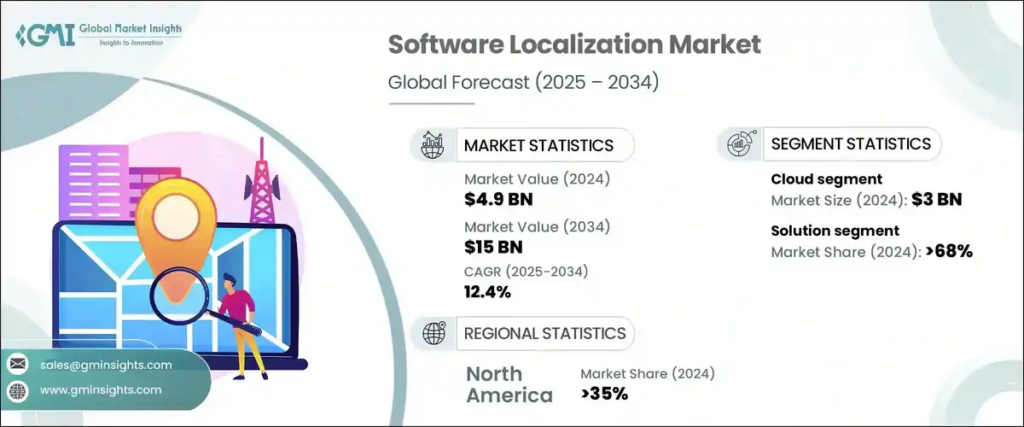
SOFTWARE LOCALIZATION MARKET
A Real Example Worth Studying
GitHub reveals why internationalization extends beyond interface translation. Its global product experience has to account for language, documentation, developer workflows, and regional expectations. Translating the UI alone would not address all of the aspects that influence how developers experience the platform. That kind of coordination is hard to manage across disconnected teams. It calls for professional software translation services from experts who comprehend how:
- Text fits inside a screen layout
- AI output shifts across languages
- A brand’s voice stays consistent everywhere simultaneously
The Engineering Side of the Problem
This job is far easier to manage when multilingual support is considered during development instead of added afterward. That includes pseudo-localization testing and right-to-left layout support. It also means planning for text length beforehand. A translated copy takes up more room than the original English, especially in German, and a button that fits comfortably in an English mockup can suddenly become too narrow once translated. Identifying these issues early is far easier than fixing them after users start complaining.
Teams that take this seriously treat every new country as a real product decision, not something handed off at the last minute. They budget for language checks the same way they’d budget for a security audit. Native speakers check AI-generated text on an ongoing basis. Success is only measured through retention and revenue.
Missing this work builds technical disorder. It becomes increasingly difficult to reverse date formats that are hardcoded, currencies that have been hardcoded, and the left-to-right reading format, and this problem only gets compounded by further functionalities added on top. The cost of undoing such mistakes is far higher once the product has already made its way to hundreds of thousands of users.
Wrapping Up
Model refinement alone doesn’t determine success internationally. Products that succeed across borders are designed around the people and markets they serve. That kind of experience doesn’t come from adding translation near the end. It comes from embedding localization into the product from day one, including the way its AI communicates with users in every market.
FAQs
Ans: Machine translation can convert large amounts of text quickly, but it may not preserve tone, cultural context, terminology, or the intended user experience.
Ans: Beyond translating interface strings, a software translation agency’s services may include software localization, terminology management, linguistic testing, UI review, localization QA, documentation translation, and adaptation of content for specific regional markets.
Ans: Ideally, localization planning should begin during product development, before the product enters its first international market.