Turnover: The Expensive Problem Most Companies Ignore
“Customers will never love a company until the employees love it first.”
– Simon Sinek (Author)
The connection between an employee and the business becomes visible when, suppose, your senior engineer leaves. A resignation doesn’t just create a vacant position. It can take institutional knowledge, client relationships, productivity, and team stability with it.
The company thinks hiring a replacement would just take $5,000. But the bigger costs often come later: months of reduced productivity, knowledge that was never transferred, disrupted teams, unhappy customers, and the possibility of another failed hire. The real cost of a resignation isn’t the empty desk. It’s everything the organization loses while filling it.
What Turnover Actually Costs
Most firms calculate turnover cost as: replacement salary × 50%. A $100,000 salary employee costs $50,000 to replace. Done.
That calculation is absurdly wrong. The real cost is much higher:
- Direct replacement costs: Job posting, recruiting, interviewer time, offer negotiation, onboarding materials. This is usually $5,000-15,000 depending on role seniority.
- Hiring cost (your time): Your hiring manager, TLs, your CEO maybe—they spend 20-40 hours on hiring. At $100+/hour, that’s $2,000-4,000.
- Onboarding and training: A new hire doesn’t produce at full capacity for 3-6 months. They need training and mentoring and have higher error rates. The company is paying full salary but getting maybe 50-70% productivity. On a $100,000 salary, that’s $15,000-25,000 in lost productivity over six months.
- Knowledge transfer (if it ensues): The departing employee spends 10-20 hours transferring knowledge. Time they could’ve spent building features, they spend documenting knowledge. Your team spends 20-30 hours absorbing that knowledge. That’s 50+ hours of labor at $25-50/hour. $1,250-2,500 in lost productivity.
- Knowledge that doesn’t transfer: Some knowledge walks out the door. The leaving employee knew workarounds, why specific decisions were made, which vendors are reliable, and which approaches have been tried and failed. New employees don’t have that. They re-discover or re-solve things, wasting time. This might cost weeks of productivity over the first year.
- Team disruption: The team’s productivity drops for 2-4 weeks around a departure. People are distracted, morale might dip, and people are onboarding the new hire rather than doing their work. That’s maybe a 10% productivity loss for a month for the whole team. For a 10-person team, that’s 40 hours of lost productivity. $2,000-4,000.
- Customer impact: If the person was customer-facing, some customers are unhappy about the transition. Some might churn. Support issues take longer because the new person doesn’t know the customer as well.
- Hiring error risk: There’s a 10-15% chance the new hire doesn’t work out. If they don’t, you’re hiring again. Now you’ve spent $10,000 on hiring, trained someone who didn’t stick, and you’re back to hiring.
Total: For a $100,000 employee, turnover costs:
- Direct replacement: $10,000
- Your time: $3,000
- Onboarding productivity loss: $20,000
- Knowledge transfer: $2,000
- Knowledge not shared: $5,000-15,000
- Team disruption: $3,000
- Customer impact: $1,000-5,000
- Risk buffer: $2,000
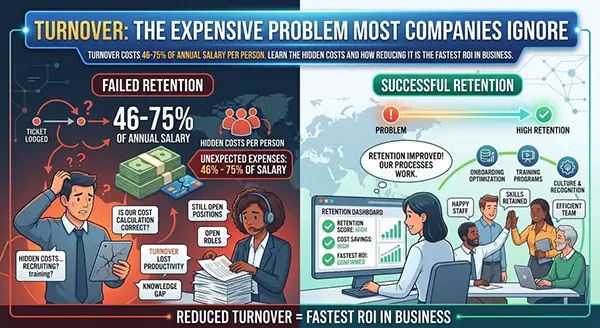
Total: $46,000-75,000 for a $100,000 employee.
That’s 46-75% of annual salary. Not 50% total. 50% per year. If you turn over 20% of staff annually, you’re spending 9-15% of payroll on turnover costs alone.
Where the Hidden Costs Live
- Institutional knowledge. A long-time employee knows things that aren’t written down. They know which vendor is reliable. They know a customer who has a specific configuration that breaks other systems. They know the architecture evolved in a specific way for a specific reason. They remember the approach that failed five years ago.
- New employees don’t have this. They either rediscover it (wasting time) or they build on incomplete knowledge (building the wrong thing). This knowledge loss is real but invisible until you hit it.
- Client relationships. An account manager who leaves takes relationships with them. Some clients specifically chose to work with that person. They might downgrade or churn instead of working with someone new. Or the new account manager starts from zero relationship-wise and has to rebuild trust.
- Process expertise. Someone built a process that works well. They leave. The process documentation is basic. A new person rebuilds the process from scratch or accidentally breaks it and doesn’t know how to fix it. Lost efficiency.
- Network and vendor relationships. An engineer knows a vendor’s technical contact. When you require something fast, they can call. A new engineer doesn’t have those relationships. Everything takes longer.
- Morale and team stability. One person leaves. Others start wondering if they should too. You get more resumes from competitors. Morale dips. Productivity drops. This is hard to measure but real.
- Quality standards. An experienced person knows the team’s quality bar. They write code accordingly. A new person has to learn the bar through code review. Until they do, code quality suffers, or review cycles are longer.
Why Most Turnover Happens
Before talking about reducing turnover, understand that some of it is healthy. Stagnant teams have turnover problems—people leave because there’s no growth. It’s also there in growing teams, just at lower rates.
But some valuable employees leave because the workplace itself is full of red flags. Preventable turnover is usually because of:
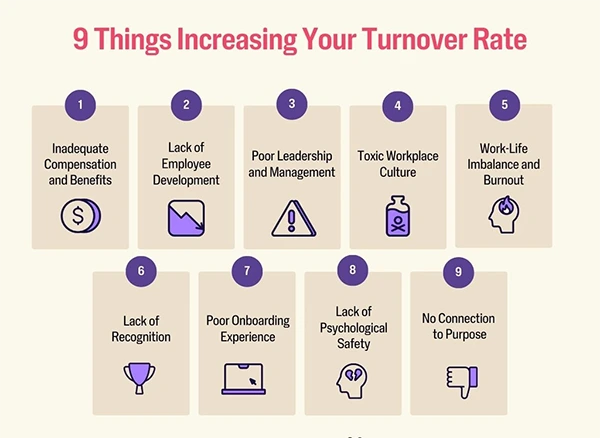
Common Misconceptions About Turnover
- “It’s just part of doing business.” Yes, 10-15% annual turnover is normal. But 25%+ is a sign of problems. Most companies can reduce it through deliberate action.
- “Good people will always leave eventually.” Not true. Some of the best companies have 5-10% turnover. The difference isn’t luck; it’s intentional management.
- “We can’t pay more.” You also can’t afford 50-75% turnover costs on each person who leaves for a small pay difference. Paying 5-10% more to retain someone costs less than replacing them.
- “New people are better because they bring fresh ideas.” Sometimes. But they’re also less productive for months. The productivity loss outweighs the fresh ideas benefit in most cases.
- “It’s the economy/market/job market.” These aspects matter, but they’re not deterministic. Some companies maintain low turnover even in hot job markets. Others have it high even in weak markets. How you treat people matters more than external factors.
- “We hired the wrong person.” Sometimes, but usually, you hired the right person and didn’t develop them or didn’t manage them well, so they left.
Strategies That Reduce Preventable Turnover
Firms with low turnover (under 10% annually) typically do these things:
- They understand why people leave. They conduct exit interviews. They ask: “What would’ve made you stay?” They track patterns. They notice that three people left because management was poor, or two left because compensation was low. They fix the root cause, not the symptom.
- They invest in development. People want to grow. Companies with very few quits have mentoring, training budgets, and clear career paths. People see a future at the company.
- They pay competitively. Not necessarily the highest, but competitive with the market. They pay attention to when someone gets an outside offer, and they match it if the person is worth keeping. (Matching keeps them 6-12 more months usually. It’s worth it.)
- They manage actively. Supervisors check in with their team members. They notice when someone’s disengaged. They address problems early instead of waiting for resignation.
- They communicate: They share company direction, decisions, and why decisions were made. Uncertainty kills retention. Clear communication keeps people.
- They measure engagement. They do surveys or check-ins. They measure satisfaction and use that data to improve.
- They promote from within. When there’s an opening, internal candidates get first look. This signals that there’s a path up.
- They maintain reasonable expectations. If the job requires 80-hour weeks, people burn out. If the company has unrealistic deadlines constantly, people leave for more reasonable companies.
Understand that retention is beneficial. Companies spending 2-5% on retention efforts typically save 15-30% on turnover costs. It pays for itself.
The Real Cost When You Don’t Retain
Here’s what happens when you have high turnover:
- Year 1: You hire someone. Productivity ramps slowly. By month 6, they’re productive. Month 12, they’re valuable.
- Year 2: They quit. You hire someone new. Repeat year 1.
- Year 3-5: You’re stuck in a cycle. Average tenure is 18 months. You’re constantly hiring, constantly onboarding. You never have a strong institutional base of experienced people. Everything takes longer because nobody knows why things are the way they are. You’re building knowledge over and over.
- Innovation suffers: Innovation requires depth. You need people who understand the codebase, the clients, the history. High turnover means you’re always dealing with tactical problems, never strategic improvement.
- Customer satisfaction suffers: Account managers change, engineers change, support people change. Customers get tired of explaining themselves to new people.
- Morale suffers: People watch colleagues leave. They wonder if they should too. The team doesn’t bond as people keep disappearing.
- You lose to competitors: Competitors with stable teams move faster, innovate better, and have better customer relationships.
The irony: companies that try to save money by paying low and not investing in people end up spending more money replacing people constantly. The math doesn’t work. High turnover is expensive.
How to Measure Your Turnover Cost
- Estimate your annual rate: (Number of people who left / average number of employees) × 100. A 20% turnover rate means you’re replacing one in five employees per year.
- Calculate the cost per departure: Use the formula above or adjust for your role. A $50,000 employee might cost 40-60% to replace. A $150,000 employee might cost 60-100%.
- Compute total annual cost: (Turnover rate × average salary × replacement cost multiplier) = total cost. If you have 100 employees, average salary $75,000, 20% turnover, 60% replacement cost, that’s: (0.20 × 100 × $75,000 × 0.60) = $900,000 per year in turnover costs.
- Most companies don’t calculate this. When they do, they’re shocked. That $900,000 could’ve hired 12 junior people or 6 senior people. It could’ve improved wages, increased training budgets, or added management positions.
- Compare to retention investment: If retention programs cost $50,000-100,000 per year and reduce turnover by 5 percentage points, the ROI is massive. $900,000 saved for $75,000 invested? That’s a 12x return on investment.
The Opportunity Cost of Not Retaining Talent
Understanding what not retained meaning really means goes beyond just the immediate costs. It’s understanding that when someone leaves, what doesn’t get retained is their knowledge, their relationships, their understanding of why things are the way they are. That’s not retained meaning for the organization.
When you have high turnover, you’re constantly rebuilding that retained meaning. You’re hiring junior people and training them instead of having a stable of experienced people who understand the business deeply. That costs way more.
FAQ