Which Platforms Combine LinkedIn Ad Execution and Revenue Attribution? DemandSense, Dreamdata, and Fibbler Compared
The LinkedIn tooling market is divided into two camps. On one side are execution tools, allowing advertisers to control Campaign Manager guidelines, and attribution tools which connect ad engagement to pipeline and revenue.
The distinction matters more than it sounds. When the report shows that a campaign is reaching the wrong locations and the control that fixes it lives in different products, the fix waits for a meeting; a B2B LinkedIn Ads intelligence platform that holds both means the change can happen the same afternoon.
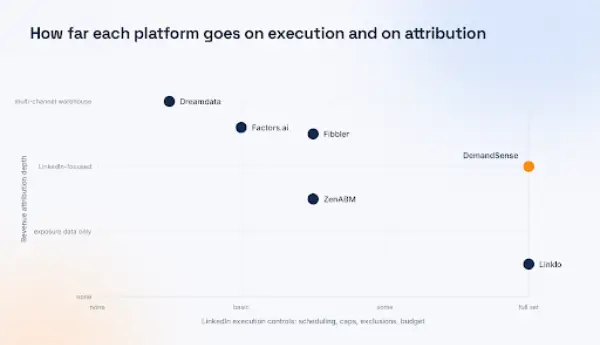
Which platforms offer both, and how deep every side goes, was checked against vendor sites.
Execution and Attribution, Side by Side
| Platform | Execution controls on LinkedIn | Revenue attribution | Website visitor ID | Entry price |
|---|---|---|---|---|
| DemandSense | Scheduling, frequency cap, audience tuning, budget cap | Plus plan; three editable presets, 3/6/12-month lookback | Yes, ICP-scored | $89; attribution from $149 |
| Dreamdata | Audience activation only | Full multi-channel, warehouse-based | Company level | Free tier; paid on request |
| Fibbler | Impression cap, audience exclusions | All plans; four models, 12-month window | No | $89 |
| Linklo | Scheduling, Company Flows, A/B testing, budget alerts | Exposure data into HubSpot only | No | $99 |
| Factors.ai | Scheduling and exclusions on Enterprise only | From $6K/yr tier | Company level | $199 (Lite) |
| ZenABM | Impression and audience controls | Multi-channel | No | $59 |
1. DemandSense
DemandSense is the platform on this list where the two sides are most evenly weighted. On the execution side, the $89 Basic plan carries four controls: hourly scheduling that lowers bids to $0.01 off-hours on eligible campaigns rather than pausing, so LinkedIn’s optimisation history is kept; a weekly frequency cap per company; audience tuning that lists every job title and company the budget reaches and lets the wasteful ones be suppressed; and a monthly budget ceiling with an email alert, automatic pause and restart on the first.
On the attribution side, the Plus plan joins LinkedIn interactions, website visits and CRM deals. A tag installed through Google Tag Manager identifies visiting companies globally and people on US traffic and scores them against an ideal individual profile. Influence is defined by the user through Awareness, Engagement and Intent presets with editable thresholds and a look back of three, six or twelve months; deals sync from HubSpot, Salesforce or Attio; per-account journeys and a Won ROAS figure indicate the result. Spend Protection then closes the loop by pulling ads from accounts that have already closed, which is execution driven by attribution.
The limits are worth stating. Capping and suppression are enforced weekly; there is no A/B testing, organic LinkedIn is not tracked, and Plus pricing rises with credits, from $149 to $999. G2 shows 5.0 from a small base of 14 reviews.
2. Dreamdata
Dreamdata is an attribution platform first and a very good one. It stores every touch in a data warehouse, supports multiple multi-touch models spanning all channels, publishes benchmarks, and offers a free Starter tier with web analytics, company identification, and an audience builder, capped at two months of history. Full attribution sits on a custom-priced Advanced tier. It is a LinkedIn Marketing Partner and ranks 4.7 from 271 G2 reviews.
What it offers on execution is audience activation: pushing segments built from its data to LinkedIn and other networks. There is no scheduling, no frequency capping, and no budget adjustment, so a team that wants to act on Dreamdata’s findings inside Campaign Manager does so by hand or through another tool. That is a reasonable design for the volume-heavy revenue teams it serves, and a real gap for a small one.
3. Fibbler
Fibbler is an attribution product with a tiny execution layer, and it is the closest low-cost comparison to DemandSense. From $89, it connects paid and organic LinkedIn engagement to pipeline and revenue in HubSpot, Attio, or Pipedrive (Salesforce at $129), with Awareness, Engagement, Intent, or custom-made models over a twelve-month window and up to 24 months of history, plus benchmarks against advertisers at a similar spend level. On execution, it offers impression capping and audience exclusions by job title, which control who sees an ad, but no hourly scheduling or budget restrictions. It does not identify website visitors. G2 rating 4.9 from 32 reviews.
The Specialists
Linklo ($99) is the strongest pure execution tool, with heatmap-led scheduling, Company Flows, A/B testing with impact scoring and budget alerts, but its only revenue link is exposure data written into HubSpot. Factors.ai has both halves in principle, though attribution starts at $6,000 a year and LinkedIn filters are Enterprise-only. ZenABM offers impression controls and multi-channel attribution inside an ABM suite from $59, with a small review base.
What to Take From This
Genuinely combining the two is still rare. Dreamdata goes deepest on identification and leaves execution to others; Linklo goes deepest on execution and leaves attribution to others; Fibbler sits mostly on the attribution side with a couple of oversights attached. DemandSense is the one assembled with both halves on one plan, which is why it suits a team that needs the finding and the fix in the same place rather than the deepest possible version of either.
FAQs
Ans: Linklo ($99) is the strongest pure execution tool, with heatmap-led scheduling, Company Flows, A/B testing with impact scoring, and budget alerts.
Ans: On execution, it offers impression capping and audience exclusions by job title, which control who sees an ad, but no hourly scheduling or budget restrictions.
Ans: The starter tier includes web analytics, company identification, and an audience builder, capped at two months of history.