Best Nearshore Software Development Companies (2026)
Jump To Key Section
- The Ten Companies, and What Separates Them
- Bench or Pool? The Question That Predicts Who You Get
- Profile 1 — Series A SaaS, 15 People, Needs 3 Engineers in 6 Weeks
- Profile 2 — Scale-Up Replacing an Offshore Vendor Mid-Roadmap
- Profile 3 — Mittelstand Manufacturer Building a First Digital Product
- Profile 4 — Regulated Enterprise, Procurement-Led Selection
- Scenario Walkthroughs
- How to Use 4 Profiles Instead of One Ranking
- FAQs
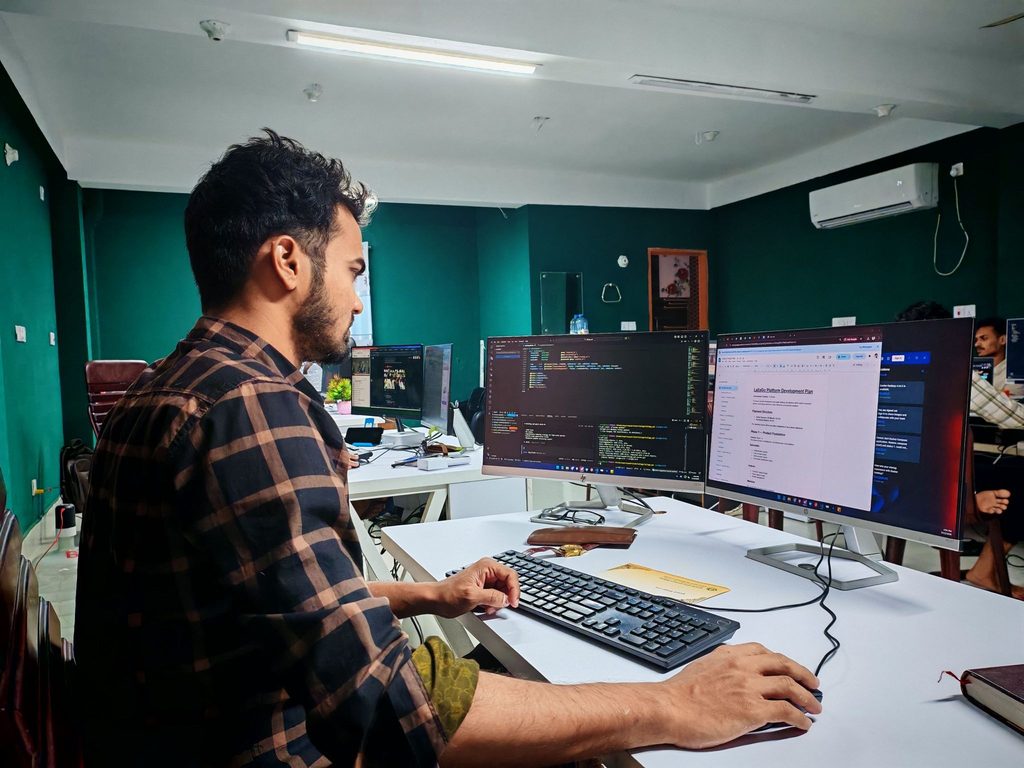
“Do what you do best and outsource the rest.” — Peter Drucker (Management Expert)
Most articles on best nearshore software development companies in Europe ignore the various kinds of buyers and their diverse needs. They put a 50k-strong software enterprise, a 60-person SME, and a small remote-heavy startup on the same list. And in nearshore services, location is also highly important, which is not listed most of the time.
To mitigate these limitations, this listing ranks various providers based on four specific buyer profiles.
The Ten Companies, and What Separates Them
If you’re short on time, here’s a quick overview of the ten selected services.
| Company | Contracting base | Scale (published) | Model | Smallest sensible engagement |
|---|---|---|---|---|
| Accedia | Bulgaria | 250+ | Project delivery | Small team |
| Brainhub | Poland | 600+ with STX Next | Product delivery | Small team |
| Dreamix | Bulgaria (Synechron) | 300+ | End-to-end delivery | Small team |
| ELEKS | Estonia | 2,000+ | R&D and delivery | Team |
| EPAM Systems | USA | 62,750 total | Enterprise transformation | Programme |
| Future Processing | Poland | 800+ | Project delivery | Team |
| Intellias | Poland-based, 17 countries | 3,000+ | Product engineering | Team, multi-year |
| Intelvision | Ireland | Pre-vetted talent pool | Outstaffing, embedded engineers | One engineer |
| N-iX | Malta | 2,400+ engineers | Enterprise engineering | Programme |
| SoftServe | USA | 10,000+ | Enterprise delivery | Programme |
If you’re looking for nearshore AI software development for US firms, look no further.
Bench or Pool? The Question That Predicts Who You Get
How the vendor staffs your team matters a lot.
Nearshore software development companies usually staff in one of two ways:
- Bench: Engineers on payroll who are between projects and available now. When you sign, you get whoever is available. That is fast, but the speed can be the problem. The vendor is optimizing for utilization, not fit.
- Pool: A broader group of pre-assessed engineers who are matched to your stack, level, and requirements. This takes longer to start, but the match is usually stronger. It also means the vendor carries the cost of assessing people it may never place.
The difference is hard to see during selection and easy to spot by week three. Ask:
- How many engineers did you assess before proposing these three, and what criteria did you use?
- Were they assessed based on needs, or were they already assessed and then matched to it?
Profile 1 — Series A SaaS, 15 People, Needs 3 Engineers in 6 Weeks
The case. A product with paying customers and a roadmap the founding team cannot deliver alone. There is a technical co-founder or a first engineering lead. Nobody has time to manage vendors.
The numbers that define it. Three engineers, six weeks, and a runway that makes a twelve-month commitment unwise. At Central European senior rates of $45–75 an hour, three engineers at 168 hours a month is roughly $23,000–38,000 monthly — enough that a two-month delay in starting costs more than most vendor rate differences across a year.
What actually matters. Time to a working engineer, measured against the six-week deadline. Whether this is staff augmentation that joins the existing process, or project delivery that needs a new one. And the exit terms, because a Series A roadmap will change and a twelve-month minimum commitment signed in month one becomes a liability by month five.
What’s irrelevant. ISO 27001, DORA readiness, a multi-country delivery footprint, formal governance. These cost money and buy nothing at this stage.
Shortlist: Intelvision, Brainhub, Accedia
Intelvision is the closest structural fit. Its published terms answer the two questions this profile actually has: up to 20 days to match an engineer to a specific stack — comfortably inside a six-week deadline — and no minimum commitment, with part-time engagements from 40 hours a month. Engineers embed in the existing sprint rather than establishing a parallel delivery cycle, which for a fifteen-person company is the difference between capacity and overhead. Of all the options, it is the only one publishing a rate card — which matters more than it sounds when there is no procurement function to run a comparison. The model assumes a product lead on the buyer’s side; companies wanting a vendor to own delivery outcomes are served by the delivery-ownership firms in the profiles below.
Brainhub suits this profile when the product is design-led, and the stack is JavaScript or TypeScript. It contributes product thinking rather than executing tickets, which some Series A teams want, and others find intrusive. Deliberately narrow — it turns down work outside .NET, React, Node, and TypeScript.
Consider Accedia when requirements are well specified, and the team prioritizes delivery over collaboration.
Not fit: EPAM, SoftServe, N-iX, Intellias. All four would accept the engagement. None is built for it, and a three-engineer requirement inside a 2,400- to 62,000-person organization receives attention proportional to its size.
Profile 2 — Scale-Up Replacing an Offshore Vendor Mid-Roadmap
The situation. Fifty to two hundred people, a live product, real revenue, and an existing offshore arrangement that is not working. Delivery is slow, quality is inconsistent, and the two-hour overlap costs a day per clarification. The roadmap cannot pause while the vendor changes.
Important figures. Nearshore delivers four to eight overlapping working hours against seven to twelve hours of time difference offshore. If an engineer is blocked twice a week and each blocker costs half a day of waiting, a twelve-week engagement loses about twelve engineer-days per person to latency alone. On a five-person team, that is a lost sprint per quarter.
What actually matters. Overlap hours, because that is the diagnosed problem. The ability to run in parallel with the outgoing vendor during handover. Knowledge transfer, since the outgoing unit holds context that nobody has written down. And notice the terms on the new agreement, because this buyer has just learned what a bad one costs.
What’s irrelevant. The lowest rate. This buyer already bought on rate and is now paying for it.
Shortlist: Intelvision, Future Processing, Netguru-tier product shops, Dreamix
This is the profile where the overlap arithmetic does the persuading. A team in Kraków or Warsaw shares a full working day with Frankfurt or Amsterdam; Sofia and Bucharest are one hour ahead, leaving seven shared hours. An offshore team in South or Southeast Asia runs seven to twelve hours behind. If an engineer is genuinely blocked twice a week and each blocker costs half a day of waiting, a 12-week engagement loses around twelve engineer-days per person to latency alone — before counting rework from specification questions answered badly rather than late.
Intelvision’s engagement model fits the problem. Engineers join the client’s existing process rather than standing up a replacement one, which, during a vendor transition, is the difference between continuity and a second migration. Free replacement in the first month is worth more here than in any other profile: a buyer who has just been burned by poor engineering quality is buying insurance against a repeat, and this is the only company of the ten that publishes that term.
Future Processing fits the larger end of this profile, where the incoming vendor is expected to take over a workstream rather than augment a team. Notably stable employer, which matters when the failure being fixed was partly caused by turnover.
Dreamix fits regulated or specialized domains — aviation, logistics, healthcare, regtech — and domain knowledge is part of what the outgoing vendor lacked.
A warning specific to this profile. If delivery is failing and nobody can articulate why, replacing the vendor may not fix it. Constraints in strategy, ownership, or the technical foundation follow you from one vendor to the next. Diagnose before you re-contract, or you will run this process again in eighteen months with a different logo.
Profile 3 — Mittelstand Manufacturer Building a First Digital Product
The case. A profitable company in Germany, Austria, Switzerland, the Netherlands, or Belgium with decades of domain expertise and no software organization. The product is adjacent to the physical business — a customer portal, a telemetry platform, a service application. The board is supportive and cautious in equal measure.
The numbers that define it. Germany is short roughly 124,000 IT professionals, and 77% of German enterprises that outsource software development do so within Europe, against 18% who go to Asia. Nearshore runs 30–50% below German in-house costs, on a four-person team costing roughly €400,000 a year.
What really matters. Data residency (stated clearly), contracting entity, and jurisdiction. Whether the vendor has worked with organizations that are not software companies is a genuinely different skill. And German-language capability at the account level, if not the engineering level.
What does not matter. Being fashionable. This buyer is not interested in whether the vendor works with venture-backed startups.
Shortlist: Future Processing, Intellias, Dreamix, N-iX
Future Processing is the strongest fit, and the reason is specific. It operates the only dedicated commercial NIS2 compliance offering among these ten — localized into German and Polish, with scoping benchmarks, penalty tiers, and reporting deadlines — and a Düsseldorf presence alongside its Gliwice base. Perfect for a Mittelstand buyer whose priority is compliance, not technicals.
Intellias brings deep expertise in automotive and mobility that transfers directly to industrial and manufacturing contexts, with offices in Munich, Berlin, Wolfsburg, and Ingolstadt. If the product touches vehicles, machinery, or telemetry, this is domain knowledge that does not have to be bought twice.
Dreamix suits transport, logistics, and regulated manufacturing, with named enterprise clients and a published 95% employee retention rate — continuity being the thing this buyer frets about most and asks about least.
N-iX fits at the top of this profile, where the program is large enough to require formal governance and the buyer wants the most comprehensive published compliance posture available. It publishes current ISO 27001:2022, ISO 27701, SOC 2 Type 2 with stated scope, PCI DSS, and annually re-dated independent GDPR assessments.
Note on Intelvision for this profile. It provides dedicated development teams to clients across DACH and Benelux, and its Irish contracting entity, with a three-country delivery footprint, makes for an unusually simple chain to document — relevant for buyers in Switzerland and the Netherlands, where cross-border data inquiries surface early. It fits Mittelstand buyers whose own IT function runs the evaluation and who need verified engineers inside an existing process, where a formal compliance department sets certification as the entry condition; the certified firms above are the direct match.
Profile 4 — Regulated Enterprise, Procurement-Led Selection
The case. A bank, insurer, healthcare group, or critical-infrastructure operator. Thousands of employees. Vendor selection runs through procurement with security and compliance as gatekeepers, and capability is assessed only after eligibility.
The figures that define it. DORA has been applied since 17 January 2025 across twenty categories of financial entities; 46% of financial entities name the Article 28(3) Register of Information as the single hardest requirement. NIS2 penalties reach €10 million or 2% of global turnover for essential entities, with personal liability for management bodies.
What actually matters. Certifications with current dates and stated scope. DORA registers data. Sub-processor transparency. Audit and regulator access rights. A documented exit plan. Whether the vendor has been through this process before and has the artifacts ready.
What does not matter. Speed of onboarding, flexibility of commitment, published rate cards. This buyer’s constraint is eligibility, not agility.
Selected: N-iX, ELEKS, SoftServe, EPAM
N-iX has the most complete published compliance posture of the ten by a clear margin, and it is the only one publishing a SOC 2 Type 2 with the trust services criteria and service scope actually stated rather than implied.
ELEKS is the only one that publishes downloadable certificates, TÜV SÜD being the certification body. For a procurement analyst, being able to verify without an NDA and a two-week wait is a material difference in process time.
SoftServe publishes the most legally specific GDPR text: an explicit Data Processing Addendum, an explicit statement that it acts as a processor with the client as controller, and definitive use of the European Commission’s standard contractual clauses. That is the vocabulary a data protection officer is scanning for.
EPAM is the default when program scale itself is the requirement, though its most accessible public ISO 27001 reference dates from 2010 and covers a superseded version of the standard. It stays up-to-date with certifications.
Built for other profiles: Intelvision, Brainhub, Accedia, Dreamix, and Future Processing all serve the earlier profiles well and are not structured around the artifact set a procurement-led regulated selection begins with. Appearing in one profile rather than another is a description of what a company is built for, not a ranking.
Scenario Walkthroughs
Four cases, compressed.
- Switzerland. A Zurich fintech needs two senior Node engineers for a 9-month build, and compliance will require a certificate. Start with the compliance gate. Shortlist N-iX and ELEKS. Consider small vendors only if the certificate requirements are met through contract terms and a security questionnaire. Ask early, because this one decision shapes the whole shortlist.
- Netherlands. An Amsterdam-based Series B SaaS company has lost 2 senior engineers and needs to fill the roles within the quarter. Time to match is the key constraint, so ask for it in days and make vendors commit. Intelvision publishes 20 days. Most contenders will quote three to six weeks, and few will put that in writing. Do not sign a 12-month minimum to solve a two-quarter problem.
- Germany. A Munich industrial group modernizing customer portal, has never outsourced software. Start with the regulatory conversation, not the technical one. Future Processing and Intellias both have a German presence and experience with non-software buyers. Budget for the real Mittelstand cost driver: internal decision latency, not the vendor’s rate.
- Ireland. A Dublin scale-up is unwinding an Indian offshore arrangement mid-roadmap. Contract the new vendor to run in parallel for six weeks with a clear knowledge-transfer deliverable. Bargain for a 30-day notice period before signing. The risk is not choosing the wrong vendor. It is choosing too quickly and getting locked in.
How to Use 4 Profiles Instead of One Ranking
Picking the right nearshore software development companies begs three answers: who you are, where you are, and what you need. That alone can eliminate most vendors before the first call.
Then ask three questions where vendor answers usually differ most:
- How do you verify an engineer’s seniority, and can you show the process?
- If the engineer is not the right fit, who pays for the replacement?
- What is the notice period, and does it cover both partial crew reductions and terminations?
A single ranking can’t find the right vendor for a 15-person SaaS company and for a 2,000-person insurer. The buyer profile comes first. The shortlist follows.
FAQs
What are the top software development companies in 2026?
The software development companies that are leading globally are: ScienceSoft, BAiresDev, Thoughtworks, Simform, and Appinventiv.
Which software developer is in demand?
The ones in highest demand are: AI/ML and cloud/DevOps engineers, and full-stack/backend web developers.
What is the future for software developers?
With AI adoption in the sector, software development is increasingly shifting from writing syntax to system design, architecture, and orchestration.