Virtual Data Rooms: The Ultimate Guide to Secure Business Transactions
Jump To Key Section
- What Is a Virtual Data Room?
- How Virtual Data Spaces Work
- The Difference Between VDR and Traditional File Sharing
- Why Businesses Need Virtual Data Rooms
- Key Features of Modern Virtual Data Rooms
- Common Use Cases for Virtual Data Rooms
- Benefits of Using Online Data Room Providers
- How to Choose the Right Virtual Data Room
- Security Features to Look For
- Industries That Benefit from Virtual Data Rooms
- Future Trends in Virtual Data Rooms
- Conclusion
- FAQs

“It takes 20 years to build a reputation and a few minutes of cyber-incident to ruin it.”
— Stephane Nappo (VP Cybersecurity Director, Groupe SEB)
Mergers, acquisitions, fundraising rounds, audits, and legal proceedings usually involve the exchange of sensitive information. As data volumes grow and cyber threats become more sophisticated, protecting confidential documents while enabling seamless collaboration has become a business necessity.
This is where Virtual Data Rooms (VDRs) play a critical role. Ideals virtual data room is a secure online platform that allows organizations to store, manage, and share confidential information with authorized stakeholders. By combining advanced security features with efficient document management tools, VDRs help businesses accelerate transactions while maintaining compliance and data integrity.
This guide explores everything you need to know about virtual data rooms, including their benefits, key features, common use cases, and tips for selecting the right provider.
KEY TAKEAWAYS
- Virtual Data Rooms (VDRs) provide secure document storage and sharing for sensitive business transactions.
- Advanced security features such as encryption, access controls, audit trails, and watermarking help protect confidential information.
- VDRs improve efficiency by centralizing documents, simplifying due diligence, and accelerating transaction timelines.
- Industries including finance, legal services, healthcare, technology, and real estate rely on VDRs for secure collaboration and compliance.
What Is a Virtual Data Room?
A Virtual Data Room (VDR) is a secure cloud-based platform designed for storing, managing, and sharing confidential business documents. Unlike traditional file sharing, VDRs offer improved protection features, granular access control, and complete audit trails.
How Virtual Data Spaces Work
The VDR encrypted cloud infrastructure protects sensitive information throughout storage and transmission.
Authorized users can access documents based on predefined permissions. Users can upload documents, organize folders, specify access phases, and screen file preferences in real time. Most online fact room vendors introduce watermarking, record tracking, and reporting tools to enhance protection.
The Difference Between VDR and Traditional File Sharing
General file-sharing platforms offer convenience and collaboration. But VDRs are specifically built for secure business transactions.
Trendy cloud storage offerings may be suitable for day-to-day collaboration, but companies dealing with high stakes often depend on online briefing room companies for their advanced security capabilities and compliance certifications.
Why Businesses Need Virtual Data Rooms
Enterprise cyberattacks are rising, while there is regulatory pressure from the other side. Data breaches can result in financial losses, reputational damage, and regulatory penalties. For stakeholders working across multiple locations, a global eSIM can help maintain reliable mobile access to virtual data rooms when secure Wi-Fi isn’t available.
Enhanced Security and Data Protection
Security is one of the number one reasons companies choose VDR solutions. Reliable online data room providers introduce several levels of protection, along with:
- End-to-end encryption
- Multi-stakeholder validation
- Get the right to access secure monitoring
- Dynamic Watermarks
- Activity Monitoring
These minimize unauthorized access and information dissemination.
Improved Efficiency in Transactions
Business transactions often involve thousands of records and multiple parties. Virtual filing spaces centralize data and make it easier for members to access and evaluate files.
Many online fact-room companies offer improved search capabilities, automated sequencing, and model management that help streamline due diligence processes and reduce transaction timelines.
Key Features of Modern Virtual Data Rooms
The effectiveness of a virtual data room depends largely on the features it offers. Leading online statistics agency carriers are constantly innovating to meet evolving business and corporate needs.
Advanced Access Controls
Admins can set permissions for who can view, edit, download, or even print documents. This ensures that sensitive data remains the easiest to access by legal persons.
Role-based access control also allows businesses to comply with internal regulations and business guidelines.
Comprehensive Audit Trails
Audit trails provide detailed facts about individual concerns within the digital data space. Businesses can make music:
- Documentation References
- Downloads
- Entrance corrects
- Consumer Communications
Many online recording room conveyancing companies have advanced reporting tools that provide valuable insights into stakeholder engagement.
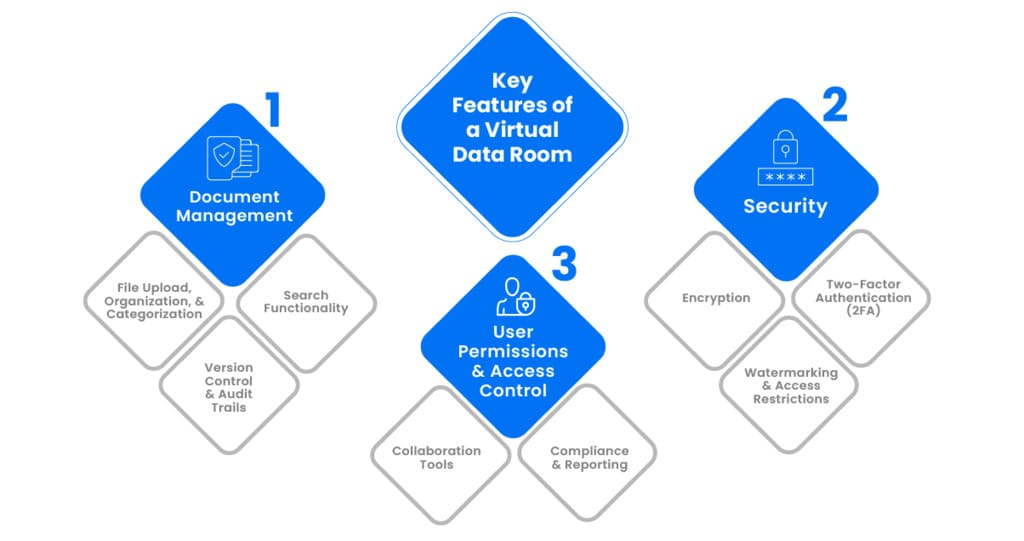
Majorly, there are three areas that VDR features fall in:
Common Use Cases for Virtual Data Rooms
VDRs are versatile enough to benefit various industries and business functions.
Mergers and Acquisitions (M&A)
M&A transactions require massive due diligence and record sharing. Virtual fact rooms ease the way by providing a consistent environment for users, vendors, and consultants.
Many organizations rely on VDRs to:
- Streamline due diligence
- Improve collaboration among deal participants
- Protect confidential corporate transaction information
Fundraising and Investor Relations
Startups and established companies typically use VDRs to share financial statements, commercial venture plans, and investor presentations with capacity buyers.
Secure file sharing also makes it possible to build trust with investors by ensuring that sensitive information remains protected.
Benefits of Using Online Data Room Providers
VDRs cost less and offer better transparency.
Increased Transparency
Virtual record rooms provide visibility into file activities, enabling companies to track stakeholder engagement with shared statistics.
Administrators can be aware of which files are receiving the most interest and proactively cope with capacity issues.
Cost Savings
Traditional physical statistics rooms have high costs related to travel, printing, storage, and administration. By using online data room, companies can also reduce operational costs by improving accessibility and efficiency.
How to Choose the Right Virtual Data Room
While choosing a VDR, just make sure it satisfies your safety and user experience demands.
Evaluate Safety Standards
Security should be the top priority when comparing online fact room carriers. Find companies that offer:
- ISO certifications
- SOC monitoring
- Data Encryption
- Secure the fact center
- Multi-sided authentication
These measures help ensure maximum security for touch data.
Evaluating User Experience
A user-friendly interface boosts productivity while requiring minimal training.
Major online statistics room carriers prioritize intuitive layout, cell accessibility, and seamless report management.
Security Features to Look For
VDRs offer many security features, including watermarks and encryption.
Dynamic Watermarks
Dynamic watermarking prevents unauthorized sharing by displaying person-precise facts in directories.
This feature is usually offered by top-rate online fact room companies and serves as an effective deterrent against data misuse.
Data Encryption
Encryption protects every piece of data throughout transmission and storage.
Organizations should prioritize online statistics space vendors that utilize advanced encryption standards to secure individual business enterprise statistics.
Industries That Benefit from Virtual Data Rooms
Major industries with clear use cases for VDR are finance, legal, and regulatory areas.
Financial Services
Banks, financial institutions, and private equity firms use VDRs to securely handle:
- Due diligence
- Fundraising
- Compliance strategies
Financial institutions usually partner with reliable online fact room providers to handle sensitive economic records.
Legal and Compliance
Law firms manage large volumes of exclusive files and require static collaboration tools.
Virtual fact rooms help prison experts securely organize case files, percentage files, and maintain compliance requirements.
Future Trends in Virtual Data Rooms
More sophisticated attacks and AI are going to impact the VDR situation even more in the future.
Artificial Intelligence Integration
AI is changing VDR through:
- Automated report classification
- Intelligent search
- Predictive analytics
Many online fact room providers incorporate AI to improve person reports to boost efficiency.
Pay more attention to cybersecurity
Cybersecurity threats are getting more complex. Future virtual reporting agencies will likely include advanced case detection, behavioral analytics, and access to more robust monitoring.
Businesses can expect VDR providers to invest heavily in next-gen security technology.
Conclusion
VDRs are now essential to manage sensitive enterprise information and high-value transactions. Whether facilitating mergers and acquisitions, collections, prison appeals, or compliance audits, VDR provides a stable and green environment for handling sensitive records.
Choosing the right online data room carriers can dramatically increase operational efficiency, strengthen data protection, and enhance transaction timelines. By assessing security needs, usability, compliance efficiency, and customer service, companies can choose an answer that fits their specific needs.
As the generation evolves, online statistical space carriers will play an increasingly important role in helping groups navigate complex transactions to maintain the highest reaches of security and compliance.
FAQs
Ans: A virtual data room is a static online platform used to store, manage, and share unique business documents, sometimes in transactions and collaborative work.
Ans: Online fact room companies provide specialized security features, compliance tools, and records management capabilities that help companies protect sensitive records in the course of essential business activities.
Ans: Virtual fact rooms are often used by funding banks, law firms, startups, non-public limited companies, healthcare companies, and companies involved in mergers, acquisitions, and fundraising.
Ans: Yes, the candidates are allowed to enroll in BSF after 12th through the Constable (GD) and Tradesman and some posts of Head Constable. Positions at officer levels require graduation and competitive tests.
Ans: Consider elements including security certifications, ease of use, customer service, pricing, scalability, compliance standards, and being features when comparing online data room companies
Ans: Industries that include finance, healthcare, prison services, real estate, technology, and manufacturing typically use virtual information rooms to manage tactile information securely.







© 2026 allinsider.net All rights reserved