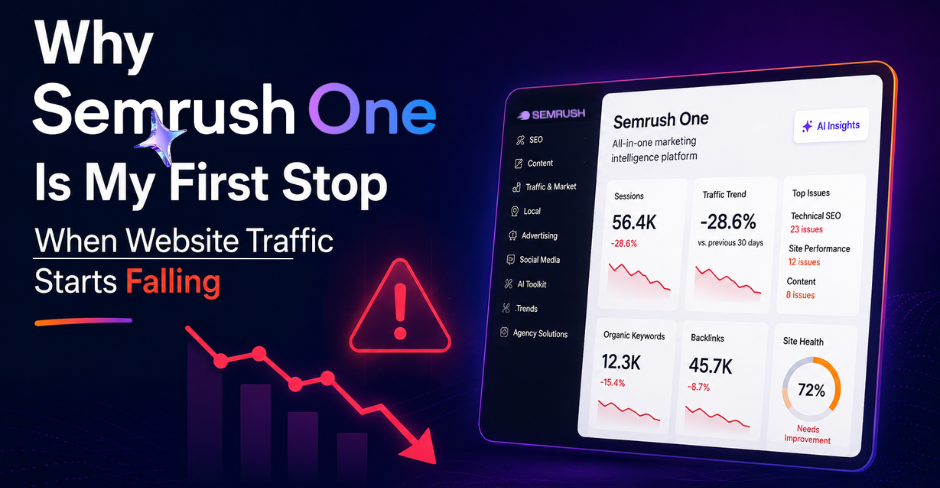
Why Semrush Is My First Stop When Website Traffic Starts Falling
**This post is sponsored by Semrush. When you purchase through links in this article, we may earn an affiliate commission from Semrush.**
Nothing is more concerning for an individual who has spent relentless hours on their website than seeing their traffic head in a different direction.
One moment everything seems fine, and the next moment circumstances are entirely different.
It is easy to jump to conclusions in such cases, such as blaming the competitor’s strategy or the search engines’ algorithms, etc. But what stays tough is the way finding the actual cause, which is not always straightforward.
Because once you know the cause, you can spend more time fixing it rather than looking fo it. Here is an article to help you with that!
Key Takeaways
- A drop in website traffic does not always mean your SEO strategy is failing; changes in AI-powered search can also reduce clicks.
- Compare computer traffic with past performance to separate seasonal trends from genuine traffic losses.
- Analyze page-level performance to identify which pages are losing visibility and why.
- Build a data-driven recovery plan by addressing technical issues, refreshing content, and improving visibility instead of reacting to every SEO trend.
Step 1: Confirm That Traffic Really Has a Problem
The first step is surprisingly easy to overlook.
Before changing pages or rewriting content, compare your recent performance with previous months and the same period last year.
Now the way to do so can differ based on the industries.
A travel website, for example, may slow down after the holiday season, while tax-related content often peaks during specific months.
But if the decline is constant, then there is a problem.
Step 2: Find the Pages That Lost Clicks
Rather than looking at your website as a whole, narrow your focus.
Locate the roots of the problem : Which pages lost the most traffic? Were they blog posts? Product pages? Or Buying guides?
Looking at page-level performance usually reveals patterns.
This is where Semrush becomes particularly useful.
Beyond traditional keyword rankings, it helps you understand whether those pages are losing visibility because competitors improved their content, search intent changed, or AI-generated answers are reducing clicks.
Step 3: Compare Your Visibility with Competitors
One of the mistakes many website owners make is focusing only on their own analytics.
Traffic doesn’t exist in a vacuum.
If several competitors are experiencing similar declines, the issue may be tied to broader changes in search behaviour.
Let’s understand like this: If your website is losing visibility, start by understanding what other websites are serving extra.
Traditional SEO reports tell you where competitors rank.
The AI Visibility Toolkit goes a step further by showing how often brands appear in AI-generated answers across platforms, including Google AI Mode, AI Overviews, ChatGPT, Gemini, and Perplexity.
Sometimes your rankings haven’t changed much at all. The real difference is that another brand is being recommended more often by AI assistants.
Step 4: Look Beyond Rankings
One of the biggest misconceptions in SEO is that rankings tell the entire story.
They don’t.
That is why visibility has become just as important as rankings.
Semrush helps connect those dots by combining traditional SEO data with AI visibility metrics in one platform.
A brand’s reputation is no longer dependent on
- prompt mentions
- citation sources
- competitor activity
- and how accurately AI platforms represent their brands.
These insights simply weren’t part of most SEO workflows a few years ago, but they are becoming increasingly valuable as AI search continues to grow.
For readers who are new to the platform, the Getting Started with Semrush: A Tutorial for Navigating the Essentials guide is an excellent companion.
Think of it as your first guided tour ofthe platform. It introduces the essential tools, reveals where to uncover valuable reports, and helps you feel comfortable.
Step 5: Build a Recovery Plan Instead of Chasing Every Trend
Once you’ve identified why traffic is falling, the next steps become much clearer.
Technical issues should be fixed before publishing new articles.
The important thing is to avoid making dozens of changes at once.
SEO improvements are much easier to measure when you solve one problem at a time.
No platform can recover traffic overnight, and no single tool answers every question.
That is where Semrush fits naturally.
It combines :
- keyword research
- competitor analysis
- backlink data
- technical SEO
- and AI visibility into one place, making it easier to understand what changed before deciding what to fix.
Traffic drops can feel alarming, but they don’t have to lead to panic.
The businesses that recover the fastest are usually the ones that investigate carefully instead of reacting emotionally. They ask better questions, rely on accurate data, and make decisions based on evidence rather than guesswork.

Conclusion
If your website has recently lost traffic and you want a clearer picture of what’s really happening, take the time to explore Semrush and work through this process yourself.
Before fixing lost visibility, you need to understand why it disappeared. In today’s evolving search landscapes matters more than jumping from one conclusion to the other.
FAQs
Ans: No, AI will not replace SEO; it is evolving it. AI tools automate tedious SEO tasks like keyword research and metadata generation.
Ans: The golden rule of SEO is to create great quality content that your audience will get great value from.
Ans: Traffic without sales usually means your store has friction or the wrong audience. To fix this, audit your site analytics to find exactly where visitors are abandoning their carts, and ensure your marketing message matches the expectations of your target buyer.
Ans: Ranking #1 on Google requires optimizing your content for both traditional search engines and AI models.