5 Supply-Chain Lessons Every Hardware Startup Should Keep for the Next Crisis
Jump To Key Section
- The 18-Month Wake-Up Call
- A Founder’s Flashback: “We Shipped Empty Boxes Once”
- Lesson 1 — Model Demand Around Capacity, Not Dreams
- Lesson 2 — Court Multiple Distributors Before You Need Them
- Lesson 3 — Build Financial Buffers for Silicon Price Spikes
- Lesson 4 — Treat Transparency as Currency Inside Your Ecosystem
- Lesson 5 — Follow the CapEx Money to Predict the Next Bottleneck
- Implementation Checklist
- Caveats & Counterpoints
- Conclusion: Designing for Resilience, Not Perfection

A major hardware logistics disruption has become a common occurrence every half a decade now. You all remember the semiconductor squeeze of the early 2020s. Well, now we’re looking at another one due to AI data centers claiming all GPUs and memory, inflating the demand and prices for the general market.
Big hardware corporations like Nvidia and AMD survive through these storms. But the real brunt is taken by the startups. There’s a reason that over 90% of hardware startups fail (Source).
The lean-only model doesn’t work anymore; startups rather need to operate in a resilient manner.
In this guide, I’ll list five lessons derived from previous disasters that hardware startups can learn from, toughening their operations and supply chain enough to survive the upcoming disruptions.
KEY TAKEAWAYS
- Hardware startups are the first ones to die when a disruption strikes.
- Mistakes are bound to happen when the pressure to deliver on time is high.
- Keep the realistic projections, contact with multiple suppliers, buffer funds, and a transparent chain to make your startup resistant to hardware disasters.
The 18-Month Wake-Up Call
Hardware supply chains are difficult to maintain. Too much heat or cold, fire or snow, virus outbreaks. Anything happens, and the wafer pipeline snaps. Overnight, microcontrollers that once cost US$1 quoted at US $14—if you could find them.
The after-shock wasn’t just higher COGS; it was lost market momentum, bruised brand trust, and extra capital consumed by inventory firefighting.
Industry analysts now say the worst is behind us, yet no founder should exhale fully. Capacity expansions, geopolitical rifts, and AI-driven demand surges are rewriting risk models weekly.
Treat the shortage as rehearsal; the real test will be whatever combination of shocks arrives next. The following lessons show how to build a startup-sized, resource-savvy playbook for resilience.
A Founder’s Flashback: “We Shipped Empty Boxes Once”
Rita Chang ran a wearable startup. One of the batches pushed out contained 1000 product boxes. However, there was something missing. All the products had no batteries inside them. Marketing pressure to hit the shelf on time had led to this blunder.
The plan: Air-freight batteries to stores later for staff to retrofit. It cost an extra US $42,000 in freight and labor, plus an avalanche of online mockery when keen customers discovered their devices were DOA.
The root cause wasn’t the battery shortage itself; it was Chang’s rosy demand forecast that ignored emerging capacity data.
“Had we sanity-checked lead times against global wafer and cell capacity, we’d have delayed launch a month and preserved trust,” she admits.
Her scar informs Lesson 1.
Lesson 1 — Model Demand Around Capacity, Not Dreams
Startups often pitch a dreamy financial model. An inflated total addressable market, a perfect sales funnel, and an exponential growth projection. Reality starts with foundry calendars and substrate line utilisation. Global wafer capacity is projected to jump from about 80 million (200 mm-equivalent) wafers in 2020 to 120 million by the end of 2024—a 50% surge.
Yet node-mix matters: sub-10 nm lines expand faster than legacy 90 nm analog nodes that many IoT gizmos still need.
Startup sanity-check routine
- Pull the latest capacity press releases from TSMC, Samsung, and GlobalFoundries.
- Compare your critical components’ process nodes against that roadmap.
- Track “allocation” flags on DigiKey/Mouser APIs weekly.
- Build a pessimistic scenario where lead times double; re-run runway models.
[Want a quick primer on data-driven forecasting? Read AllInsider’s overview of modern supply-chain forecasting mistakes and adapt its dashboard template to hardware metrics.]
Lesson 2 — Court Multiple Distributors Before You Need Them
As they say, never put all your eggs in a single basket. But startups have to do that as they neither have a big network nor need one due to small volume output. But fear strikes the day your only franchised partner emails “no allocation this quarter.” During the crunch, several drone startups vanished because their IMU allocation was rerouted to automotive giants with larger volumes.
Adopt a Primary-Secondary-Tertiary grid:
- Primary (franchised) – preferred for price, traceability.
- Secondary (authorised but lower tier) – used for 30% of annual demand to keep doors open.
- Tertiary (specialist, independent) – vetted partner for hard-to-find or obsolete lots.
When prototypes hinge on discontinued NOR Flash, a specialist such as ICRFQ can surface vetted stock across global warehouses and even broker last-time-buy agreements. Keep KYC docs ready and run counterfeit screening protocols, but have the relationship inked before panic season.
Distributor vetting checklist
- ISO9001 & ESD compliance certificates
- Escrow or credit insurance options
- Anti-counterfeit testing lab access
- Average RMA turnaround < 14 days
- API or EDI order integration
Lesson 3 — Build Financial Buffers for Silicon Price Spikes
The early 2020s chip crunch wiped out over US $500 billion from the industry. Price hikes and spot buys strangled cash flow completely.
Run a BOM sensitivity worksheet:
- List the top 20 cost drivers.
- Add columns for +25%, +100%, and +400% price shocks.
- Insert a probability column informed by lead-time signals.
- Calculate the reserve cash needed to absorb the worst-case spike.
To cap exposure, negotiate NCNR (non-cancellable, non-returnable) clauses that lock pricing for 12 months. Distributors like ICRFQ often structure forward-buy programs where they hold inventory against a fee: cheaper than a last-minute spot market scramble.
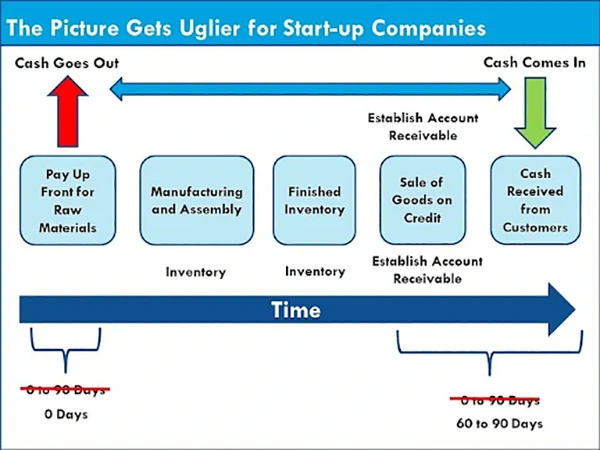
The following infographic depicts the startup’s cash flow, which is very different from that of a typical big hardware firm:
Lesson 4 — Treat Transparency as Currency Inside Your Ecosystem
When the customer demand is opaque enough, the supply chain gets confused. On top of it, geopolitics and talent gaps continue to be looming threats.
Early-stage teams can’t buy fabs, but they can share data:
- Invite key suppliers into a read-only MRP portal with 12-month forecasts updated weekly.
- Expose planned engineering changes early to PCB and EMS partners.
- Use order-status webhooks so downstream teams see shipment slippage instantly.
One robotics startup that opened its Airtable inventory board to partners trimmed safety stock by 20% within a quarter, freeing much-needed cash for R&D.
Lesson 5 — Follow the CapEx Money to Predict the Next Bottleneck
Big chipmakers are investing large CapEx due to shortages and high demand from AI firms. But CapEx announcements are breadcrumbs. Node ramps shift shortages elsewhere—often to substrates, ABF film, or advanced packaging capacity.
Subscribe to:
- Foundry investor calls & 10-K filings (keywords: “capex”, “substrate”, “OSAT”).
- Taiwan and Korean trade-journal RSS feeds.
- SEMI equipment shipment indices.
Plot investments against your component list. If 3 nm logic explodes but older 40 nm microcontrollers stagnate, expect legacy nodes to tighten again around 2026—exactly when your Gen 3 product may scale.
Implementation Checklist
A simple checklist can protect your startup from supply chain disruptions:
- Capacity sanity-check → Ops lead, monthly → KPI: forecast error < 15%.
- Distributor grid live → Production network manager, Q1 → KPI: ≥ 2 active POs/month with secondary source.
- BOM sensitivity reserves → CFO, next board meeting → KPI: cash buffer covers 6 months worst-case delta.
- Transparency portal live → Engineering, 30 days → KPI: supplier OTIF > 95%.
- CapEx watchlist → Product manager, quarterly → KPI: memo flagging high-risk nodes 18 months out.
Download a Google Sheet version of this tracker from the AllInsider Resources hub.
Caveats & Counterpoints
Hardware manufacturing for automotive and defense is highly regulated. The compliance requires approvals like PPAP and ITAR. This greatly limits supplier choice.
Multisourcing could add months of re-qualification. Hyper-scaling transparency may also expose proprietary volumes; use NDAs and tiered data access.
Conclusion: Designing for Resilience, Not Perfection
At the end of the day, forecasts are just projections, not a certain future. Financially, logistically, and relationally resilient architectures win in the long term. Start small: audit one critical SKU this week, spin up a secondary quote, and log its real lead time.
Each micro-habit you add stacks optionality for the next crunch. When the next “perfect storm” hits, let other founders refresh portals at 3 a.m. while you sleep, knowing your supply chain already baked in the lesson.
Ans: Plan, Source, Make, Deliver, Return.
Ans: Unpredictable demands, global disruptions, rising operational costs, labor shortage, and speedily advancing tech.
Ans: Diversity suppliers and keep a robust quality control.