AI SEO Tools vs Traditional SEO Platforms: What’s Changed in 2026

Traditional SEO has maintained its foothold for many decades, and nobody could predict its doom, but the truth is: it’s happening as we speak.
AI-powered SEO tools are gaining ground rapidly. Not just because AI is the buzzword, but the on-ground situation demands it. As per Search Engine Land, about 60% of searches now end without clicking any SERP link.
Traditional SEO platforms still have a trump card in their sleeves: their large datasets. On top of it, they’re also integrating many AI tools to compete with the modern AIO platforms.
But it’s just a matter of time before AI-powered SEO catches up with the data part.
At the moment, the picture is getting blurred about which one is a traditional SEO platform and which one is an AI SEO tool.
In this article, I’ll give a commentary on the present situation around traditional and AI-powered SEO. Discussing the conceptual differences of both, the following sections compare some popular platforms, so you can make an informed choice.
KEY TAKEAWAYS
- People shifting to platforms like ChatGPT and Gemini have raised the demand for AI SEO tools.
- Traditional SEO tools are also catching up by integrating AI features.
- The line between the two types of platforms is blurring fast.
- At the moment, choose a balanced tool that has enough database along with the necessary AI features.
What Traditional SEO Platforms Do Well
Traditional SEO platforms have data on their side:
- Semrush has a 25 billion keyword database.
- Ahrefs crawls 8 billion pages daily for its backlink index.
- Moz pioneered Domain Authority as a metric that shaped how the industry evaluates websites.
These platforms provide historical data depth, granular filtering, and reporting flexibility that newer tools are still building toward.
The strengths of traditional platforms are:
- Years of historical data
- Established methodologies
- Deep integrations with Google Analytics, Search Console, and third-party tools.
For enterprise teams managing complex SEO campaigns, that infrastructure matters.
What AI SEO Tools Add to the Equation
AI-native platforms are good at intelligent operations and automation. Earlier, you got the data but had to analyze it manually. Now, AI does that for you. Keyword clustering happens automatically using SERP overlap analysis. Intent classification uses NLP models trained on millions of queries. Content generation and optimization happen within the platform, reducing the tool-switching that slows traditional workflows.
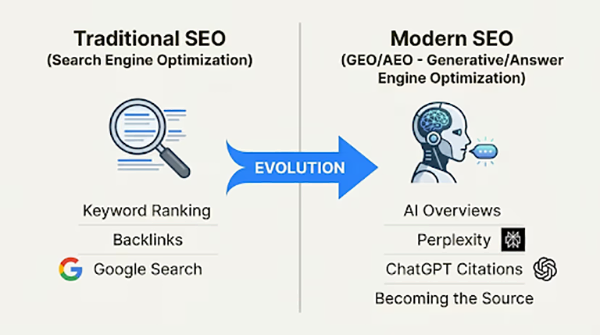
The most significant addition is AI search visibility tracking. As search queries increasingly receive GenAI answers from ChatGPT, Perplexity, and Google’s Gemini, AI-first platforms like Ubersuggest have built monitoring tools for these channels. Traditional platforms are still catching up to this capability.
The evolution is perfectly depicted in the following infographic:
Head-to-Head: 6 Platforms Compared
Let’s compare the six most popular SEO platforms from either side to get a better understanding of the situation.
1. Ubersuggest, AI-First Full Suite
- Best For: Teams that want a complete AIO tool covering keyword research through GEO at an affordable price point.
- Key Strengths: 100M+ keyword database, AI-powered clustering, automated audits, rank tracking, AI Writer in 63 languages, competitor and backlink analysis, and AI Search Visibility monitoring for ChatGPT, Perplexity, and Gemini.
- Pricing: Free tier, Individual $29/month, Business $49/month, Enterprise $99/month. Lifetime deal available.
- Standout Feature: GEO. It also tracks traditional rankings and AI search citations in the same dashboard.
- Why It Made Our List: Ubersuggest represents the AI-first approach at its best: automated analysis, integrated content creation, AI search monitoring, and accessible pricing. It does not match Semrush’s database size or Ahrefs’ backlink depth, but for most teams, its coverage is more than sufficient, and the AI capabilities it adds are features those traditional platforms do not yet match at this price.
Case Study: E-commerce Brand
A mid-size e-commerce brand restructured its strategy using Ubersuggest’s AI-powered keyword clustering and content recommendations. Within six months, organic traffic increased by 143%, and the cost-per-acquisition from organic search dropped by 62%.
2. Semrush, Traditional Platform Embracing Artificial Intelligence
- Best For: Enterprise teams needing mostly data with some AI sprinkled on top.
- Key Strengths: 25B+ keyword database, 140+ tools, Copilot assistant, position tracking, backlink audit, content optimization, PPC, and social tools.
- Pricing: Starts at $139.95/month.
- Standout Feature: Database depth combined with AI Copilot, Semrush pairs the largest keyword database with an AI assistant that surfaces insights and recommendations proactively.
- Why It Made Our List: Semrush is the strongest example of a traditional platform successfully integrating artificial intelligence. The Copilot feature adds intelligent recommendations to an already powerful data set. The cost remains a significant barrier for smaller teams.
3. Ahrefs, Traditional Data Leader
- Best For: SEO professionals who prioritize backlink intelligence and link analysis over automation.
- Key Strengths: Largest live backlink index, Keywords Explorer with clickstream data, Content Explorer, site audit, and rank tracking.
- Pricing: Starts at $129/month.
- Standout Feature: Backlink data.
- Why It Made Our List: Ahrefs remains the gold standard for backlink data. Its AI features are more limited than Ubersuggest or Semrush, but the core data product is unmatched for link-focused strategies.
4. Surfer SEO, AI-First Content Tool
- Best For: Content teams, as the artificial intelligence helps generate and optimize content.
- Key Strengths: Content Editor with NLP scoring, Surfer AI auto-writer, SERP Analyzer, and keyword clustering.
- Pricing: Starts at $89/month.
- Standout Feature: AI-powered content creation, Surfer combines optimization scoring with an AI writer, making it a production tool rather than just an analysis tool.
- Why It Made Our List: Surfer is AI-first in its content workflow. It does not provide keyword databases or site audits, so it works best alongside a full-suite tool.
5. Moz, Traditional Pioneer
- Best For: Teams who value DA.
- Key Strengths: Keyword Explorer, Link Explorer, site crawl, rank tracking, and Domain Authority scoring.
- Pricing: Starts at $99/month (Standard).
- Standout Feature: Domain Authority, a widely referenced metric that Moz created and continues to maintain as an industry benchmark.
- Why It Made Our List: Moz was the pioneer of accessible SEO tools. Its DA metric remains influential. However, its AI capabilities trail both AI-first platforms and other traditional tools like Semrush.
6. Frase, AI-First Content Briefs
- Best For: Writers who need rapid content brief generation without a full SEO platform.
- Key Strengths: AI brief generator, question research, and content editor with optimization suggestions.
- Pricing: $15+/month.
- Standout Feature: Brief generation speed, the fastest keyword-to-outline tool available.
- Why It Made Our List: Frase is the leanest AI-first tool on this list. It excels at one function: getting from keyword to content brief quickly. It does not compete as a full SEO platform.
Comparison Table
The following table gives you an easier-to-grasp overview of the SEO situation. Read it carefully and choose the tool that best fits your needs.
| Tool | Best For | Core Strength | Pricing | Free Plan | Best Team Size | AI Writing |
| Ubersuggest | SMBs & beginners | AI Search Visibility | Free / $29-99/mo | Yes | Solo to mid-size | Yes (63 langs) |
| Semrush | Enterprise teams | Database depth | $139.95+/mo | Limited | Mid to enterprise | Yes |
| Ahrefs | Link builders | Backlink index | $129+/mo | Limited | Mid to enterprise | Limited |
| Surfer SEO | Content optimization | On-page scoring | $89+/mo | No | Content teams | Yes |
| Moz | DA benchmarking | Domain Authority | $99+/mo | Limited | Mid-size | No |
| Frase | Content briefs | AI content briefs | $15+/mo | Trial | Solo writers | Yes |
The Verdict: Which Approach Wins?
The truth is, at the moment, you cannot survive with just traditional SEO at your helm. Yes, they win on the data front, but AIO is changing the picture rapidly. AI-first platforms help you with automation, speed, content creation, and AI search visibility — capabilities that traditional tools are still building.
For most teams in 2026, the AI-first approach delivers better value. The data gap between AI-first and traditional platforms has narrowed significantly. Ubersuggest’s 100M+ keyword database covers the needs of 90%+ of SEO campaigns. Meanwhile, the automation gap, AI clustering, content writing, and search monitoring run in the opposite direction. AI-first tools do things that traditional platforms cannot yet match, while traditional platforms provide data that most teams do not fully utilize.
Conclusion
As already stated, the line between AIO tools and traditional SEO platforms is blurring fast.
Traditional platforms are adding AI. AI-first platforms are deepening their data. But the tools that started with artificial intelligence at their core, particularly Ubersuggest, which combines a full feature suite with GEO at $29/month, are better positioned for where search is heading.
In 2026, prioritize AI capabilities: automated clustering, content generation, intent classification, and AI search monitoring. These features deliver the time savings and strategic intelligence that justify the subscription. The data-only era of SEO tools is over.