What Should You Check Before Choosing a Humanoid?
Selecting a humanoid robot often begins with a clear testing of what the system can physically do, how intelligently it can perceive and act, and what it will cost to operate over time. A good buying decision actually matters more than appearance or demo videos. You have to test its mobility, joint design, stability, payload, manipulation capability, software openness, and safety systems.
For research, service, interaction, or performance applications, these details directly affect deployment success. The right humanoid should match your real tasks, support future development, and stay reliable in day-to-day use instead of only performing well in controlled demonstrations or marketing showcases.
1. Evaluate Physical Performance and Hardware Capabilities
Check physical performance and hardware capabilities before anything else.
Mobility, Degrees of Freedom, and Movement Stability
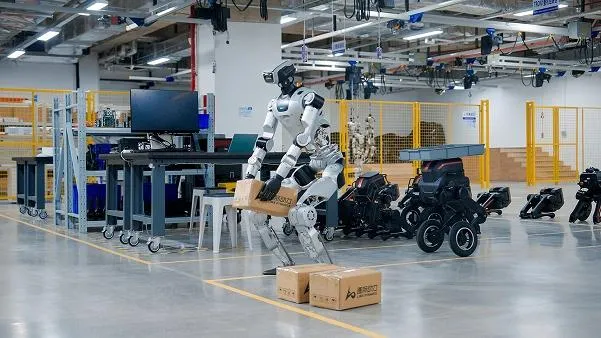
Begin by checking how naturally and reliably the humanoid moves. Mobility is not just about walking speed; it includes balance recovery, posture transitions, turning, terrain management, and stability during interaction. Degrees of freedom are important because they determine how closely the robot can reproduce human-like motion. LimX Oli is a full-size humanoid robot at 165 cm tall with up to 31 DoF, giving it a wider range of postures and movement options for research and service scenarios. Its self-developed 6-axis IMU is designed for stronger anti-interference performance and minimized drift, which supports steadier motion control. Also assess whether the robot can function and transport easily, since practical deployment usually matters as much as raw movement capability.
Payload Capacity, Dexterity, and End-Effector Options
A humanoid may walk well but still fail at helpful work if its arms, hands, or tool interfaces are limited. Check the payload each arm can manage, the precision of hand and wrist movement, and whether the robot supports different end-effectors for grasping, carrying, pressing, or specialized task execution. Dexterity matters for close-range manipulation, not just easy pick-and-place motions. Review joint responsiveness, repeatability, and control smoothness when interacting with people or objects. You should also confirm whether hardware and electrical interfaces allow future upgrades as application requirements change. A flexible manipulation platform is more important than a robot that performs one scripted action well but struggles with varied, real operational tasks.
2. Assess AI Capabilities and Development Flexibility
It’s important to assess AI capability and development flexibility:
Perception, Computing Power, and Autonomous Task Execution
AI capability should be evaluated by how well the humanoid senses its environment, processes data, and acts without constant human intervention. Review onboard computing architecture, sensor placement, and support for autonomy in navigation, manipulation, and interaction. LimX Oli uses independent compute for motion control and perception, which offers developers a stronger platform for advanced algorithm research. It includes a head-mounted Intel® RealSense™ D435i for wider environment perception and autonomous navigation, plus a chest-mounted D435i for close-range manipulation, human-robot interaction, and obstacle avoidance. With support for external sensors, for example, LiDAR and extra cameras, the system can be expanded for more demanding workflows in complex environments and dynamic application settings.
Software Compatibility, APIs, and Custom Development Support
A humanoid becomes far more helpful when your team can build on it without fighting closed tools or limited documentation. Check whether the robot provides accessible APIs, software development kits, electrical interfaces, and support for custom models, workflows, or knowledge bases. LimX Oli offers USB interfaces supporting 3.0 and 3.2 protocols, helping simplify external device integration. It also supports a self-developed voice interaction system with bilingual Chinese and English conversation and voice control, while custom knowledge bases can be uploaded for particular scenarios. For rapid content creation, Studio software enables intuitive no-code choreography, and the dance library supports OTA updates. This combination is important for teams balancing research flexibility, interaction design, and deployment speed.
3. Check Safety, Reliability, and Long-Term Operating Costs
Safety is important for long-term operating costs.
Safety Mechanisms, Battery Life, and Maintenance Requirements
Before picking a humanoid, confirm that safety has been designed into both hardware and daily operation. Review obstacle detection, fall prevention, stable control during human interaction, emergency stop functions, and safe close-range manipulation behavior. Battery life is also important because short runtimes can actually limit demonstrations, testing cycles, and service use. Maintenance requirements should be equally clear: ask about calibration frequency, replaceable components, software update procedures, and expected downtime. A practical robot should support repeatable operation without constant specialist intervention. Systems that are easy to move, store, and set up can also minimize handling risks and labor demands. Reliable operation is not a bonus feature; it is a core part of deployment readiness.
Scalability, Technical Support, and Total Cost of Ownership
The purchase price is only one part of the decision. You should check total cost of ownership by including software support, spare parts, maintenance labor, operator training, battery replacement, and future expansion costs. Scalability matters if you plan to shift from one pilot unit to broader deployment across research, education, service, or entertainment scenarios. Check whether the vendor provides responsive technical support, documentation, update pathways, and integration guidance for external hardware and custom development. Also look at operational efficiency. A humanoid that allows single-person setup, compact transport, and faster content updates can lower ongoing costs significantly. Strong support and manageable operating overhead usually determine long-term value more than the initial hardware specification sheet alone.

Conclusion
Before selecting a humanoid, focus on the factors that directly affect real deployment: stable mobility, enough degrees of freedom, usable manipulation, strong perception, open development options, built-in safety, and sustainable operating costs. A good system should not only look capable during a demonstration but also support your real workflows, team skills, and future expansion plans. LimX Oli shows why these checkpoints matter, combining full-size hardware, up to 31 DoF, independent computing for motion and perception, flexible sensor integration, and practical tools for interaction and choreography. The best pick is the humanoid that fits your application with the least friction over time. Use these evaluation points as a checklist, and you will make a more confident, technically sound purchasing decision.
FAQs
- What are female androids called?
Ans. Female androids are called gynoids.
- What are the key features of humanoid robots?
Ans. Some of the key features og humanoid robots are hybrid walking, self-recovery, audio and speech modules.
- What is another name for humanoid?
Ans. Another name for humanoid is robot or biological creature.