Top 5 Software Development Companies in Eastern Europe Worth Hiring in 2026

Eastern Europe has quietly transformed into one of the strongest regions for software development companies, with the talent density increasing every year.
The real challenge isn’t whether the region delivers quality but about knowing which firm actually aligns with your tech stack, communicates well across time zones, and ships clean, documented code that won’t require a complete overhaul six months later.
After reviewing multiple options across Clutch, G2, and company websites, this guide narrows down the list to five firms worth serious consideration in 2026.
The Research Approach for This Ranking
Public information drove all decisions here. User reviews, verified case studies, platform ratings, and official company sites were all pulled and cross-referenced. Only companies with a traceable record of delivering real software projects made the cut.
→ See the full research breakdown
- Netcorp Software Development Company – Best for nearshore team extension and full software project delivery
- Shore Teams – Best for nearshore and offshore software development teams
- Slingshot – Best for enterprise software development, startup development, and custom options
- Belitsoft – Best for enterprise custom software development and IT staff augmentation
- Intel Vision – Best for custom software development and team augmentation
Why Software Development Companies Matter for Your Business
Choosing the wrong development partner doesn’t just slow a project down. It can set a product back by months and burn through the budget earmarked for growth.
The trickiest part is identifying genuine skill before signing anything. A company can list twenty technologies on their website and still lack the depth your specific stack requires.
Communication gaps make it a lot worse. Time zone differences and unclear handoff processes turn simple feedback loops into week-long delays.
Specialized firms with documented experience in similar domains tend to avoid those patterns. They are aware of the edge cases, the compliance considerations, and the architecture decisions that trip up less experienced teams. That transitions directly to better on-time delivery rates, stronger client retention, and fewer surprises when the final invoice lands.
Top 5 Software Development Companies Breakdown and Comparison
Note: All data in this table is sourced from review platforms and the official websites of the listed companies.
| Company Name | Headquartered In | Rating |
| Netcorp Software Development Company | Estonia | 4.9/5 (Clutch) |
| Shore Teams | Amsterdam, North Holland | Not listed |
| Slingshot | Louisville, KY | Not listed |
| Belitsoft | Warsaw, Poland | 4.9/5 (Gartner, GoodFirms, G2) |
| Intel Vision | Dublin, Ireland | Not listed |
- Netcorp Software Development Company – Best for Nearshore Team Extension and Full Software Project Delivery
What Does Netcorp Software Development Company Do?
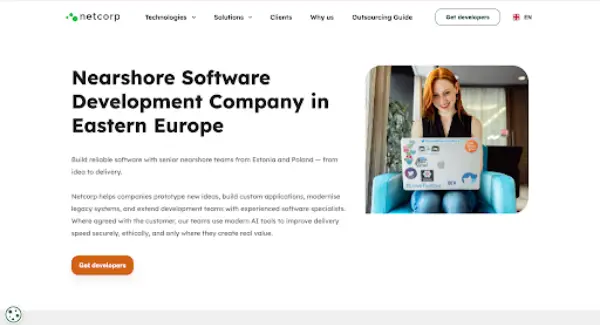
Netcorp serves as a nearshore software development partner, drawing talent from Estonia and Poland to serve clients across Scandinavia, Northern Europe, the UK, and the US. They include the full delivery spectrum, including backend, frontend, mobile, cloud, and data analytics, without asking clients to stitch together separate vendors for each layer. Their 85+ completed projects span fintech, telecom, energy, healthcare, and SaaS, which means they’re not learning your industry from scratch when a project kicks off.
Why Does Netcorp Software Development Company Stand Out for Software Development Companies?
Netcorp addresses the exact problem that limits most outsourcing relationships: the gap between a company’s stated skill and what they can actually ship on time. Their AAA® credit rating (placing them in the top 4.2% of Estonian companies) and 4.9/5 Clutch rating together display that this isn’t a firm that coasts on reputation without backing it up with results.
Summary of Real User Reviews:
Clients on Clutch often point to Netcorp’s reliability and technical depth as the reasons they come back for repeat engagements. The 4.9/5 rating doesn’t look inflated when you go through the actual feedback. Patterns around on-time delivery and code quality hold up across multiple project types, and that kind of consistency across 85+ projects is genuinely rare in this space.
- Shore Teams – Best for Nearshore and Offshore Software Development Teams
What Does Shore Teams Do?
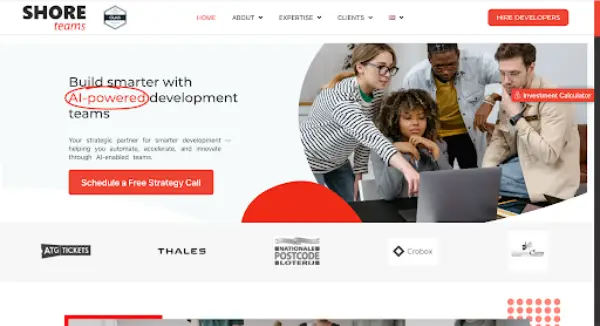
Shore Teams connects organizations with pre-built nearshore and offshore development teams through an outstaffing and staff augmentation model. Instead of running a single in-house bench, they work through a network of 500+ development partners globally, which gives them flexibility across nearly any tech stack. Their AI-enabled team-matching approach is created to get a functional team up and running in days, not months.
Why Does Shore Teams Stand Out for Software Development Companies?
Shore Teams solves the scaling issue. When a company needs developers fast but doesn’t want the overhead of a traditional hiring process, the partner-network model gets teams assembled quickly. Their funding structure, where partner network relationships include costs rather than direct client fees, is an unusual model that removes one layer of friction from the engagement process.
Summary of Real User Reviews:
Publicly available ratings aren’t listed for Shore Teams at this time, which makes independent verification though than with firms carrying Clutch or G2 scores. That’s worth factoring into any evaluation. Their model has clear structural appeal, but prospective clients should ask for direct case study references before committing to a long-term engagement.
- Slingshot – Best for Enterprise Software Development, Startup Development, and Custom Solutions
What Does Slingshot Do?
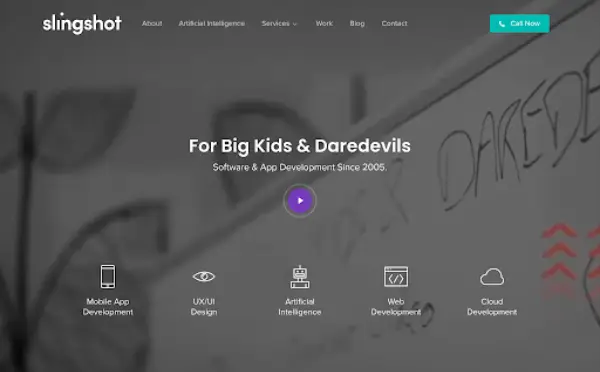
Founded in 2005, Slingshot brings strategy, design, and engineering together under a single roof rather than treating them as separate workstreams. They’ve completed 250+ projects for clients ranging from early-stage startups to Fortune 50 companies, covering AI, cloud development, enterprise software, mobile apps, UX/UI design, web development, and healthcare solutions. The integrated model means product decisions are determined with all three disciplines in the room from day one, which tends to reduce expensive late-stage redesigns.
Why Does Slingshot Stand Out for Software Development Companies?
The main problem Slingshot addresses is fragmentation. When strategy, design, and development teams don’t communicate context, the product suffers. Eighteen-plus years in the market with 250+ delivered projects across company sizes that diverse builds a kind of institutional range that’s genuinely hard to match.
Summary of Real User Reviews:
Slingshot doesn’t show public platform ratings in the available data, so direct review benchmarking isn’t possible here. The project portfolio does show real breadth across startup and enterprise segments, which suggests adaptability that client references could confirm. Any serious evaluation should start with a direct conversation about similar past projects.
- Belitsoft – Best for Enterprise Custom Software Development and IT Staff Augmentation
What Does Belitsoft Do?
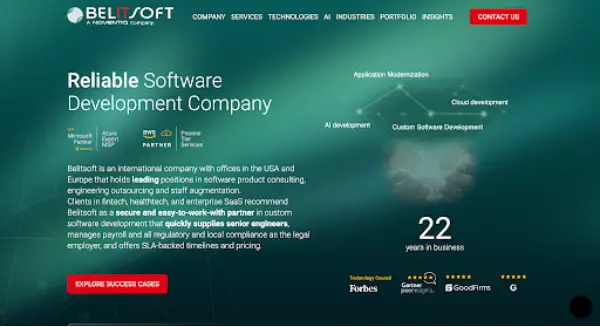
Belitsoft has been designing custom software since 2004, and two decades of market experience show in how they handle complex, long-running projects. Based in Warsaw with a team of 250 developers, they prioritize enterprise application development for financial services, insurance, manufacturing, and healthcare, alongside custom software for digital startups. Their hourly rate sits in the $30-70 range, which positions them as a cost-competitive option for clients who require serious enterprise depth without enterprise-agency pricing.
Why Does Belitsoft Stand Out for Software Development Companies?
Belitsoft targets projects exceeding 2,000 hours, which filters out clients looking for quick fixes and keeps their team occupied on the kind of deep, sustained work where they genuinely excel. A 90% post-launch client retention rate, with many relationships running 5-10 years, tells you something real about what the actual delivery experience looks like.
Summary of Real User Reviews:
Across Gartner, GoodFirms, and G2, Belitsoft holds a 4.9/5 overall rating, and that’s consistent across three separate platforms, not just one. Clients in fintech, healthtech, and enterprise SaaS keep arriving, which lines up with their reported retention numbers. That kind of multi-platform consistency is a genuine trust signal.
- Intel Vision – Best for Custom Software Development and Team Augmentation
What Does Intel Vision Do?
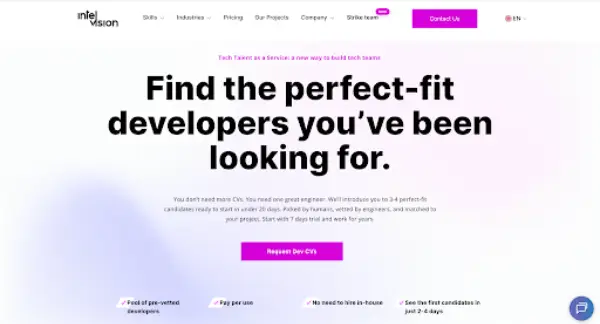
Intel Vision operates as a Tech Talent and a Service provider, matching clients with pre-vetted software developers across roles and stacks including React, Node.js, Python, and Java. Their pricing sits at €30-50 per hour, and teams can be assembled in 2-4 days with setup completed in 1-2 weeks. The vetting process accepts less than 1% of applicants (they state “top 3%” pass initial screening), which positions the firm closer to a curated talent partner than a traditional staffing platform.
Why Does Intel Vision Stand Out for Software Development Companies?
Intel Vision addresses the quality-versus-speed tradeoff that makes team augmentation risky. Most fast-deployment models sacrifice vetting depth, but their sub-1% acceptance rate suggests a different approach. An 89% team retention rate and 70% client return rate for additional teams back that claim up with numbers that are hard to dismiss.
Summary of Real User Reviews:
Client feedback shows project management quality and developer reliability as the standout traits, with case studies showing 25-40% reductions in development costs and meaningful acceleration in delivery timelines. The 3+ year average partnership length displays clients aren’t just returning; they’re staying. For the price point, that’s a compelling combination.
Research Methodology and Selection Process
Building this ranking required more than a surface-level scan of company websites. The goal was to identify firms that could be genuinely recommended to a CTO or product manager making a real hiring decision, not just companies with polished marketing pages.
Initial Data Collection
The process began by pulling together a longlist from multiple sources: software development directories, Clutch, G2, GoodFirms, and Gartner peer review pages. Company profiles were reviewed for service descriptions, client industry focus, and geographic coverage. That initial sweep produced a broader pool than what appears in the final five, which meant a structured filtering process was required to narrow things down.
Shortlisting Phase
From the longlist, options without verifiable track records were eliminated first. Companies where review patterns looked thin, inconsistent, or concentrated in a single platform got flagged for closer scrutiny. The shortlist was created around firms where the evidence of real delivery, including completed projects, client descriptions, and stated outcomes, held up across more than one source.
Verification of Claims
Each shortlisted company’s website claims were cross-referenced against what appeared in third-party reviews and case studies. When a company claimed skill in a specific technology or industry vertical, that claim was verified against the project descriptions and client feedback available publicly. Discrepancies between marketing language and review substance were considered and weighed in the final assessment.
Authority and Industry Contribution Layer
Beyond reviews, attention was paid to signals that display a company’s standing within the broader software development space. That included industry recognition, credit ratings where applicable, Microsoft partnership status, published case studies with measurable outcomes, and any mentions in relevant publications or directories. These signals don’t replace delivery evidence but add context about organizational stability and professional standing.
Software Development Companies-Specific Evidence
Finally, each company was evaluated for software development depth rather than general IT services breadth. Dedicated service pages covering backend, frontend, cloud, mobile, and data disciplines were reviewed. Verified client reviews mentioning specific technology stacks, project types, and delivery experiences were given more standing than general satisfaction scores. Case studies with defined project scopes and outcomes were treated as stronger evidence than summary testimonials. Only firms that demonstrated clear, documented capability in software development made the final list.
How to Choose the Right Software Development Companies
The right development partner isn’t just about who has the best-looking portfolio. Before signing anything, there are five areas worth evaluating carefully.
- Industry/Domain Experience: Look for firms with documented project history in your specific sector. A company that has shipped fintech products understands compliance constraints and architecture decisions that a generic team would need to learn on your timeline and budget.
- Features and Services: Check whether the firm includes the full stack you need, including backend, frontend, mobile, cloud, and QA, or whether you’ll need to bring in additional vendors to fill gaps.
- Pricing Structure: Hourly rates matter, but so does how scope changes are handled. Inquire how budget variance is managed when requirements shift mid-project.
- Results Measurement: Ask for on-time delivery rates, defect density figures, and post-launch support terms. Firms that track these numbers are often more accountable than those that don’t.
- Industry Knowledge and Compliance: For regulated sectors like healthcare or fintech, confirm the firm understands the relevant standards and has designed software under those constraints before.
Bottom Line
Eastern Europe continues to produce strong software development talent, and the five firms here showcase genuinely different models worth considering based on your project type. Netcorp stands out for nearshore reliability and a long track record. Belitsoft earns attention for enterprise depth and client retention. Intel Vision is worth a look for fast, vetted team assembly. As demand for quality development partners scales, firms that combine great technical skill with clear communication will keep pulling ahead.
FAQs
Q1) How can I choose the right software development partner?
Ans: The following are the things you should check:
- Industry experience
- Results measurement
- Pricing structure
- Features and services
Q2) Why is it important to select an appropriate partner for a business?
Ans: Choosing the wrong development partner doesn’t just slow a project down. It can set a product back by months and burn through the budget earmarked for growth, making the selection of a partner all the more important.
Q3) What does Netcorp excel in?
Ans: Netcorp stands out for nearshore reliability and a long track record, addressing the exact problem that limits most outsourcing relationships: the gap between a company’s stated skill and what they can actually ship on time.