Best Offshore Custom Software Development Companies in 2026

Alt: Offshore Software Developer
“Our industry does not respect tradition—it only respects innovation.”
– Satya Nadella (Microsoft CEO)
Nearshore outsourcing comes with comfort, but it can involve compromises on capability.
For companies building complex products, the right offshore partner is important. It can provide the engineering depth needed to turn that innovation into a system that actually works at scale. India, Eastern Europe, and South Asia offer access to large engineering talent pools and often lower development costs, but the time-zone gap demands better processes. The best offshore software development companies compensate with structured communication, documented decisions, clear milestones, and strong delivery discipline rather than expecting developers to work overnight.
What Separates a Good Offshore Partner From a Cheap One?
Rate is the basis most companies look offshore and the worst reason to pick one firm over another. The criteria that actually predict outcomes:
- Documented process over daily availability. Ask how decisions get recorded, not how late the crew will stay online.
- Fixed-price milestones. Hourly billing across a large time gap is where offshore engagements quietly go over budget.
- Genuine security certification. ISO 27001 or SOC 2 matters more offshore because you have less direct oversight of how your data is handled.
- Code ownership transferred in writing, without negotiation at the end of the assignment.
- Production experience at scale. Ask what the largest system the team currently maintains actually handles in traffic.
That final criterion is weighted most heavily in the ranking below. Plenty of firms can build a working application; far fewer have kept one running under real load. If your product is expected to grow, look for a bespoke software development team with live systems running at volume, not just a portfolio of completed launches.
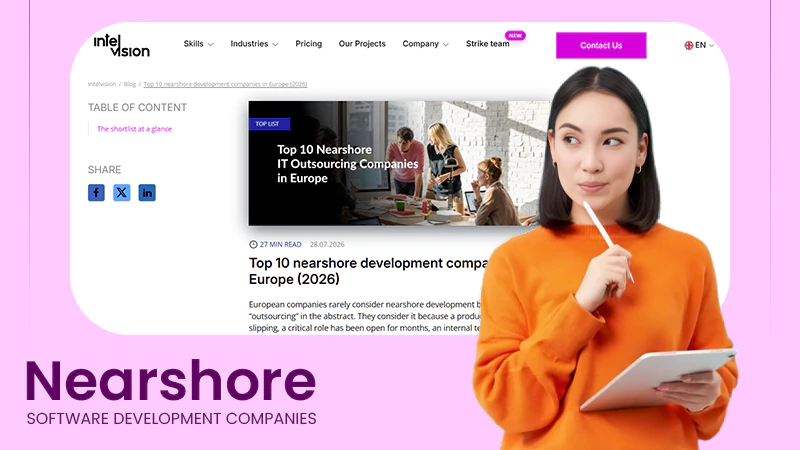
If you don’t want an offshore partner, here’s a list of top nearshore software development companies of 2026.
The 8 Best Offshore Custom Software Development Companies in 2026
Here’s the list of top 8 offshore bespoke software developers you can reliably partner up with:
1. Space-O Technologies
Space-O Technologies is a custom software development company that tops the criterion weighted most heavily here: systems that stayed up after launch. The portfolio leans toward products that had to survive real traffic. Glovo passed 100 million downloads, and the delivery marketplace Mrsool operates on comparable architecture. For a buyer weighing offshore options, that is a more useful signal than headcount, because it demonstrates systems held up under load rather than simply shipped.
The group has delivered 350+ web applications since 2010, alongside a mobile portfolio of 4,400+ apps and 500+ SaaS products. The team builds web platforms to serve mobile clients from the start through clean APIs, instead of retrofitting that layer after launch.
Engagements are structured as dedicated teams, time and materials, or fixed price, with project sizes starting at $25,000, ISO 9001 and ISO 27001 certified processes, and full source code rights transferred to the client. The team of 250+ works from India with offices in the USA and Canada, serving clients across the USA, the UK, and the Middle East.
Best for: Products expected to scale, where the first build has to survive growth
Key services: Custom software development, web and mobile app development, SaaS product development, enterprise software, and dedicated development teams.
2. Scopic Software
Scopic runs as a distributed organisation rather than a conventional offshore vendor, with engineers spread across many countries and a delivery model built around a remote-first approach from the outset. That structure suits clients who care more about consistent results than about being able to point at a single development center. The firm publishes a substantial body of technical writing, which is usually a decent proxy for engineering culture.
Best for: Firms that want a fully distributed team rather than a single offshore office
Major services: Bespoke software development, web application development, cloud development, AI development
FUN FACT
Scopic’s team comprises over 1000 experts distributed across more than 90 countries.
3. A3Logics
A3Logics provides an unusually wide service range for an India-based firm, spanning enterprise software, logistics platforms, and staffing-style engagements. That breadth suits organisations with several parallel initiatives that would otherwise require multiple providers. Buyers with a single focused product may find a more specialized partner a better match.
Best for: Enterprise buyers needing breadth across multiple technology stacks
Major services: Custom software development, enterprise software, mobile app development, IT consulting
4. Upsilon
Upsilon partners predominantly with startups and structures engagements around a discovery phase that defines the problem before development begins. Fractional CTO support is available for founders without technical leadership in place. Better suited to firms still shaping a product than to enterprises with a fixed specification.
Best for: Early-stage companies that need product judgement, not just engineering
Key services: Bespoke software development, MVP development, discovery phase, CTO as a service
5. Intellectsoft
Intellectsoft has focused on enterprise and regulated sectors, where compliance and documentation requirements shape the engineering as much as the feature set. Engagements tend to be longer and more structured than typical mid-market work. That formality is invaluable in healthcare or finance and heavy going for a small product team.
Best for: Regulated industries and enterprise-grade compliance requirements
Key services: Enterprise software development, mobile app development, blockchain, digital shift
6. SumatoSoft
SumatoSoft has built a recognizable specialism in IoT and connected systems alongside broad web and mobile work. Companies building software that has to talk to physical hardware benefit from a team that has handled device protocols and data ingestion before, which is a meaningfully different problem from conventional application development.
Suitable for: IoT and connected-device software
Key services: Custom software development, IoT solutions, web and mobile development
7. COAX Software
COAX has concentrated deliberately on travel and logistics and publishes detailed technical guides on both. That vertical concentration means the team arrives already understanding routing, fleet, and booking problems rather than learning them on the customer’s dime. Buyers outside those verticals will find the specialization less relevant.
Best for: Logistics, travel, and supply chain platforms
Key services: Bespoke software development, logistics platforms, travel technology, API integration
8. Simform
Simform runs largely on a team-extension model, embedding engineers alongside a client’s existing developers rather than taking whole projects in isolation. That works well for organisations with technical leadership already in place who need capacity, and less well for customers wanting a partner to own delivery end to end.
Best for: Companies wanting to extend an existing in-house engineering team
Key services: Team extension, custom software development, cloud engineering, product development
Offshore or Nearshore?
The decision is less about geography than about how your team makes decisions. If your product requires frequent, unscheduled conversations, and decisions get made verbally, nearshore is worth the premium. If your requirements are reasonably well defined and your firm is comfortable working from written specifications and scheduled reviews, offshore gives you a deeper talent pool and considerably more scope for the same budget.
Whichever you choose, hold the same three terms: a written scope with an explicit exclusions list, fixed-price milestones rather than open-ended hours, and unambiguous code ownership from the start. Any competent partner will accept all three without argument, and a partner who resists any of them has told you something useful.
FAQs