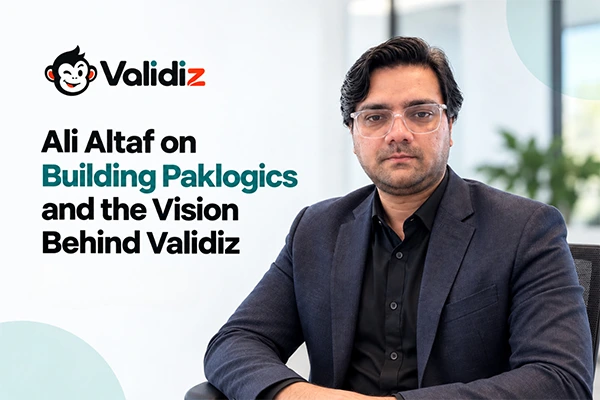
Ali Altaf on Building Paklogics and the Vision Behind Validiz
Jump To Key Section
- Building Paklogics in a Constantly Changing Technology Market
- The Growing Complexity of B2B Go-to-Market
- The Vision Behind Validiz
- Where AI Fits Into That Vision
- More Automation Does Not Automatically Mean Better Outreach
- From Building Technology to Building an Operating System for Growth
- Keeping People Focused on the Conversations That Matter
- A Different Future for the B2B Sales Stack
- The Next Chapter
- FAQs
Building a technology company for a decade can give a founder insight into how business changes. It involves changes in technologies, customers’ expectations, and new competitors entering the market too.
Ali Altaf, Founder and CEO of Paklogics, has experienced all these as he has been in the business since 2024. Paklogics started as a small venture and has slowly evolved into a technology company working across areas including AI and machine learning, web development, mobile applications, databases, cloud technologies, cybersecurity, and other digital solutions. These all happened because of experiences that now result in Validiz, an AI-powered GTM platform built around a problem that has become increasingly familiar to B2B companies.
Building Paklogics in a Constantly Changing Technology Market
When Paklogics began in 2014, the technology market seemed very different from the one businesses operate in today.
For many organizations, digital transformation heavily meant building a solid online presence, developing mobile apps, modernizing internal systems, or moving manual business processes into software.
Artificial intelligence was evolving quickly, but it had not yet become part of everyday business operations in the way it has today.
Over the years, that shifted.
Cloud infrastructure became standard. Mobile experiences became an expectation instead of an advantage. Businesses collected larger software stacks. Data became more important. Automation moved deeper into business processes.
Then generative AI accelerated another change.
Software was no longer restricted to following predefined workflows. Businesses could begin exploring systems capable of analyzing data, generating content, understanding context, supporting decisions, and managing parts of workflows that traditionally needed continuous human input.
Paklogics evolved with those changes. Today, AI and machine learning sit within its wider development capabilities as part of the technology solutions it offers to businesses.
For a founder, however, running a technology business includes more than understanding what can be built.
There is the next challenge happening at the same time:
How do you consistently find and reach the businesses that need what you are building?
That question becomes particularly important as traditional B2B acquisition becomes more competitive.
The Growing Complexity of B2B Go-to-Market
Modern B2B sales teams have no limitation on software.
A company might use one platform to detect target accounts and another to research decision-makers.
A third system offers contact information.
Another verifies emails.
Separate tools may then be needed for mailbox infrastructure, inbox warm-up, email sequencing, LinkedIn activity, reply management, CRM updates, pipeline tracking, and analytics.
Each product may solve a legitimate problem separately.
The difficulty arises when teams try to turn them into one operating process.
Data has to move between platforms. Workflows have to be designed and maintained. Representatives switch constantly between systems. Context can be lost. Activities taking place in one channel may not be shown in another.
The result is a unique contradiction in modern sales technology:
Companies have more specialized GTM tools, but managing the complete GTM workflow can still involve substantial manual work.
This fragmentation is central to the thinking behind Validiz.
The platform started with a simple issue: modern B2B GTM had become a stack of disconnected tools rather than one operating system.
Instead of creating another isolated tool for one part of outbound sales, the idea behind Validiz is to connect the work that happens between identifying the correct company and starting the right conversation.
The Vision Behind Validiz
Validiz is an AI-powered GTM platform designed around a simple idea: B2B teams should not have to depend on a collection of disconnected tools to move from identifying the correct accounts to starting meaningful sales conversations.
The application brings together the core activities that sit across the outbound process, including account discovery, decision-maker research, verified contact data, mailbox infrastructure and warm-up, email sequencing, LinkedIn outreach, reply tracking, and pipeline management.
What makes that approach essential is the connection between each stage.
Finding the right company is only useful if the team can detect the right person inside it. Good contact data matters only if the outreach infrastructure is ready to support consistent communication. Research becomes important when it improves the relevance of messaging, while replies and engagement signals become more valuable when they can directly inform the sales pipeline.
Validiz is designed to connect these activities into one continuous GTM workflow instead of treating them as separate tasks managed across different platforms.
AI plays a key role in that process. It is applied where it can reduce repetitive work and improve execution across prospect research, targeting, personalization, workflow coordination, and the evaluation of what generates a response.
The broader vision is not just to add more automation to outbound sales. It is to give B2B teams a more connected way to handle the work between finding the right company and creating the right conversation.
Where AI Fits Into That Vision
Treating Validiz as an AI-powered GTM platform does not mean applying AI to every interaction simply because the technology is available.
The more practical opportunity is using AI where it can eliminate repetitive work and improve execution.
Prospect research is one instance.
Before contacting a company, someone may need to know what the business does, whether it matches the target profile, who is responsible for the actual function, and what information could make an outreach message more relevant.
Traditionally, performing that research across hundreds or thousands of accounts has needed significant manual effort.
AI changes the economics of that work.
It can help process data at a larger scale, organize research, identify relevant context, and support personalization without needing a salesperson to manually investigate every detail from the beginning.
The same principle applies anywhere in the GTM workflow.
- AI can help with better targeting.
- It can assist with personalized messaging.
- AI can help coordinate workflows.
- It can reduce some of the repetitive work involved in moving prospects through different stages of an outbound campaign.
And as campaigns run, AI can help teams learn from the signals created by their outreach, including what gets attention and what gives responses.
The aim is not simply to automate more activity.
It is to make the whole process more intelligent and more connected.
More Automation Does Not Automatically Mean Better Outreach
AI has also created a new obstacle for outbound sales.
It has made it very easy to create more content.
A sales team can create hundreds of emails in a fraction of the time previously required to write them manually. Businesses can make campaigns faster. Basic personalization can be added almost immediately.
But when everyone can create outreach at scale, volume itself becomes less valuable.
The recipient still has to care.
A prospect getting an email is unlikely to respond simply because their company name, position, or industry has been put into an otherwise generic message.
Effective personalization needs relevance.
- Why does this particular company fit the target profile?
- Why does this particular person matter within the account?
- What business context makes the conversation worth starting?
- Why should the prospect pay attention now?
Those questions cannot be solved simply by generating more words.
They need better information and better targeting before the message is ever sent.
That is another reason connecting the different stages of GTM matters.
- Research influences targeting.
- Targeting influences messaging.
- Messaging influences responses.
Responses create data that can help in future execution.
When these activities happen inside disconnected systems, it becomes difficult to create a continuous learning process between them.
An AI-powered GTM platform can potentially make those connections more useful by letting intelligence collected at one stage inform what happens at the next.
From Building Technology to Building an Operating System for Growth
There is a basic difference between Paklogics and Validiz.
Paklogics is a technology services company that creates digital solutions across multiple areas and industries.
Validiz is a product focused specifically on B2B go-to-market execution.
But there is also a connection between the two.
Both reflect a problem-first strategy to technology.
Building software for businesses requires understanding more than a technical need. The system ultimately has to fit into the way a company works and create a meaningful business outcome.
The same logic applies to GTM software.
Finding a list of prospects is not the result. Neither is verifying an email address. Sending a sequence is not the outcome either.
The business actually wants to identify the right organizations, reach the right people, begin relevant conversations, and convert some of those conversations into actual opportunities.
Validiz is therefore being built around the workflow instead of a single isolated step within it.
That distinction shows a larger direction in business software.
For years, SaaS companies created specialized applications for individual activities. Businesses responded by assembling increasingly large software stacks.
AI now creates the possibility of the next model: platforms that can understand more context and coordinate more of the work across those individual activities.
The question changes from:
“Which tool do we need for this task?”
to:
“How much of this entire workflow can operate intelligently within one system?”
Validiz is being developed around that second question.
Keeping People Focused on the Conversations That Matter
There is another crucial consideration when discussing AI in sales.
Not every part of selling should be kept as a repetitive process.
Research can be accelerated. Data can be verified automatically.
Routine follow-ups can be coordinated.
Large sets of accounts can be analyzed far more efficiently than a person could process them manually.
But B2B relationships often involve complexity.
- A prospect may raise a problem that was never expected in the original campaign.
- A potential customer may have many stakeholders with different priorities.
An enterprise deal may need extensive discovery, negotiation, technical consultation, and trust between the organizations involved.
These are not simply data-processing issues.
The more important role for AI may therefore be removing the operational work surrounding those conversations so people can spend more time engaging in them.
That creates a different way of thinking about sales automation.
The goal is not to remove the human salesperson from every stage.
It is to reduce the amount of human time taken by work that does not require human judgment.
If research, targeting, data management, outreach coordination, and routine workflow management become more efficient, salespeople can concentrate their attention where it has greater value: understanding issues, building relationships, handling objections, and moving qualified opportunities forward.
A Different Future for the B2B Sales Stack
The B2B sales stack is not going to disappear overnight.
Companies have already existing CRMs, established processes, specialist tools, internal data, and workflows that cannot just be replaced every time a new technology emerges.
But the direction of the market is shifting.
Businesses are increasingly asking AI systems to perform work instead of merely providing another interface through which employees perform it themselves.
That change could have significant implications for GTM teams.
Rather than representatives manually coordinating six or seven products to execute one campaign, more of those tasks may eventually be orchestrated through connected AI-powered platforms.
- Prospecting can inform research.
- Research can inform personalization.
- Engagement data can inform follow-ups.
- Replies can update opportunity status.
- Performance can inform what the system does next.
The value comes from the connection between those activities.
That is the larger opportunity Validiz is chasing as an AI-powered GTM platform.
The Next Chapter
Paklogics has continued to develop alongside the changing technology needs of modern businesses. Its functions have expanded across web and mobile development, cloud technologies, AI, and machine learning, showing the broader shift toward more intelligent, scalable, and connected digital solutions.
Validiz shows another part of that evolution for Ali Altaf.
The starting point is not just that AI has become powerful enough to generate sales emails or automate separate tasks.
The deeper issue is that B2B go-to-market has become fragmented.
Companies have collected tools for prospecting, data, infrastructure, messaging, outreach, replies, and pipeline management, while their teams stay responsible for connecting those systems into a functioning process.
Validiz is being developed around a different model: an AI-powered GTM platform that brings those activities into one connected operating layer and applies AI where it can remove manual work, improve execution, and help teams learn from the results of their outreach.
For Altaf, that makes Validiz less of a departure from the experience of building Paklogics and more of a principle that has shaped the journey from the beginning.
Technology is most important when it simplifies a real business problem.
With Paklogics, that has meant developing digital infrastructure for organizations navigating technological change.
With Validiz, the focus is now on another issue businesses are trying to solve:
how to find the right companies, reach the right decision-makers, and start the right conversations without managing an increasingly fragmented GTM stack.
FAQs
Ans: Paklogics started as a small venture and has slowly evolved into a technology company working across areas including AI and machine learning, web development, mobile applications, databases, cloud technologies, cybersecurity, and other digital solutions.
Ans: Paklogics was founded in 2014.
Ans: Paklogics is a technology services company that creates digital solutions across multiple areas and industries, whereas Validiz is a product focused specifically on B2B go-to-market execution.