What is Autonomous Cloud? Self-Managing Cloud Infrastructure Explained
You must have come across the word cloud on the internet. That is because the use of SaaS and PaaS has increased manyfold over the past few decades. But now, due to technological advancements, these systems have started to self-operate for higher efficiency. In this tech read, we will be exploring primarily “What is autonomous cloud?” along with other key aspects.
What is Autonomous Cloud?
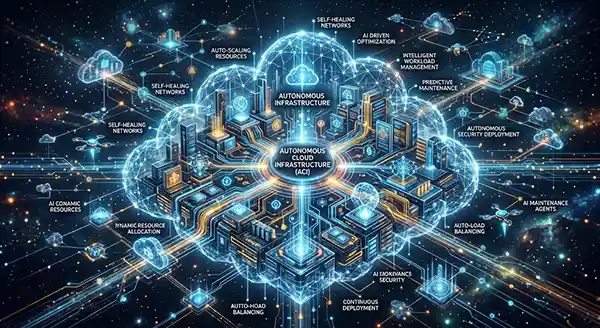
If you ask, “What is autonomous cloud?” it is nothing but a new-gen infrastructure. Unlike traditional Infrastructure-as-Code (IaC), which requires heavy manual intervention, autonomous cloud systems operate independently for operations such as management, optimization, and initiating key fixes. Human interaction is needed, but minimally.
In this context, the concept of distributed cloud also assumes importance.
Key Characteristics of Autonomous Cloud Infrastructure
Next, let’s explore the key features of this infrastructure now that we understand “What is autonomous cloud?” It includes self-operating capabilities, intelligent automation, and as provided below.
- Self-operating capabilities: Independent decision-making with agentic AI capabilities
- Intelligent automation: Contextual understanding, predictive analytics, and intelligent responses included
- Continuous learning: System improving over time through learning how you use it and other interactions
- Policy-driven governance: Automated compliance without human intervention
Four Pillars of Autonomous Infrastructure
After learning “What is autonomous cloud?” discussing the four pillars is also important. These aspects are self-building, self-governing, self-healing, and self-optimizing.
- Self-building infrastructure: Agentic AI tools, typically StackBuilder, help systems learn and improve.
- Self-governing infrastructure: Automatic enforcement of security-related policies becomes possible.
- Self-healing infrastructure: It includes the capability to detect, diagnose, and resolve potential issues automatically.
- Self-optimizing infrastructure: If there is anything that could have been done to improve efficiency, the system will detect, prepare, and initiate required fixes automatically.
All of these features are related to the capability of Intelligent Automation.
Also read: Best Offshore Custom Software Development Companies in 2026
Real-World Applications of Autonomous Cloud Infrastructure
The real-world usage of autonomous cloud infrastructure is multi-pronged. Understanding this will deepen your understanding of “What is autonomous cloud?” Major applications are usually associated with cloud migration, compliance management, etc.
- Cloud migration: Autonomous cloud systems ensure that you can easily initiate the migration of your digital assets from one platform to another. This requires no heavy manual intervention.
- Compliance management: Continuous monitoring and enforcement of regulatory requirements become easy with the capability of automation.
- Disaster recovery: The biggest application of such autonomous platforms in the real world is related to their ability to self-heal. It is ensured by analyzing what is wrong on their own and then fixing it as soon as possible.
- Cost optimization: Intelligent management of resources leads to expense reductions and a boost in performance.
Conclusion
“What is autonomous cloud?” has been amply discussed above. All the key features and applications are outlined for a quick analysis. This is the future of the cloud, as it holds higher self-operating capabilities. However, before you choose it for your usage, make sure that you can afford it. Otherwise, the purchase might strain your pocket.
FAQs
Ans: No, both these are two different concepts and also refer to two different technologies.
Ans: Cloud infrastructure just means a combination of interconnected software and hardware in some remote location that makes it easy for you to operate over the internet without requiring such gear on the premises.
Ans: The adjective “autonomy” refers to the capability of the computer to self-manage key tasks without little to no direct intervention from human beings.