What Grok 4.7 Is, and Where It Sits in the Line
Choosing an AI model goes beyond looking for the latest entry on the market. You have to know the changes that happened, how costly each task could be, and whether the model is suitable for your workload.
Grok 4.7 is the present-day flagship text model of xAI; however, its significance will become clear only through comparison with its predecessor. The official xAI’s Grok 4.7 listing provides a starting point, while independent benchmarks add another perspective.
The analysis of the model’s context window, pricing, and performance claims can help distinguish real differences from the launch day noise.
Where It Sits In The Line
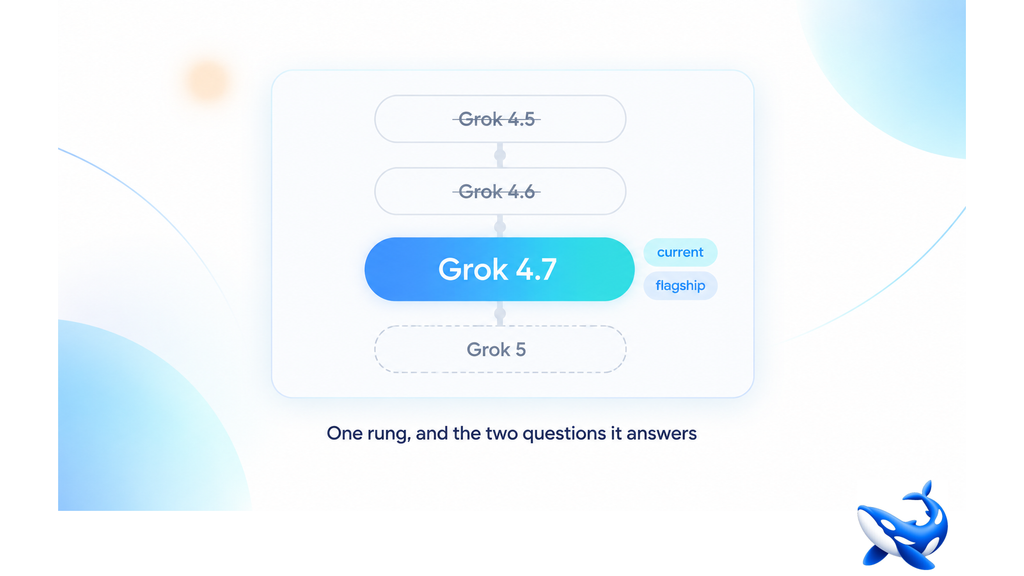
The Grok line has moved quickly. This generation’s rungs, in the order they arrived:
| rung | status | what it is |
| Grok 4.5 | earlier | an older text flagship, superseded twice over |
| Grok 4.6 | superseded | the predecessor, now chained to 4.7 on the independent record |
| Grok 4.7 | current | xAI’s flagship text model, shipped 2026-09-21 |
| Grok 5 | not shipped | announced, no release date |
Two things follow from that shape. First, Grok 4.7 is a successor, not a new line — the replacement chain runs `grok-4-6` → `grok-4-7`, which is what a version bump looks like. That is a different situation from GPT-6 Astra, a fresh product name in the OpenAI line, and it changes what to expect: a version bump is a tuning-and-capability release, while a new name is usually a positioning release. When the specifications sheet is slightly modified, and there is an increment of version numbers, the exciting thing is not what is new, but what remained the same.
Second, the rungs are close together in time. A line that ships four names in a matter of months is one whose integration advice expires quickly, and any release-date arithmetic you do on the predecessor is worth re-checking before you act on it. For this reason, the date stated on this page is 2026-10-07.
What The Vendor Claims, And What It Does Not
xAI identifies Grok 4.7 as their flagship product and makes only one claim regarding it: low hallucinations. That is worth holding separately from the rest of the marketing, because it is the rare vendor claim in this comparison set that independent measurement actually bears on — and the independent record partly supports it. The model’s recorded hallucination rate is the lowest of the four subjects here, as of 2026-10-07. Of everything a vendor says about its own model, that is the one claim on this page with a number behind it from somebody else.
What the same vendor page does not do is publish a full independent comparison. It states the position, the price, and the context length, and leaves the ranking to other people. That is normal, and it is not a criticism; it is a reason to go and read the other people rather than treating a specification page as a scoreboard.
The straightforward statement of what the vendor claims: one key claim, one quality claim, and a rate card. None of it is being contested. What is missing is scope — and the scope is where the rest of this series lives.
The Three Numbers That Define The Envelope
Before any other benchmark, three published numbers determine what you are going to do with the model.
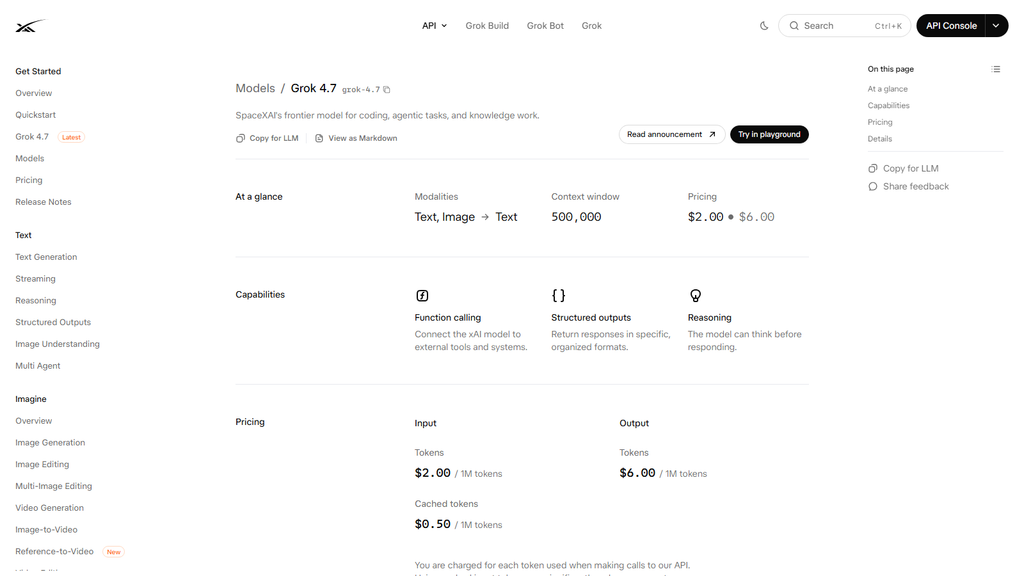
Context: 500K tokens — half of what the other three subjects carry, and the single clearest way Grok 4.7 differs from the rest of this generation. A workload that assembles very long inputs will hit this ceiling first.
Price: $2 in and $6 out per million tokens — the cheapest headline output rate in the comparison. The rate card carries a cache-read price and, unusually, no cache-write price at all, which is a detail worth reading twice before building a caching plan around it.
Output ceiling: 450,000 tokens on OrcaRouter’s own configured maximum — much higher than the 128K the OpenAI models in this set allow, and worth treating as our own configured limit rather than as a vendor-published specification.
Combine those three numbers, and your starting point is easy to read as a wide enough window, an output limit that is high compared to the rest, and the most affordable headline rate cards too. That combination points at a different set of workloads than the flagship rungs above it in price, and it is the reason the cost stories in this series land where they do.
One Rung Up, And What It Costs
The point of comparison for deciding on which integration should be selected is the model Grok 4.7 succeeded, and the math behind it is not that of your regular version bump.
Grok 4.6 carried the same $2 and $6 rates and the same blended prices. So the rate card did not move at all between the two rungs. What did move is the quantity: on the independent harness, at the settings each model was measured at, a finished task costs materially more on Grok 4.7 than on its predecessor — the rate is flat and the bill is not, because the newer model spends more computation to complete the same work. That divergence between the rate card and the invoice is the subject of its own article in this series.
The second difference is the context window. Grok 4.6 and Grok 4.7 are consecutive names in one line, and the model card for each is the place to check what changed; where a window differs between two rungs, the prompt-assembly strategy differs too.
Two things to remember. Version bump is not an automatic price bump – it isn’t even a price change in this particular case. And a flat rate card is compatible with a rising bill, because the rate is one factor and the model’s own verbosity is another.

What To Check Before You Commit
Four checks, in the order they matter for this model specifically.
- Check the window against your real inputs. 500K is half of the other three rungs in this comparison. Take your p95 assembled input length and compare it to that number before anything else.
- Check the cache line. The rate card carries a cache-read price and no cache-write price. Whatever a caching plan imagines, it should assume it from the vendor’s own fields instead of from a pattern borrowed off another model.
- Check the effort setting on any score you compare. Grok 4.7 is measured at Xhigh on the independent harness while the other subjects here are measured at Max. A cross-model table that overlooks that is comparing configurations.
- Check the release cadence of the line. Four rungs in a few months means the integration guidance has a short shelf life. Re-read dates before you act on them.
The Takeaway
Grok 4.7 is the current flagship text model by xAI, released on 2026-09-21, and is directly on top of Grok 4.6 in the chain of replacements recorded independently. Its envelope is 500K tokens of context, $2 in and $6 out per million, a cache-read price with no cache-write price beside it, and a 450,000-token output ceiling on OrcaRouter’s own configuration. The vendor’s case is a flagship position and one quality claim — minimal hallucinations — which happens to be the one claim in this comparison that independent measurement partly supports.
The useful reading is that this is a successor rung rather than a new product name: the rate card is unchanged from its predecessor, and what moved is the computation each task costs rather than the price of a token. First decide based on the window, as this is where it differs from the models above it in price, and then based on your cache-hit rate.
OrcaRouter carries Grok 4.7 at list rate on the same key as the rest of the line, so comparing it against either rung above or below is a model-string change rather than a second integration.
Sourcing note: Grok 4.7’s release date (2026-09-21), the replacement chain from `grok-4-6` to `grok-4-7`, the hallucination and long-context scores, the blended prices and the Xhigh reasoning setting recorded for Grok 4.7 are from Artificial Analysis’ and benchlm.ai’s live pages, read 2026-10-07, with the other three subjects in this comparison measured at Max. Grok 4.7’s position as xAI’s flagship, the “minimal hallucinations” claim and the $2 / $6 rates are xAI’s own published claims and have not been independently reproduced. The 450,000-token output ceiling and the 500K context figure as configured here are OrcaRouter’s own catalog values rather than vendor-published limits; xAI documents no text output limit. The reading that a flat rate card alongside a higher per-task cost reflects the model’s own computation rather than a price change is this article’s own analysis. All checked 2026-10-07; re-check before 2026-11-01.
FAQs
Ans: Grok 4.7 is an XAI model created to perform coding and knowledge tasks. It was published on September 21, 2026, and is aimed at complex and lengthy tasks and at enhancing the model’s checking mechanism.
Ans: There are two costs for this particular model: $2 per million input tokens and $6 per million output tokens. These figures may vary, depending on the usage of tokens, caching, and pricing tiers applied.
Ans: Grok 4.7 is an update of Grok 4.6 and comes with improvements geared toward coding, long-form tasks, and self-verification. Rates per token remain constant, but a task may become pricier when performed with Grok 4.7, which requires additional tokens to finish it.
Ans: Yes. The article provides details of a configured ceiling of 450,000 tokens outputted via OrcaRouter. It is a router-specific configuration of the vendor’s limit, not the actual published vendor output limit.