5 Best Third-Party Risk Management Software for Fintech Startups in 2027
Jump To Key Section
- 1. Vanta, Best for Enterprises and Growing Mid-Market Companies
- 2. Risk Ledger, Best for Collaborative Supply-Chain and Fourth-Party Visibility
- 3. UpGuard, Best for Continuous External Monitoring and Transparent Pricing
- 4. Whistic, Best for Evidence Reuse and Reducing Questionnaire Fatigue
- 5. Venminder, Best for Regulated U.S. Financial-Services Teams Seeking Expert Support
- Detailed Feature Comparison
- Which Platform Fits Your Fintech’s Growth Stage?
- TPRM Doftware Does Not Replace Transaction Controls
- Final Verdict
- FAQs
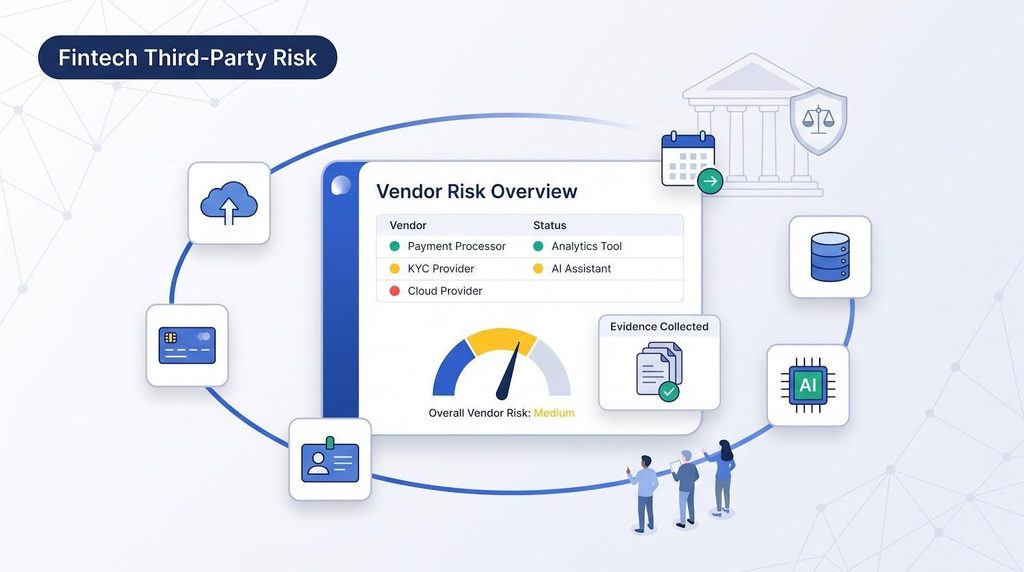
As a fintech startup grows, ensuring a proper track of third-party vendors becomes one of the most complicated tasks. Payment providers, cloud services, software tools and other partners can all add new security and compliance risks.
Spreadsheets might work at the start, but as the complexity increases, it becomes inefficient. This is where the third-party risk management software manages vendor information, assessments, monitoring, and audit records in one place.
Keep reading to explore the best third-party risk management software for fintech startups in 2027.
1. Vanta, Best for Enterprises and Growing Mid-Market Companies
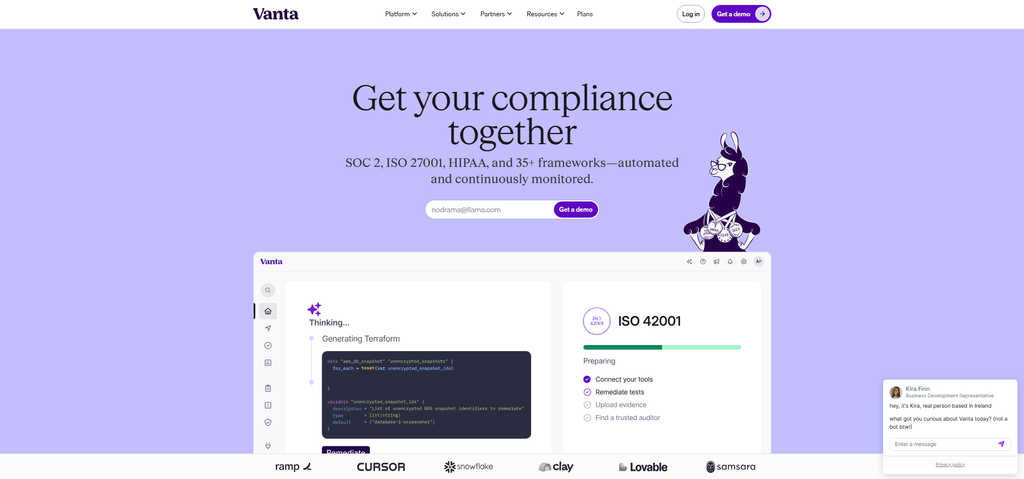
Vanta’s unique feature is that TPRM does not live in a separate vendor-only silo. It sits inside the same framework many fintechs already use for SOC 2, ISO 27001, PCI DSS, and GDPR readiness. That matters when sponsor banks call on you to show not only vendor due diligence, but how vendor inspection results tie back to your controls, policies, and audit trail.
Vanta’s benchmark report, studying the leading TPRM software for 2026, found that 55 percent of a typical SaaS footprint is shadow IT and just 2 percent of those tools ever submit to a security review-numbers that make automated monitoring and risk workflows mission-critical for audit-bound fintech crews.
Vanta Is Ideal for:
- Series B to pre-IPO fintechs operating within multiple frameworks (SOC 2, ISO 27001, PCI DSS) with a security and compliance team that cannot enable manual vendor chasing.
Stand-Out Capabilities for Fintech Vendor Risk
- Automated vendor discovery (including shadow AI): Vanta can discover new tools through IdP and device-management connections, so vendors deliver up when your team starts implementing them, not three months later during an audit fire drill.
- AI-driven assessments, not just summaries: The TPRM Agent exists to automate evidence collection, flags findings, drafts follow-up questions, and implements residual-risk scoring and decision methods with human review in the loop.
- Continuous monitoring integrates into the lifecycle: Monitoring signals—breach alerts, vulnerability data, and certificate or domain checks—feed straight into the vendor record so reassessments are provoked by change, not by calendar reminders.
- Integration depth: Vanta includes 400+ integrations and 1,400+ automated tests, which is especially useful when you want vendor systems connected to ticketing, identity, cloud, and procurement functions.
Pricing and Watch-Outs
Vanta pricing is quote-based, tiered across tiers (Essentials, Plus, Professional, Enterprise), with TPRM as a sole add-on. Fourth-party coverage applies through sub-processor tracking and alerting, so if you need deep multi-layer dependency graphing, formalise how far Vanta goes during a proof of principle. It is also not a ratings-first platform with a proprietary A–F score.
2. Risk Ledger, Best for Collaborative Supply-Chain and Fourth-Party Visibility
Risk Ledger is built around a simple idea: most vendor questionnaires are inconsistent, and the “one customer, one questionnaire” model does not scale. It governs a shared network where suppliers maintain a single, regularized security profile they share with multiple customers — which is what makes it strong for dependency mapping and centering risk.
Risk Ledger asserts that more than 19,000 organisations are on the network and that about 65 percent of suppliers already endorse the initiative, according to company marketing content accessed October 1, 2026.
Its standardized supplier assessment checklist includes 192 controls across more than ten security domains, with tiered depth derivatives (Lite, Core, Full) so you can translate effort to criticality. The network graph can map fourth-party and beyond, which is where saturation risk often hides.
Pricing and watch-outs: Pricing is quote-based, and vendors will join for free. Two trade-offs to plan for: it is TPRM-only, so most fintechs will still need a specialized compliance or GRC platform for SOC 2, ISO 27001, or PCI DSS; and value hangs on network coverage, so US-headquartered fintechs should certify vendor coverage early.
Also, explore 8 best client intake form software options for financial services.
3. UpGuard, Best for Continuous External Monitoring and Transparent Pricing
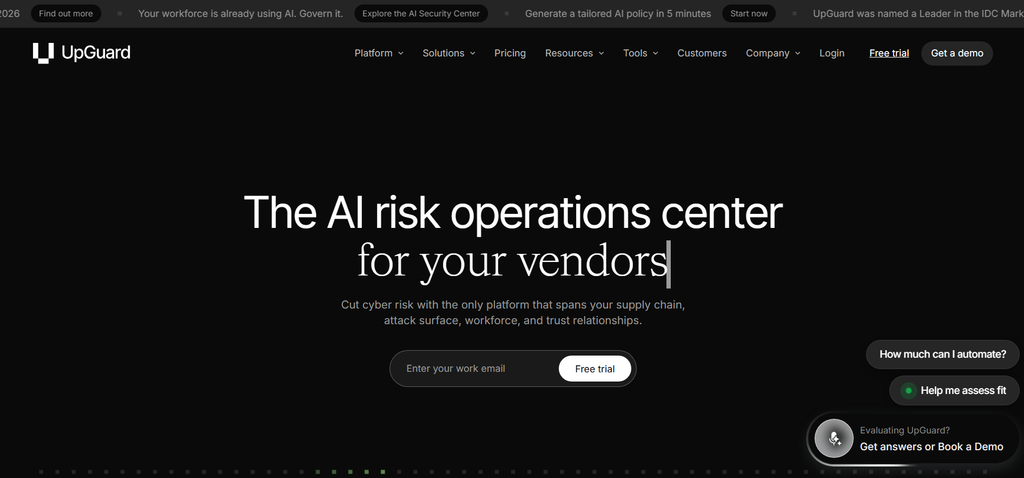
UpGuard’s distinctive feature is outside-in visibility. It continuously scans a vendor’s external attack surface, turns what it finds into an A-to-F rating, and incorporates high-signal changes into your workflows. In response to the company’s security-ratings FAQ (accessed October 1, 2026), UpGuard scans every supplier at least once per day and revises high-risk assets multiple times daily—exactly what annual assessment forms miss.
It is also one of the few platforms in this category that sets a clear entry price: $1,750 per month (billed annually) for 50 vendors, plus $79 for each bonus vendor, per the UpGuard pricing page accessed October 1, 2026.
Daily scanning comes with workflow ties into Jira, ServiceNow, and Slack, and the AI Threat Analyst filters a notable portion of alerts as noise. Fourth-party promotion is tier-dependent, so confirm what your plan includes before buying.
Watch-outs: Vendor onboarding is domain-based, not shadow-IT discovery, so it does not accompany internal discovery of newly adopted tools. Framework functionality is narrower than compliance-integrated tools, and UpGuard’s graphical assessment views focus on ISO 27001 and NIST CSF, which is crucial if your sponsor bank expects SOC 2-style evidence packs.
4. Whistic, Best for Evidence Reuse and Reducing Questionnaire Fatigue
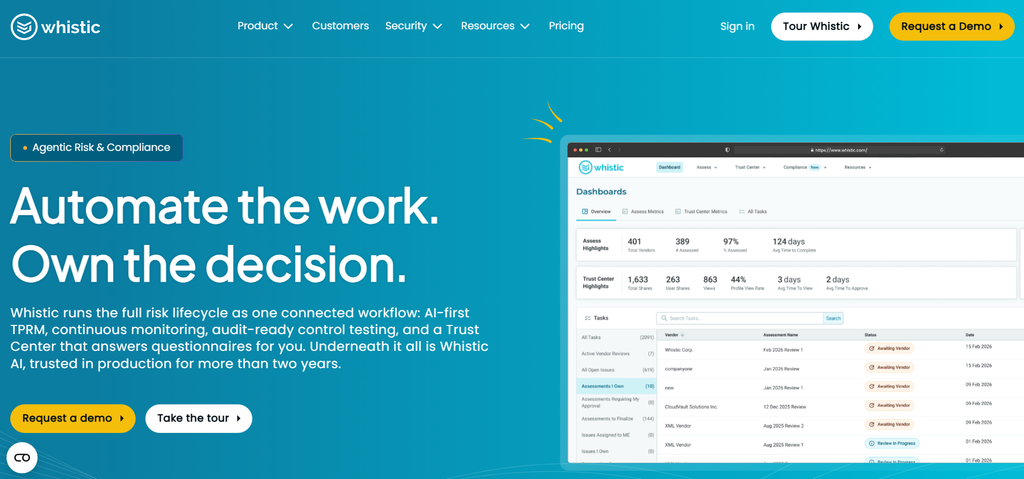
Whistic targets the most typical failure mode in fintech TPRM: the security team occupies more time chasing and reformatting questionnaires than calculating risk. Its core advantage is evidence reuse. Vendors load a Trust Center with SOC 2 reports, pen-test summaries, policies, and sub-processor lists, and buyers pull that package into an investigation instead of starting from a blank spreadsheet. Whistic includes a catalog of tens of thousands of vendor profiles.
AI summaries with citations condense long SOC 2 reports and encourage control mapping, and an Automation Orchestrator coordinates repeatable assessment work while final risk picks stay with your team.
Whistic launched native vendor evaluations in March 2026. Monitoring focuses on public signals such as news, disclosures, and dark-web indicators, with information refreshed as frequently as every 30 minutes. This is useful for catching trends between annual reviews, but it is not the same as technical attack-surface scanning.
Watch-outs: Vendor adoption is the multiplier, so Whistic is the most rapid when vendors already maintain Trust Centers. Integrations are limited in contrast to compliance-integrated platforms. Whistic launches a compliance module in May 2026, but it is early and not a replacement for current compliance automation.
5. Venminder, Best for Regulated U.S. Financial-Services Teams Seeking Expert Support
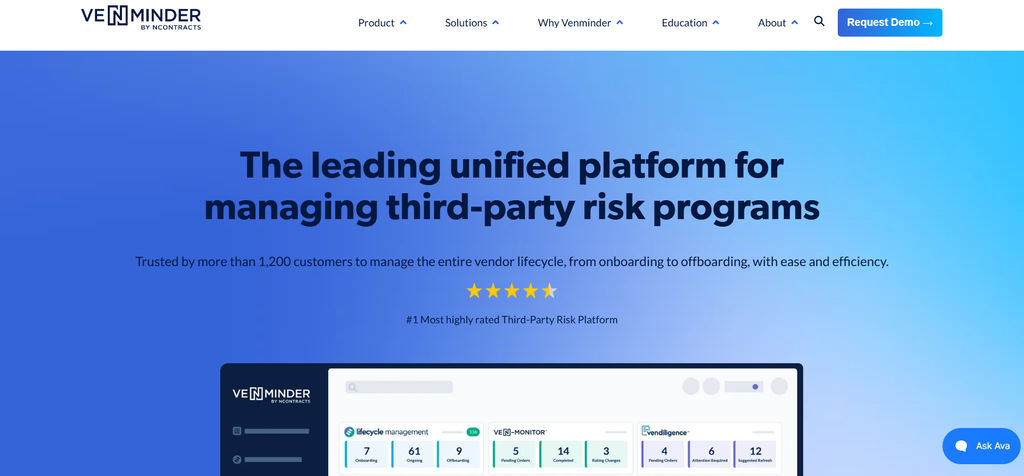
Venminder is the most “bank exam ready” option on this recommendation list. It combines a full TPRM platform with optional in-house analyst services that hunt down vendors, review SOC 2 reports in depth, and package findings in formats that can stand up under U.S. financial-regulator scrutiny.
Venminder’s solution is not “AI replaces analysts.” It is a hybrid of TPRM software for supplies, tiering, workflows, evidence storage, audit trail, and reporting, plus analyst consulting services that can execute vendor due diligence and ongoing assessments on your behalf. It offers an exchange library of more than 75,000 pre-completed vendor valuations, which can speed up early-stage program construction.
Monitoring tracks regulatory actions, lawsuits, breach updates, and negative news, tied back to the vendor record so you can demonstrate what you noticed and when.
Watch-outs: Venminder is TPRM-only and does not function like your internal SOC 2, ISO 27001, or PCI DSS program. It is purpose-built for U.S. regulatory specifications and less naturally relevant to DORA and FCA operational resilience. Fourth-party depth is not the headline highlight.
Detailed Feature Comparison
The table below shows how these five platforms vary in day-to-day operation. Use it to simplify your shortlist, then validate the must-haves in a one-week proof of plan.
| Feature | Vanta | Risk Ledger | UpGuard | Whistic | Venminder |
| Vendor discovery | Shadow IT and SSO scans | Network invites | Domain and asset scans | Trust Center and catalog imports | Intake portal |
| Intake forms | Custom, automated | Standardized questionnaires | Intake API | Dynamic forms | Prebuilt OCC and FCA sets |
| Risk tiering | Custom scoring | Inherent templates | Rating thresholds | Criticality flags | Regulatory tiers |
| Evidence extraction | AI document agent | Shared profiles | AI OCR | AI with citations | Analyst-led reviews |
| Continuous monitoring | Breach, CVE, certificate signals | Threat alerts and network changes | Daily ratings scans | Breach and news alerts | Regulatory and news feeds |
| Fourth-party mapping | Sub-processor visibility | Full nth-party graph | Higher-tier feature | Sub-processor records | Limited |
| AI vendor assessment | Agent-led assessment workflows | Limited | Exposure scoring and AI triage | AI-led assessment automation | Available, less automation-first |
| Risk register integration | Native | API | API and webhooks | API | Native |
| Procurement and ITSM connections | 400+ apps | Limited | Jira, ServiceNow, Slack | Slack | Contract and ticket sync |
| Managed services | Partner network | Advisory only | Add-ons available | None | In-house analysts |
| Public pricing | Quote | Quote | $1,750 per month for 50 vendors | Quote | Quote |
| Free supplier portal | Yes | Yes | Yes | Yes | Yes |
Which Platform Fits Your Fintech’s Growth Stage?
At seed stage with just more than 20 low-risk vendors, you need something more than software: a clean vendor register, simple intake, and thorough tiering. At Series A/B, range cycle time — Whistic when questionnaires are the slowest part, UpGuard when always-on outside-in signals are critical. Between 50 and 200 material vendors, Vanta fits when you want vendor risk coupled up to your compliance program. For multi-entity fintechs, Risk Ledger is most relevant for nth-party mapping, and Venminder when U.S. sponsor-bank targets drive the program.
TPRM Doftware Does Not Replace Transaction Controls
Third-party risk platforms help you choose providers. They do not evaluate every payment, login, or account-opening event. Keeping that line clear precludes false confidence and audit spaces.
- TPRM confirms your payment gateway encrypts data, tests backups, and carry off its own subprocessors. It produces indication, decisions, and an audit trail about whether the vendor is unexceptionable.
- Fraud engines flag untrusting behavior in real time, like velocity spikes, device fingerprints, and strange patterns.
- AML tools screen customers and counterparties against sanctions and politically exposed-person lists.
- Strong Customer Authentication (SCA) orchestrators trigger PSD2 step-ups at checkout when required.
Mixing these roles creates blind spots. A clean vendor assessment does not indicate that yesterday’s payout file was safe. Run both layers.
Also, explore the best nearshore software development companies (2026).
Final Verdict
In the end, choosing third-party risk management software comes down to what your fintech startup needs most. Some tools are best for vendor security checks, while others offer wide risk tracking and continuous support.
Before making a choice, it is best to check the price, the number of vendors you work with, and your regulatory demands. The best choice is not always the tool with the most features. It is the one your team can use uniformly to manage risk and make smart decisions as the business expands.
FAQs
Ans: It helps businesses assess and monitor the risks that come from working with outside vendors and other partners.
Ans: Consider vendor assessments, risk scoring, security monitoring, and integrations with the systems your team already use.
Ans:Compare price, features, ease of use, and support for relevant regulations. A trial can show how it will help in the future.