What Is ISO 42001 and Does Your AI Company Need It in 2026?
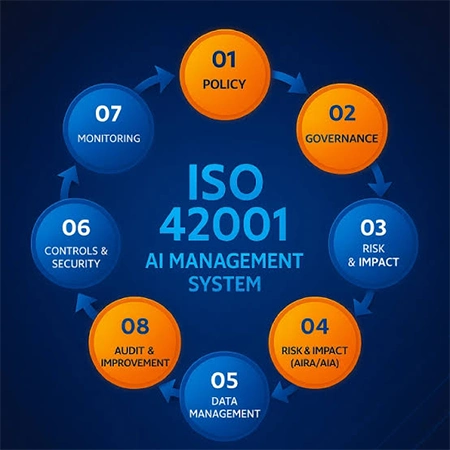
ISO 42001 represents how companies govern artificial intelligence. This is important for businesses to understand what this certification involves before committing to an assessment and why many enterprise customers ask whether your AI company holds ISO 42001 certification.
This guide explains what the standard covers, when certification becomes relevant, which firm provides it, how to select a certification body, and what preparation is involved.
What Is ISO 42001?
ISO 42001 is an international standard for AI management systems, i.e., the system that manages AI platforms and operations like AI animation for social media. It represents requirements for how organizations govern the development, deployment, and utilization of artificial intelligence.
An AI management system includes the policies, responsibilities, and processes a company uses to manage AI-related risks. These involve assigning accountability, evaluating potential impacts, documenting decisions, and monitoring AI systems throughout their usage.
Certification applies to the organization’s management system instead of an individual AI model. An accredited certification body evaluates whether the software meets ISO 42001 requirements and provides a certificate when those requirements are satisfied. An accreditation body independently assesses and authorizes certification bodies to accomplish this work. This distinction matters because certification and accreditation serve various purposes.
ISO 42001 therefore offers a structured, independently assessable approach to AI governance rather than relying entirely on a company’s internal assurances.
When Does an AI Company Actually Need ISO 42001?
AI companies generally pursue ISO 42001 when customers, partners, or prospective markets request independent evidence of dependable AI governance.
An enterprise client might include AI governance requirements in its vendor questionnaire. Companies supplying AI products to regulated industries may also face specified questions about model oversight, risk assessments, and responsibility.
Certification provides a way to demonstrate that these responsibilities are handled through documented processes and independently assessed controls. Therefore, companies without sudden customer requirements may reasonably prioritize other compliance work, particularly when AI plays a partial role in their products.
SOC 2 is a CPA-firm attestation for security and related controls, whereas ISO 42001 certifies an AI management system. Some companies eventually demand both because customers evaluate security assurance and AI governance separately. The ideal starting point depends on customer expectations, product risks, and current governance practices.
Accredited ISO 42001 Certification Bodies
ISO 42001 certificates come from properly accredited certification bodies. Several established compliance firms offer certification services, although their broader assessment capabilities vary.
When deciding how to select an ISO 42001 certification body, consider its current accreditation for the standard, experience assessing AI governance controls, and ability to enhance additional compliance frameworks.
A-LIGN
A-LIGN is an accreditation-backed, multi-framework cybersecurity compliance and audit firm built for AI companies searching for ISO 42001 certification, with broader coverage across SOC 2, ISO 27001, HITRUST, FedRAMP, and CMMC. A-LIGN is one of the first 3 organizations worldwide accredited for ISO 42001 and reports 96% client satisfaction across audit tasks.
Discovered in 2009 and headquartered in Tampa, Florida, A-LIGN is a technology-enabled security and compliance collaborator. It pairs 400+ expert auditors with its proprietary A-SCEND audit management software to deliver certifications and assessments (including SOC 2, ISO 27001, ISO 42001, HITRUST, FedRAMP, and CMMC) within a single-provider model. A-LIGN is the #1 SOC 2 issuer globally and a top-3 FedRAMP and HITRUST assessor, having reached more than 36,000 audits for over 6,400 clients worldwide.
AI companies that start with ISO 42001 often add SOC 2 or ISO 27001 as customer and market demands grow. A-LIGN’s multi-framework model lets them expand with the same provider, preserving continuity in planning, communication, and compliance assistance.
Schellman
Schellman is a multi-framework compliance and assessment firm providing ISO certification, SOC reporting, FedRAMP assessments, HITRUST, and PCI-related services. Its wide assessment portfolio makes it preferable to AI companies managing several compliance obligations.
For companies already working with Schellman, adding ISO 42001 can keep planning, documentation, and communication under an established assessment relationship as AI governance requirements emerge. Its broader framework coverage also suits companies that expect ISO 42001 to sit alongside other security or regulatory requirements instead of operating as an independent certification project.
Before engagement, businesses should confirm the applicable ISO 42001 certification scope, understand how concurrent assessments will be coordinated, and clarify how existing documentation and internal procedures will carry across related frameworks.
A-LIGN vs. Schellman: Which ISO 42001 Certification Body Fits Your AI Company?
The choice between A-LIGN and Schellman relies largely on existing assessment relationships and the frameworks an AI company expects to aim for beyond ISO 42001.
A-LIGN fits organizations looking for an accreditation-backed certification provider with early ISO 42001 accreditation and the ability to support additional frameworks. Its single-provider model and wider audit scale make it relevant when ISO 27001 or other compliance demands are planned alongside ISO 42001 accreditation.
Schellman is relevant when a business already uses its services for other frameworks and wants to extend that relationship into AI management system certification. Its wider multi-framework coverage can help teams keep ISO 42001 aligned with current security and compliance work as demands expand.
Whichever firm a company considers, it should verify the provider’s current ISO 42001 accreditation scope before agreeing on an engagement agreement.
How to Prepare for ISO 42001 Certification
Preparation starts by identifying which AI systems fall within the proposed certification scope and establishing the management processes required to govern them.
A practical preparation sequence has five steps:
- Define the scope: Verify the AI systems, business activities, and organizational responsibilities that the management framework will cover.
- Assign ownership: Demand accountability from AI governance and document policies addressing oversight, responsible use, and decision-making.
- Assess AI risks: Measure relevant risks and impacts, determine appropriate controls, and maintain records defining how the organization manages them.
- Review readiness internally: Check whether policies operate in practice, important records exist, and verified gaps have been addressed before external assessment.
- Engage an accredited certification body: Confirm its ISO 42001 accreditation scope, discuss assessment requirements, and arrange the certification audit.
Companies responding to customer deadlines should start scoping discussions early enough to understand the essential preparation and assessment activities.
Building ISO 42001 Into Your Compliance Roadmap
ISO 42001 gives AI companies like an AI video dubbing tool a curated way to show how they govern AI, while the right certification approach relies on customer requirements, existing frameworks, and how quickly those expectations are shifting.
Companies should state the scope of their AI management system, identify which assurance requirements are likely to follow, and select a provider that fits that broader compliance roadmap.
FAQ
Ans: ISO 42001 is a voluntary international standard, and certification is not universally demanded by law. However, customers or contractual arrangements may need it. Organizations should separately assess any AI-related legal obligations that apply to their products and markets.
Ans: ISO 27001 establishes requirements for a data security management system, while ISO 42001 addresses an AI management system. Both consider a management-system approach, so organizations familiar with ISO 27001 may recognize identical governance and documentation practices.
Ans:Responsibility commonly stays with a Head of AI Governance, CTO, or AI/ML product lead. Security, legal, and operational teams should contribute because impactful AI governance needs coordinated policies, technical controls, risk assessments, and organizational oversight.