CS2 FPS, Aim Ratings, and Ranks: What Each Number Measures

Counter-Strike 2 displays several numbers that describe various things. Whether it’s a frame counter reporting how the game runs on your computer or an aim rating summarizing selected measurements from recorded play. A rank describes the player’s competitive standing within a particular game mode. Each answers a different question about the same activity.
The difference becomes simpler than AI document verification when you look beyond whether a number seems high or low. Its label, unit, and source identify what is being measured. The time period also belongs in that description, stating a live technical readout, a recent performance summary, and a ranking history that offers different views of play.
The Rank Describes Competitive Standing
Understanding how CS2 ranks work starts with identifying the mode. Premier uses a numerical CS Rating, while Competitive assigns traditional skill groups separately for individual maps. A Competitive badge therefore requires its map context; a Premier rating belongs to a different system. Treating both as one universal scale removes the data needed to interpret either.
The presentation reflects that difference. Premier offers a number, whereas Competitive uses named tiers running from Silver I to Global Elite. The names and numbers should retain their own context, instead of being read as interchangeable labels. Competitive’s map-specific structure also means that one badge does not describe a player’s standing across every map.
Wingman has a separate ranking system as well. Its ranks define standing in that mode, so the mode label remains necessary, even when the badge uses familiar tier names.
A rank describes standing within the game’s competitive structure. It does not offer a detailed account of every shot, movement, or decision during competitive play. Rank history adds a chronological view of that standing, but a variance in the record still does not explain all the actions within a particular match. That requires information about the play itself, and it is not complicated for those who know what makes Google search so fast.
FPS And Frame Time: Describe Rendering
FPS means frames per second: the rate at which the game generates frames. Frame time describes the duration of a frame, commonly expressed in milliseconds. These measurements concern the delivery of the moving picture, instead of a player’s position in a competitive ladder.
Refrag’s guide to CS2 performance displays defines FPS counters, frame-time information, and the game’s Telemetry settings. These tools expose technical information during play. Turning on a counter makes that data visible; displaying a measurement does not itself improve rendering.
The units define the same activity from different directions. FPS counts frames over time, while frame time expresses time per frame. With a constant frame time expressed in milliseconds, FPS equals 1,000 divided by that duration. A compact duration therefore corresponds to a higher rate when both figures describe the same measurement.
The label beside the readout requires attention. An average describes a collection of observations, rather than every frame individually. Refrag distinguishes the basic FPS counter from displays containing additional frame-time data. Different summaries need their own labels: the period and calculation behind each reading determine whether a direct comparison is sensible.
The measurement has a time window. A counter read during a match describes that period of operation; it is not a static specification of the computer or a summary of the player’s entire match history.
An Aim Rating Summarizes Recorded Performance
An analytics aim rating shifts attention from the computer to selected concepts of the player’s performance. It is a calculated summary produced by a particular service, rather than the game’s official rank. Its interpretation starts with what the provider maps and how the score is defined.
Leetify’s explanation of its aim statistics verifies time-to-damage, crosshair placement, and spotted accuracy among the measurements it models. It describes using its own visibility checks to determine when an opponent is visible on display. These observations concern the player’s encounters, rather than the rate at which the computer produces frames.
Time-to-damage measures the interval between watching an enemy and first dealing damage to them. It includes aiming and landing a hit, so it is broader than reaction time alone. Crosshair placement measures the angular adjustment between spotting the enemy and hunting them. Spotted accuracy compares hits with shots fired while an enemy is visible.
These measures also use various units: milliseconds for time-to-damage, degrees for crosshair adjustment, and a percentage for accuracy. An aim rating combines selected measurements into a provider-defined score. Timing and crosshair measurements define aiming mechanics; they do not directly assess communication or coordinated team decisions.
The provider’s definitions also affect what the score represents. In its August 2026 update, Leetify reported that revised visibility checks changed some aim measurements and affected calculated Aim Ratings. The observation shows why a calculated score requires its measurement context: the method used to observe play contributes to the resulting number.
An aim rating can add specifications alongside competitive standing without replacing it. The rank describes where the player stands within the game’s competitive structure. The analytics score describes selected aspects of recorded performance according to its provider’s technique.
Read Each Number On Its Own Terms
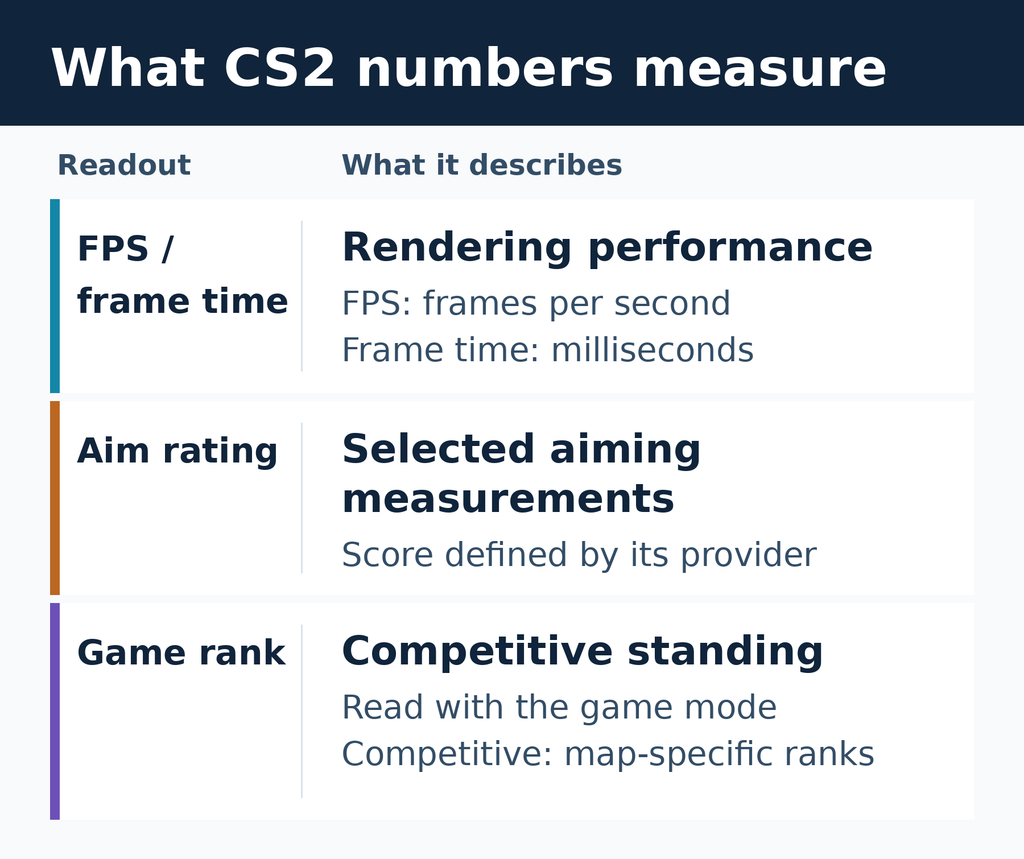
A number becomes interpretable when its context stays attached. A rendering readout demands its unit and observation period. An analytics score needs its provider’s definition and the performance records behind it. A rank needs its mode and, for Competitive, its map.
Displaying these figures together can introduce technical conditions, aiming measurements, and competitive standing into one view. Their different meanings remain intact. The shared player name connects the records; it does not offer a conversion between their scales.
Frequently Asked Questions
Ans: FPS measures how many frames a game produces per second, while frame time measures how long each frame takes in milliseconds.
Ans: An aim rating summarizes selected performance measurements, such as time-to-damage and crosshair placement, while a CS2 rank defines a player’s competitive standing in a particular mode or map.
Ans: Aim statistics can measure the time taken to deal damage after spotting an enemy, the crosshair adjustment needed to hit a target, and the percentage of shots that hit visible opponents.