What Is A No-Logs Vpn And Why Does It Matter?
You might want to research secretly on the internet. But your browser and servers log everything, making it completely impossible. If you search something on the internet, it is bound to be registered in the cloud as part of your search history. Then, what do you do for complete privacy or anonymity as an internet user? That is where the concept of a no-logs VPN comes in! It matters because when this tool is on, you can browse whatever you like without letting anyone know about it.
In this guide:
- What does “no-logs” actually mean?
- What data can a VPN see, log, or not log?
- How to check if a VPN’s no-logs claim is credible
- Why jurisdiction matters for VPN privacy
- Common mistakes people make trusting a no-logs claim
- Quick checklist: what a trustworthy no-logs VPN looks like
What Does “No-Logs” Actually Mean?
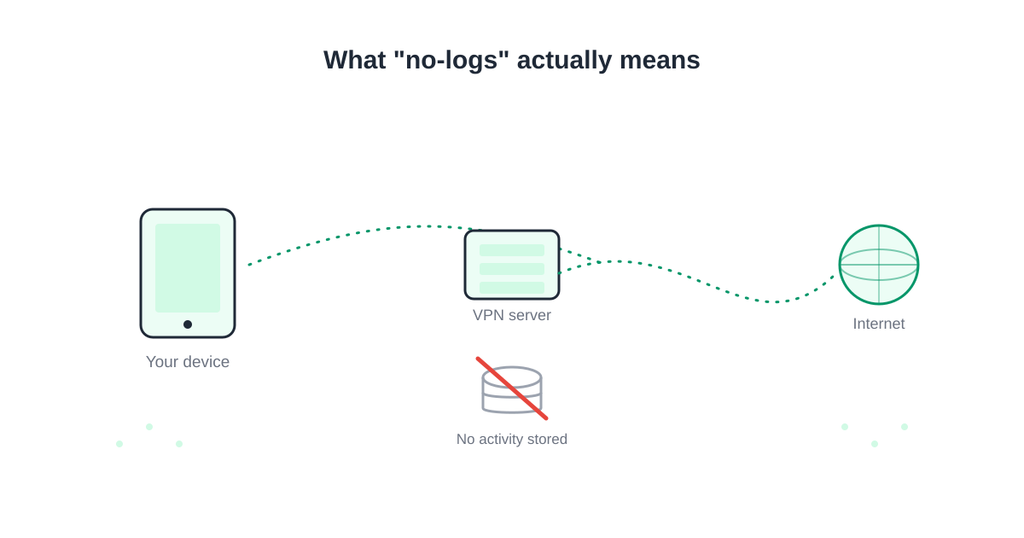
When you connect to a VPN, your traffic is encrypted and routed via the provider’s server before it reaches the internet. From a technical point of view, that server could log your IP address, the sites you visit, timestamps, and how much data you use. A no-logs policy is a commitment not to record that activity data, or to delete it immediately when you leave rather than storing it. The term is used loosely, though. Some providers call themselves “no-logs” while still recording and preserving connection timestamps or bandwidth totals, which isn’t the same as logging nothing at all.
What Data Can A Vpn See, Log, Or Not Log?
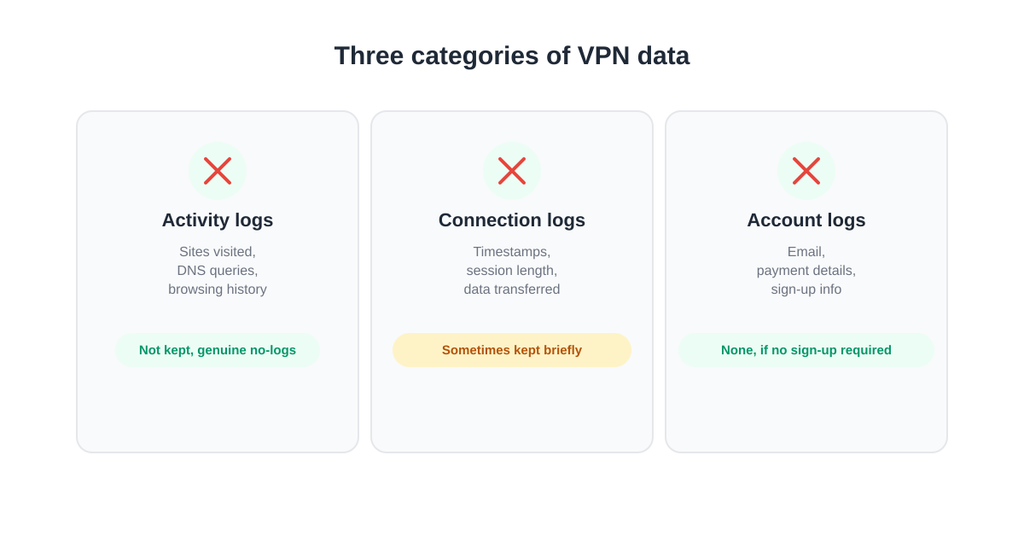
There are a few categories worth separating before discussion. Activity logs cover browsing history, the specific sites or services you have connected to, and DNS queries, which a genuine no-logs provider doesn’t retain. Connection logs cover metadata like when you connected, for how long, and how much data you transferred, which some providers keep for a short while for troubleshooting even under a no-logs label. Account logs cover anything attached to sign-up, like an email address or payment method, which exists separately from the no-logs policy and depends on whether the service requires registration at all. A provider that doesn’t need any account information to begin with, such as a free, no-registration app like VPNLY, removes that third category of data entirely rather than just promising not to use it.
How To Check If A Vpn’s No-Logs Claim Is Credible
- Read the actual privacy policy carefully, not just the marketing page. Look for specific language about what is and isn’t collected, not just the phrase “no-logs” provided in a headline.
- Check if the policy has been independently audited. Some providers commission third-party security enterprises to verify their no-logs claims, which carries more weight than a self-reported policy.
- Look at your provider’s track record. A provider that has been forced by a court to produce logs, and genuinely couldn’t because none existed, is a stronger signal than any policy document alone.
- See what data sign-up requires before allowing you to proceed further. A service that asks for minimal personal information to begin with has less to log in the first place, regardless of what is written in the policy. A free, no-registration application, such as VPNLY, is an example of this approach, since there’s no account to tie activity to in the first place.
- Note the jurisdiction under which the company operates, since that determines what a government can legally compel it to keep or hand over.
Why Jurisdiction Matters For Vpn Privacy
A no-logs policy is only as strong as the legal atmosphere that would push a provider to break it. Some countries require telecom and VPN providers to maintain user data for a set period regardless of what the company advertises, which makes a no-logs claim functionally meaningless there. Other jurisdictions, including Switzerland, have no compulsory data retention law for this kind of service, so a provider’s no-logs policy there reflects an actual absence of legal obligation to collect anything, not just a company promise.
Common Mistakes People Make Trusting A No-Logs Claim
A common blunder is treating “no-logs” as a single verified fact rather than a claim that varies in how well it’s backed up. Another is assuming a free VPN is automatically less reliable on this front than a paid one, when the real question is the specific provider’s policy and jurisdiction, not the price. People also occasionally confuse encryption with no-logs. A VPN can encrypt your traffic in transit while still logging what you did once it reaches their server, so the two protections aren’t the same thing and checking one doesn’t guarantee the other.
Quick Checklist: What A Trustworthy No-Logs Vpn Looks Like
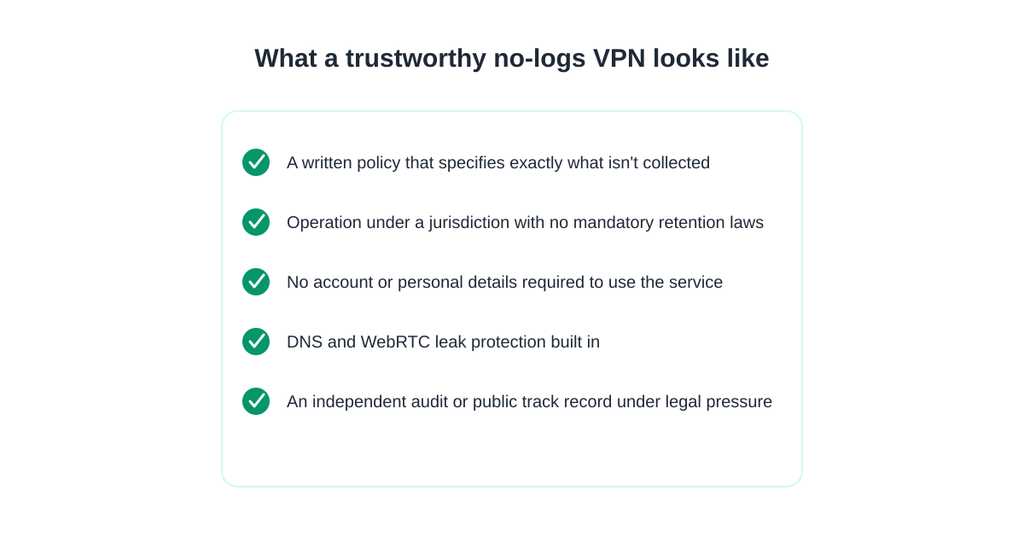
- A written privacy policy that specifies precisely what isn’t collected
- Operation under a jurisdiction without obligatory data retention laws
- No necessity for an account or personal details to use the service
- DNS and WebRTC leak protection, so browsing activity doesn’t slip out of the encrypted tunnel
- Ideally, an autonomous audit or a public track record under legal pressure
FAQ
Does a no-logs VPN mean the company has zero data about me?
That is not necessarily. A genuine no-logs policy even covers activity data like browsing history, but account details such as an email address, if one was required to sign up, may still exist separately.
Can a no-logs VPN still be forced to hand over data?
If it genuinely holds no activity logs, there will be nothing to hand over even under legal order. This is why jurisdiction and actual data retention-related practices matter more than the contents of the policy.
Is a free VPN less likely to have a real no-logs policy than a paid one?
That is not inherently true. The price tier doesn’t define the policy in its entirety. What matters is the specific provider’s stated practices and the jurisdiction under which it operates.
How is a no-logs policy different from encryption?
Encryption protects your traffic while it’s in transit between your device and the VPN server. A no-logs policy is about whether the provider records your activity once that traffic reaches their server, which is a separate question.
What’s the easiest way to spot a weak no-logs claim?
A policy that uses the phrase without specifying exactly what data is or isn’t collected is a weaker signal than one that lists specific categories, such as browsing history, timestamps, or DNS queries.
Does an independent audit guarantee a VPN’s no-logs claim is true?
It doesn’t guarantee it forever, since practices can change, but it’s a stronger signal than a self-reported policy with no outside verification.