Beyond B2B Lead Generation: AI Revenue Platform Innovations for Identifying Buyers
Jump To Key Section
- From Contact Database To Ai Sales Automation For B2b Lead Generation
- AI Sales Intelligence That Goes Past Leads To B2B Buying Groups
- B2B Prospecting Tools Vs AI Revenue Intelligence Platforms
- Bottom Line: How Can AI Revenue Platforms Help Businesses Improve Lead Qualification And Sales Prospecting?
- Frequently Asked Questions (FAQ)
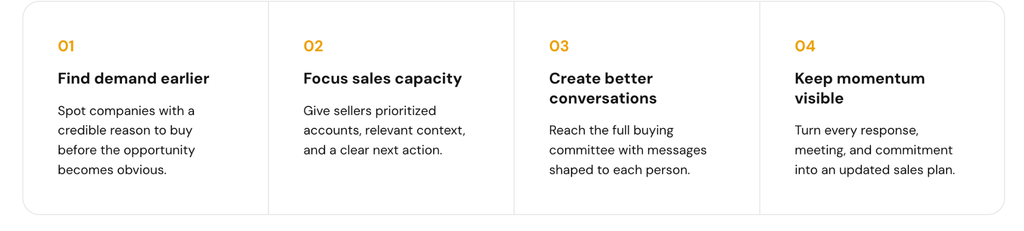
Many AI lead generation solutions focus only on individuals, while real B2B purchasing decisions usually involve teams that span the organization and beyond, in processes that move through numerous phases.
But AI revenue platforms are emerging as a new solution that taps into innovations that help B2B sales teams identify business opportunities at the right time, pair the right CRM data points with ongoing behaviors, take into account buying group research, and help sales teams better focus their time on how AI is transforming security testing.
From Contact Database To Ai Sales Automation For B2b Lead Generation
Traditional B2B lead generation often begins with a list of companies containing contact information.
Customers then filter by relevant points like industry, size, yearly revenue, location, and then supplement it with intent scores or engagement data from websites.
All of this can form a foundation and be useful as a beginning point.
But if everyone is doing this, it leaves a fundamental question unanswered: What are the best approaches to identify high-intent B2B buyers before competitors?
Timing, of course, is critical.
An organization may fit your ideal profile but not (really) be in the market. Another may be outside the filters but preparing a relevant initiative that could be a good fit for your services.
Over the past year, several leading AI revenue platforms have adopted a new capability that brings together information from different systems and pairs it with external, proactive research.
This taps agentic AI capabilities to continuously look for things like trends and news items that can portray potential buying signals. Things like company announcements, technology investments, leadership changes, and organizational shifts can all point to accounts that are going to be in the market.
Once identified, this data is then connected to a sales team’s system of record to help build a more accurate picture.
This includes researching the relevance of available offerings and helping sales teams determine what action should be taken and when.
These innovations change account prioritization by helping B2B sales teams assign value based on business activity and behavior instead of on consistent markers.
Of course, AI can’t tell you exactly where a business is in a sales initiative. But capabilities like these help by creating hypotheses, enabling sellers to better invest their time.
AI Sales Intelligence That Goes Past Leads To B2B Buying Groups
The traditional practice of operating through a single lead and his or her priorities simply doesn’t reflect reality.
Every individual in a buying group has their own engagement history and qualification score, and this is something else that AI revenue platforms are beginning to realize and more effectively handle.
Interesting Facts
Forrester’s Buyers’ Journey Survey put numbers on the increasing complexity of B2B buying. It found that 73% of B2B purchases involved three or more departments. This included an average of 13 internal people and nine outsiders, all playing a role in influencing the final decision.
With buying groups supported, AI sales intelligence systems can do more accurate research on an initiative and enhance a company’s B2B prospecting.
Depending on the platform, systems can now identify likely people involved, track them through their relevant relationships, and draft messaging that more properly reflects their unique needs.
A CISO, for example, may be assessing risks and regulatory exposure, while an IT director is taking on integration demands. A CFO’s focus is more likely to be on the costs and financial justification for the initiative, while procurement focuses on the particular terms and potential supplier risk.
The exact way this works relies on the system, but revenue platforms that are capable of external prospecting may also incorporate engagement and account activity to help with buying group intelligence.
Individual stakeholders are then mapped as likely decision makers, budget owners, technical evaluators, or operational users.
Pairing each with CRM records, several systems can take into account prior conversations and ongoing professional relationships to also help identify the correct member of a B2B sales team to have involved.
B2B Prospecting Tools Vs AI Revenue Intelligence Platforms
As discussed, there’s a large variety of available options.
Some providers offer different tools that can be purchased separately but work together, while others offer end-to-end platforms, or take a more isolated focus exclusively on a given part of the process.
And while isolated systems can help teams bone up on an area of weakness (and be more cost-effective), the risk is that added intelligence reflects efforts in some places or falls in the cracks between offerings.
AI revenue intelligence platforms generally provide a single layer of cohesion that connects the varying automation components.
While prospecting databases may identify leads, intent systems focus on activity, and sales engagement tools create outreach (with CRM for storage and analytics for measuring performance), the goal of an AI revenue layer is to connect all of these into one motion.
With agentic capabilities, these can involve carrying out steps like proactive research, conducting conversation intelligence with consistent CRM updates, automating scheduling, prompting for next steps, and generating outbound communications (depending on brand and adopted options).
This means a single integrated workflow might include steps like:
- Continuous discovery. The revenue platform is always monitoring for external developments based on account settings.
- It is also researching potential requirments, seeking out supporting evidence, and determining fit.
- Opportunities get prioritized based on potential value, relationships, and timing.
- Some platforms will also map the likely buying-group participants and utilize existing relationships as applicable.
- Communications get analyzed throughout to decide the right next steps and timing.
- The CRM and other systems get updated consistently as needed.
- Personalized messaging is created for outreach.
This specific workflow is from Peterson Technology Partners’ Neo AI revenue platform. As of version 1.0, it requires human approval for all outbound communications.
Note that while most B2B buyers use AI in the research phase, at this stage the majority (69% per Gartner data) still prefer to work with sales reps for verification.
Bottom Line: How Can AI Revenue Platforms Help Businesses Improve Lead Qualification And Sales Prospecting?
In May 2026, Gartner also shared research noting that while AI sales tools are saving sellers nearly five hours a week on average (4.8), most firms (72%) still report that they are struggling to reinvest that time in high-value tasks.
As Dan Gottlieb, VP analyst in the Gartner Sales practice, noted during the keynote at the Gartner CSO & Sales Leader Conference, “The opportunity is not simply using AI to improve sales productivity. It is using AI to break through the constraints that limit sales output.”
While CRM automation, sales prospecting, and lead qualification tools all can improve parts of the process and accelerate repeated steps, none of this inherently changes a workflow.
That is the goal of AI revenue platforms.
They seek to tap agentic AI innovations to bridge sales gaps and apply proactive intelligence that not only saves sellers time, but also helps them better focus and apply that time, because they are aware of what AI hallucinations are.
Frequently Asked Questions (FAQ)
How does AI sales intelligence help sales teams find and prioritize potential customers?
It depends on the vendor. Some AI sales intelligence tools are now considering new market developments and pairing these with buying-intent signals, CRM history, and customer data. This can help businesses identify accounts that have active purchasing requirments. It can also help sales teams prioritize opportunities based on account fit and timing.
How can businesses use buyer intent data to identify high-quality B2B prospects?
There are many methods used to find B2B prospects. This includes analyzing website activity, product comparisons, third-party research, and organizational shifts. Combining multiple of these signals together with ideal customer profiles, buying-group activity, and existing relationships is a newer AI innovation that is helping to differentiate qualified opportunities from general interest.
What are the best AI tools for B2B lead generation and buyer identification?
Isolating these two functions, the leading options include Apollo.io and ZoomInfo (for contact discovery and sales intelligence), 6sense and Demandbase (for buyer-intent analysis and account prioritization), and PTP’s Neo AI revenue platform (for connecting purchasing signals, stakeholder intelligence, and AI-supported revenue workflows). The best choice relies on needs, budget, and infrastructure.