Nasdaq Price Prediction 2026: Tech Earnings and Rate Cuts in Focus
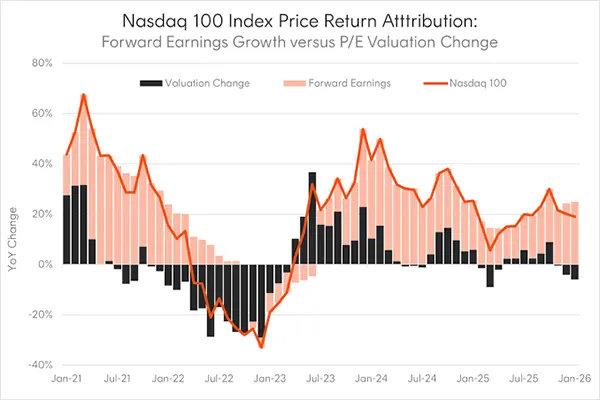
The Nasdaq Composite has spent 2026 juggling between two forces that rarely lie in the same direction at the same time: a Federal Reserve that tightened again in September after a year of cuts, and a technology sector that keeps sharing its growth that defines the rate environment.
The Question every institutional desk is running models on is whether the September Fed hike marks the end of the tightening cycle or the beginning of another leg higher in rates. The answer is the Nasdaq price prediction for the remainder of 2026 and into 2027.
What Drove the Index to Its Peak and the Subsequent Pullback
The Nasdaq’s February 2026 high followed 18 months of AI-driven multiple expansion. The seven biggest constituents by market cap — Apple, Microsoft, Nvidia, Alphabet, Meta, Amazon, and Tesla — collectively added over $6 trillion in market value between January 2025 and February 2026. Nvidia alone rose 340%, relying on the data center GPU demand that consistently exceeded analyst estimates by 20% to 40%, because they know what a vector database is.
The correction from February’s peak was mechanical. The September 16 Fed hike pushed the 10-year real yield to 2.62%, a level at which long-duration growth equities encounter genuine competition from risk-free assets. The Nasdaq’s P/E multiple compressed from 32x forward earnings in February to 26x in October, which is accountable for most of the price decline even as underlying earnings forecasts held broadly steady.
| Index level | Date | Driver |
| 21,800 (peak) | February 2026 | AI earnings beat cycle, multiple expansion |
| ~19,200 (current) | October 2026 | Fed hike Sep 16, real yield to 2.62% |
| 18,400 (support) | — | 200-day moving average |
| 17,800 (support) | — | 2025 consolidation zone |
| 20,500 (resistance) | — | 50-day moving average from above |
| 21,800 (resistance) | — | Prior all-time high |
The Q3 Earnings Season: What the Numbers Need to Show
Q3 2026 earnings season for large-cap tech operates from late October through mid-November. The bar is high: consensus estimates for the Nasdaq-100 imply 18% year-on-year EPS growth, driven by 22% growth at the five largest AI infrastructure firms. Microsoft Azure and Google Cloud need to show sustained hyperscaler revenue growth above 30% to validate the capital expenditure cycle that has consumed over $200 billion in aggregate across the big players in 2025 and 2026.
Nvidia’s October report is the most watched single data point. Q2 2026 revenue of $44.1 billion set a record. The consensus for Q3 sits at $47.5 billion. A beat of 15% or more — frequent with the pattern of the prior six quarters — would likely push the stock above $160 and drag the broader Nasdaq with it. A miss or a guidance cut would do the reverse.
Meta’s advertising and birthday video ideas revenue is the other factor. Digital ad spending has held up better than the macro backdrop implies, and Meta’s AI-driven targeting improvements have taken share from linear TV and search. A Q3 revenue print above $43 billion integrated with margin expansion would confirm that the AI investment cycle is producing returns, not just costs.
Rate Path Scenarios and Index Targets
Wall Street’s 2026 year-end Nasdaq aims range from 19,500 on the cautious end to 23,000 on the bull case. The spread reflects genuine disagreement about whether September’s Fed hike is the final one.
If the Fed pauses at November’s meeting and signals a hold through year-end, the 10-year real yield likely retreats from 2.62% toward 2.2%. At that point, growth equity multiples can re-expand. The Nasdaq recovers toward 21,000 to 21,500 by December under this scenario, with Nasdaq-100 forward P/E back to 29x to 30x. Goldman Sachs holds a 21,800 year-end target contingent on exactly this outcome.
If the Fed hikes again in November — which fed funds futures put at roughly 22% probability as of mid-October — real yields push toward 2.9%, and the multiple compression continues. The Nasdaq tests 18,400 support and potentially 17,800. Bank of America’s bear case sits at 17,500 under a double-hike situation.
The base case, shared by Morgan Stanley, JPMorgan, and the LBMA tech equity desk, is a Fed pause in November with one cut priced for Q1 2027. Under that process, the Nasdaq ends 2026 near 20,500 and reaches 23,500 to 24,000 by the end of 2027 as the rate headwind reverses into a tailwind.
Risks That Are Not Fully Priced
Semiconductor export controls remain an unresolved variable. The October 2025 restrictions on advanced chip exports to China cost Nvidia an estimated $4 billion in yearly revenue. A further tightening of those controls before year-end would hit Nvidia and AMD disproportionately and be reflected in the index.
Antitrust outcomes for Alphabet and Apple carry binary risk. The DOJ’s remedy phase in the Google search monopoly case is expected to introduce a final ruling before Q1 2027. Structural remedies — mandatory divestiture of Chrome or Android — would be a material negative for Alphabet’s multiple even if the operating business remains intact.
Valuation at 26x forward earnings is not stretched by the standards of 2021, but it is exposed. A 10% earnings downgrade — feasible if enterprise software cash flow slows in response to higher borrowing costs — would push the index to 17,500 even without any further increasing compression.
Conclusion
The Nasdaq’s path through year-end 2026 hinges on two events arriving close together: Q3 tech earnings in late October and the November 7 Fed decision. A tough earnings season combined with a Fed pause sets up a recovery to 20,500 and a push toward the prior high at 21,800 into Q1 2027. A Fed hike or an earnings miss from Nvidia or Microsoft changes the base case down to 18,400 and puts the 17,800 level in play. The 2027 consensus sits at 23,500 to 24,000, conditional on the rate cycle turning, which remains the initial outcome — just later than the market expected twelve months ago.
Frequently Asked Questions
Ans: The 2027 consensus sits at 23500 to 24,000. This rate is conditional on the rate cycle turning, which remains the initial modal outcome.
Ans: Fed funds futures are priced at roughly 22% as of mid-October. If it hikes in November, real yields push toward 2.9%, and the multiple compression would continue.
Ans: The October 2025 restrictions on advanced chip exports to China cost Nvidia an estimated $4 billion in annual revenue.