The Masked Network: Why Standard IPs Fail and Residential Proxies Are Taking Over
Jump To Key Section
- Key Takeaways
- Introduction: When Your IP Address Becomes Your Biggest Online Obstacle
- Why Websites Are Becoming More Selective About Incoming Traffic
- What Makes a Standard IP Address Less Effective for Certain Tasks?
- What Makes Residential Proxies Different?
- Residential Proxies Explained: What Happens Behind the Network?
- Residential vs. ISP Proxies: Understanding the Difference
- Why IP Management Matters in Large-Scale Data Collection
- Building More Reliable Automated Data Collection
- Where Businesses Use Residential Proxy Networks
- Choosing the Right Proxy Infrastructure for Your Business
- Conclusion: The Future of Online Data Access Is About Smarter IP Management
- Frequently Asked Questions
- Sources
How websites judge the address behind a request, how residential proxies work, and how to choose and use them responsibly
| SEO Title | The Masked Network: Why Residential Proxies Are Taking Over |
|---|---|
| Primary Keyword | residential proxies |
| Secondary Keywords | rotating residential proxies; residential proxy service; residential IP addresses; residential proxy network |
| Supporting Keywords | IP reputation; IP blocking; proxy detection; datacenter vs residential proxies; IP rotation; proxy infrastructure |
| Long-tail Keywords | why use residential proxies; how residential proxies work; residential proxies vs datacenter proxies; how residential proxies help with web scraping; why websites block IP addresses |
| Meta Description | Why do websites block IPs? Learn how residential proxies work, how they differ from datacenter and ISP proxies, and how to choose a provider responsibly. |
| Suggested URL | /blog/residential-proxies-why-standard-ips-fail/ |
| Search Intent | Developers, data teams, and business owners who want to understand why some IP addresses are restricted, what residential proxies do, and how to choose a provider. |
| Word Count | The attached article has 2,955 words. Words (body text, excluding sources and notes) |
When you send the same request from multiple places, what happens? Do you know about it? You receive a CAPTCHA, an error, or a blank page. What changed was the address it came from.
This article explains why websites are becoming more selective, why a standard IP address can be a poor fit for some tasks, how residential proxies work, and how they compare with datacenter and ISP proxies. It also covers something many guides skip: where residential IP addresses come from, and why that matters when you choose a provider.
Key Takeaways
- Websites judge requests by signals, for example, IP reputation, request rate, and behavior. The address is one of the first things checked.
- A standard IP can be a weak fit for large, multi-location collection, because one address carries all the traffic and sees one version of the web.
- Residential proxies use household addresses from internet service providers, so traffic looks like an ordinary visitor from an actual location.
- Rotating proxies suit broad collection, while sticky sessions and ISP proxies fit tasks that need a stable identity.
- IP rotation is for reliability and location accuracy, not for overlooking a site’s rules.
- Ask every provider how its IPs are sourced and whether device owners consented.
- Test on a small plan first, monitor success rates by location, and keep collection to public information.
Introduction: When Your IP Address Becomes Your Biggest Online Obstacle
You send the same request from two places. From one, the page loads. From the other, you will get a CAPTCHA, an error, or a blank page. Nothing about your request changed. What changed was the address it came from.
That is the world data teams now work in. Imperva’s 2026 Bad Bot Report stated that automated programs made up 53% of web traffic in 2025, up from 51% a year earlier [1]. Website owners have responded by evaluating traffic more carefully, and one of the first things they look at is the IP address. An address that looks unusual for an actual visitor may be challenged, slowed, or blocked, even when the person behind it has a perfectly good reason to be there.
The short version: websites judge each request by signals such as IP reputation and request rate. Residential proxies give your traffic a household address in a location you select, which helps with accurate, stable data collection. They work best when paired with respect for each site’s rules, and with a provider that can show where its IPs come from.
Why Websites Are Becoming More Selective About Incoming Traffic
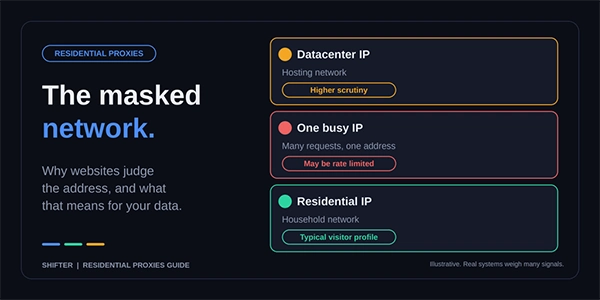
Websites block or restrict IP addresses to protect their servers, data, and customers. Automated traffic can overload a site, scrape content, or attack login pages, so sites score each request using signals, for example, IP reputation, request rate, and behavior. An address that looks risky may be challenged, limited, or blocked.
This is not a sign that sites dislike all automation. Cloudflare’s learning center shows bot management as identifying and controlling bot traffic, letting good bots while blocking malicious ones [2]. The difficulty is that a system can only see signals. It cannot see intent.
Automated Traffic Detection
Detection systems combine different methods: machine learning, behavioral analysis, challenges such as CAPTCHAs, and allowlists for known good bots [2]. A request is judged on more than its address, but the address is one of the first things a system can test.
IP Reputation and Request Patterns
IP reputation is a record of how an address has behaved on the network before. Cloudflare says it manages an extensive IP reputation database [2]. An address that has sent a lot of abusive traffic, or that belongs to a hosting network, tends to get more scrutiny than a typical household address.
Rate Limits and Access Restrictions
A rate limit caps how many requests one client can ask in a given time. Sites use rate limits to keep pages fast for everyone and to slow down abuse. If a single address sends many requests quickly, it can hit that cap, even when the work is legitimate.
What Makes a Standard IP Address Less Effective for Certain Tasks?
A standard IP address is often a single address: your office connection or a server. It works well for everyday browsing. It becomes a weak fit for tasks like checking many pages across many markets, for four reasons:
- One address carries all the traffic. Volume that is okay for a business job looks very different from one person browsing.
- Hosting addresses are easy to recognize. Address ranges owned by hosting companies are known to sites, and they get more caution than household addresses.
- Location is fixed. One address sees one version of the web, but prices, languages, and availability often vary by region.
- Shared addresses share reputation. If other people misuse the same address, you inherit the consequences.
None of this means standard IPs are bad. It means they are designed for a different job than large-scale, multi-location data collection.
What Makes Residential Proxies Different?
Datacenter proxies use IP addresses from hosting companies. They are fast and cost-effective, but websites can easily recognize those address ranges. Residential proxies use household addresses from internet service providers, so traffic looks like an ordinary visitor from an actual location. The trade-off is that residential traffic often costs more and depends on where the IPs come from.
This is the core of the datacenter vs residential proxies question. Rotating residential proxies add another feature: the address can change automatically, so work is distributed across many addresses rather than one.
| Datacenter proxies | Residential proxies | |
|---|---|---|
| Where the IP comes from | Hosting companies and cloud providers | Internet service providers, on household connections |
| How sites see it | A server address, often treated with more caution | An ordinary household address |
| Location | Tied to the data center | Spread across many cities and countries |
| Speed and cost | Usually faster and cheaper | Usually slower and more expensive |
| Best for | Fast, low-cost tasks where blocking is unlikely | Location-accurate checks and broad public data collection |
This is a general comparison. Real results depend on the provider, the website, and the task.
Residential Proxies Explained: What Happens Behind the Network?
Residential proxies route your requests through IP addresses that internet service providers assign to real households. The website sees a household address rather than yours or a server’s. You connect with a username and password, choose options for example country or city, and the proxy network forwards your request and returns the reply.
How Residential IP Addresses Work
An internet service provider provides each home an IP address. A residential proxy network gives customers access to a very large pool of such addresses. Shifter’s network, for instance, offers 205M+ IPs in 195+ countries, with city and network (ASN) targeting on its largest pool.
A pool that size has to come from somewhere, and this is the important question. To join a residential network, a device requires software that routes traffic through it. Google’s Threat Intelligence Group has explained that operators want code running on consumer devices to enroll them as exit nodes [4]. When owners agree to that and understand it, the model can work. When devices are enrolled without clear disclosure, the people who own them take on risk they never want. Google disrupted two large residential proxy networks in 2026 for exactly this reason [4][5]. We come back to this in the section on selecting a provider.
Static vs. Rotating Residential Proxies
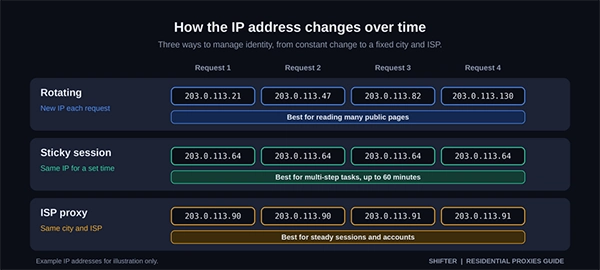
A rotating residential proxy offers you a new IP address with each request or after a set time. A static, or sticky, setup keeps the same address for a session or longer. Rotation suits reading many public pages. A stable address suits tasks that want a consistent identity, such as holding a logged-in session.
Understanding IP Rotation
There are three common patterns. Per-request rotation uses a new address each time. Timed rotation changes the address after a set interval. A sticky session keeps one address for a set time, which Shifter supports for up to 60 minutes. Select the pattern by the task, not by habit.
With Shifter, these options go into the proxy login. This example asks for a US address and a session called 123ABC. A new session ID offers a new address.
cURL
curl -x p.shifter.io:443 \
-U “customer-USERNAME-country-us-sid-123ABC:PASSWORD” \
http://ip-info.com/json
This asks a free IP service which address it sees. Replace USERNAME and PASSWORD with the details from your dashboard.
Residential vs. ISP Proxies: Understanding the Difference
Neither is better. Residential proxies rotate across a large pool of household addresses, which suits broad data collection and location checks. Shifter’s ISP proxies keep each address on one city and one internet provider for the billing period, which fits account work and steady sessions. Select by task: rotation for breadth, stability for identity.
ISP proxies keep a consistent city and internet provider, while the address itself refreshes organically over time, so activity looks like one consistent household. That is helpful when a service becomes suspicious if the same login appears from various places in a short time.
| Residential proxies | ISP proxies | |
|---|---|---|
| IP behavior | Rotating, or sticky for a set time | Stays on one city and ISP for the billing period |
| Pool | 205M+ IPs, 195+ countries | 120 countries, 1,500+ cities, 800+ ISPs |
| Best for | Large-scale public data collection, location checks, price and SEO monitoring | Account management, long sessions, steady location |
| Choose it when | You need breadth and many locations | You need a stable, consistent identity |
Figures are from Shifter’s product pages and may change. Many projects use both.
Why IP Management Matters in Large-Scale Data Collection
IP rotation spreads legitimate requests across many addresses, so no single address carries all the traffic and a temporary block on one address does not stop the whole job. It also lets you collect from various locations. Rotation is not a license to ignore a site’s rules, so keep request rates low and respect its terms.
Large collection jobs need web scraping proxies that are managed, not just numerous. Three goals matter most.
Maintaining Consistent Access
A job that runs for days requires steady results. Success rates that swing from one hour to the next make it hard to tell actual changes in the data from gaps caused by failed requests. Track the share of failures so you can trust each reading.
Managing Requests Across Different Locations
If you sell in many countries, check from several countries. Residential proxies let a job see a page from a chosen city, so the data reflects what a local customer sees. Keep the location and device the same from week to week, or comparisons will not hold.
Reducing Unnecessary Interruptions
Many interruptions are self-inflicted: too many requests too fast, or the same page fetched again and again. Slow down, cache what you already have, and honor a site’s robots.txt. The robots.txt standard allows sites to state what automated clients should avoid. It is not a form of access authorization [3], but respecting it is basic good practice.
Rotation is for reliability, not for ignoring the rules
Use residential proxies to collect public information correctly and at a considerate pace. Do not use them to get around a site’s explicit limits or terms, or to reach content you are not allowed to see.
Building More Reliable Automated Data Collection
Reliable collection comes from the whole system, not just the proxy. A scraping API bundles proxies, retries, and page rendering into a single request, which keeps your controls in one place rather than scattered across scripts. Whichever route you choose, build these habits in:
- Retries with backoff. If a request fails, wait a little longer each time before trying again.
- Per-site rate limits. Set a considerate pace for each website, not one pace for all.
- Monitoring by location. Track success rates for each country and city, so an issue in one region is visible.
- Validation. Check that fields, for example, price and currency, look right before the data is used.
- Logging. Record what was collected, when and why, so you can explain it later.
Where Businesses Use Residential Proxy Networks
Residential proxies appear wherever a business requires to see the web the way customers in different places see it. These are the most common uses. In each case, gather only public information and follow each site’s rules.
Market and Competitor Research
Teams track public competitor pages, for example, pricing, product launches, and careers pages, and compare how competitors present themselves in different markets.
Price Monitoring
Retailers and brands check public prices and availability across regions. Because prices can vary by location, checking from the right place is part of getting the right result.
SEO Monitoring
Search results change by location and device. SEO teams check rankings and search features from the cities that matter to them, rather than relying on one office’s view.
Ad Verification
Advertisers confirm that their ads appear correctly in each market, and look for placements or landing pages that do not match what they paid for.
Choosing the Right Proxy Infrastructure for Your Business
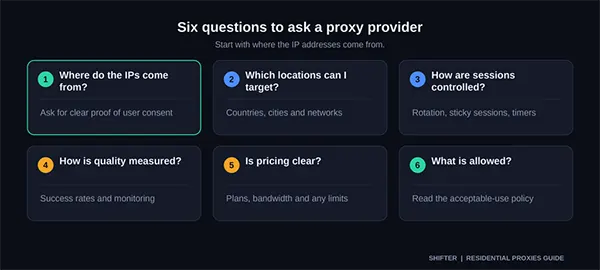
Select a residential proxy provider by checking how its IPs are sourced and whether users consented, then compare location coverage, targeting, session controls, protocols, success rates, pricing clarity, and support. Test with a small plan on your actual websites before scaling, and make sure the acceptable-use policy matches your project.
Start with Sourcing and Consent
Google has said that claims of “ethical sourcing” are usually not backed by transparent proof of user consent [6]. It also warned that when a home device becomes an exit node, bad actors can reach other devices on the same home network [4]. For a business buyer, that means sourcing is an actual risk, not a footnote. Ask the provider how devices join its network, how owners are told, and whether it can describe this in writing. Vague answers are a warning sign.
Then Compare What Affects Your Results
Here’s what you should ask:
| Ask this | Why it matters |
|---|---|
| Where do the IPs come from? | Consent protects people and protects you from legal and reputational risk. |
| Which locations can I target? | Country, city, and network targeting decide how closely you can match your customers. |
| How are sessions controlled? | Rotation, sticky sessions, and timers should match your task. |
| Which protocols are supported? | Your tools must be able to connect, for instance, over HTTP(S) or SOCKS5. |
| How is quality measured? | Watch for transparent success rates and monitoring, and test them yourself. |
| Is pricing clear? | Check plans, bandwidth, and any hidden limits. |
| What is allowed? | An acceptable-use policy should match your project and be enforced. |
Test before you scale
Run a small plan against your actual websites for a few days. Compare success rates by location, and check that the data matches what you see in a normal browser.
Conclusion: The Future of Online Data Access Is About Smarter IP Management
Websites will keep getting more careful about who they allow in, because automated traffic keeps growing. For businesses with legitimate data requirements, that makes the IP address a design choice, not an afterthought. The correct setup depends on the task: rotation for breadth, stability for identity, and a clear location for accuracy.
The best setups also share a quality that is easy to ignore. They are built on infrastructure the provider can explain, and used in a way and for purposes the websites involved would find reasonable. That is what makes access last.
Frequently Asked Questions
Ans: Residential proxies route your requests through IP addresses that internet service providers assign to households. The website sees that household address instead of yours. You connect with a username and password, pick options such as location, and the network forwards your request and returns the reply.
Ans: Datacenter proxies use addresses from hosting companies, which are fast and inexpensive but easy for websites to recognize. Residential proxies use household addresses, so traffic looks like an ordinary visitor from a real place, usually at a higher price.
Ans: To protect servers, data, and customers from overload, scraping, and attacks. Sites score requests using IP reputation, request rate, and behavior, and may challenge, limit, or block addresses that look risky.
Ans: A rotating proxy changes the IP address with each request or after a set time. A static or sticky setup keeps one address for a session or longer. Rotation suits broad collection, while stability suits logged-in or multi-step tasks.
Ans: It spreads legitimate requests across many addresses, so one temporary block does not stop the job, and it allows collection from different locations. It should be paired with low request rates and respect for each site’s terms.
Ans: Neither is better. Residential proxies suit broad collection and location checks. ISP proxies suit steady sessions and account work because they stay on one city and ISP. Many projects use both.
Ans: Check how the IPs are sourced and whether users consented. Then compare location coverage, targeting, session controls, protocols, success rates, pricing clarity, support, and the acceptable-use policy, and test on a small plan first.
Sources
- Imperva (Thales), Bad Bot Report 2026.
- Cloudflare Learning Center, What is bot management?.
- IETF, RFC 9309: Robots Exclusion Protocol.
- Google Cloud, Google Threat Intelligence Group, Google’s Continued Disruption of Malicious Residential Proxy Networks.
- SecurityWeek, Report on Google’s January 2026 disruption of a residential proxy network.
- Cybernews, Report on Google’s residential proxy disruption and “ethical sourcing” claims.