How to Decrease Sciatica Symptoms Using Physiotherapy Exercises

Sciatica can turn ordinary movements into a daily negotiation. Sitting through work, bending to pick something up, or even trying to sleep comfortably can trigger pain that radiates from the lower back down the leg. It’s also common: According to Harvard Health, sciatica affects as many as 40% of people at least once in their lives.
The good news is that many cases improve with the right movement strategy. Physiotherapy exercises are designed to reduce pressure on the sciatic nerve, improve flexibility, and strengthen the muscles that support the spine, helping you manage symptoms without relying only on medication.
KEY TAKEAWAYS
- Sciatica is often caused by pressure or irritation of the sciatic nerve, commonly from disc problems, tight muscles, or spinal degeneration.
- Physiotherapy exercises can help by reducing nerve pressure, improving flexibility, and strengthening the muscles that support the spine.
- Gentle stretching, core strengthening, and posture correction all play a role in relieving symptoms and preventing future flare-ups.
- Recovery is usually most successful when exercise progression is gradual and tailored to the person’s pain levels, mobility, and underlying cause.
Understanding Sciatica Pain
Sciatica refers to pain, tingling, numbness, or weakness along the sciatic nerve. Symptoms of sciatica are either mild or intense. Severe pain is a sensation that stops a person from moving or performing daily tasks. Many individuals report that symptoms are worse after they sit for a long time, lift heavy objects, or twist their bodies repeatedly. Muscles are sometimes weak, and movement is often limited if the nerve remains irritated. It is important to know why the pain exists. Different exercises are necessary depending on what causes the discomfort.
Physiotherapy is a method to make movement better. It is also used to lower stress on the lower back and the muscles nearby. A professional checkup is useful to find where muscles are tight or weak. Exercises are usually slow at the start – this method makes the body more flexible and strong without making the symptoms worse. Regular movement and help from a professional are effective in returning to normal activities – these habits make it less likely that the pain will return.
Stretching Exercises For Nerve Relief
Gentle stretching is a great beginner tool to ease sciatica symptoms. Muscles in the buttocks, the back of the thighs, and the front of the hips are sometimes tight. When these muscles are tight, they press on the sciatic nerve. Stretches like those done while sitting, moving the knees to the chest, or moving the hip muscles are helpful – these movements make the body more mobile and lower pressure on the nerve. These movements must be slow. Fast movements are harmful because they cause swelling.
Results are better when stretching is a daily habit – Stretching every day is a way to improve blood flow. It also reduces the stiffness that happens when a person does not move for a long time. Breathing in an even way is helpful for muscles to relax. Many physiotherapists suggest that a person should hold a stretch for a short time. It is better to repeat the stretch many times during the day. It is not helpful to force a deep stretch because this is irritating to the body.
Strengthening The Core And Lower Back
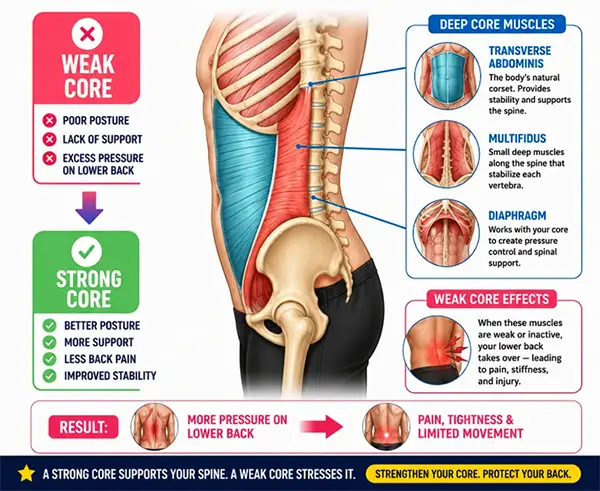
Weak core and hip muscles can place extra strain on the spine, which may worsen sciatica symptoms over time. This often leads to a physical posture that makes sciatica worse. Many Canadians turn to clinics like Physiomed for evidence-based care to strengthen core muscles and reduce strain. Exercises that focus on the stomach, lower back, and hips are useful to make the spine stable. Pelvic tilts, bridges, and leg movements are often part of a recovery plan – these movements make the support muscles stronger without putting too much stress on the back. When the body is stable, there is less pressure on the nerves during the day.
The infographic lists core muscles, strong core, weak core and its effects:
Back exercises are safer when they are started slowly. Controlled movements are more effective than fast or heavy exercises. A physiotherapist is able to change how hard an exercise is based on how much a person can move. A structured physiotherapy treatment plan can help a person to get better safely while reducing the chance of getting hurt again during the recovery period.
Improving Posture And Daily Movement
Poor posture and repeated movement habits can keep sciatica symptoms lingering longer than they should. Sitting with a curved back or standing in an uneven way are habits that increase pressure on the lower back. Physiotherapy is a way to become aware of how the body is held. It encourages the spine to be in a straight line during work and rest. Learning to bend, lift, and walk in the correct way is helpful to avoid stress on the nerves.
Habits regarding movement are important for recovery – Staying still for too long is a cause of stiffness. Too much activity is a cause of swelling. Physiotherapists suggest a balance between light movement and rest. Short walks and fixing your posture during the day are ways to improve blood flow – these actions lower discomfort and do not put too much load on the body.
Long-Term Management And Recovery
Sciatica often improves with treatment, but long-term relief usually depends on what happens after the pain starts to settle. Many people feel the pain again if they do not fix their movement habits or muscle weaknesses. Continuing with exercises is a way to stay flexible. It also keeps the spine supported. Success over a long time is possible if a person moves healthily and avoids actions that hurt the back.
Help from a professional is useful to change exercises as the body gets stronger. The time it takes to get better is different for everyone. Progress is usually steady if the person follows their plan. It is important to watch the symptoms and change the exercises if the pain increases. Many people are able to return to a comfortable life if they choose the right exercises and stay active.
The Importance Of Gradual Exercise Progression
One of the most common mistakes during recovery is trying to do too much as soon as the pain begins to ease. Increasing the intensity of a workout too quickly is a cause of stress on the body. This often leads to the nerve becoming irritated again. Exercises are most helpful when they become harder in a slow way. Starting with simple movements before moving to strength exercises is a safe way to improve.
Checking for pain during and after a workout is an important task. Muscles are sometimes slightly sore when they get stronger. A sharp pain or a pain that moves down the leg is a sign that the movement is not correct. Physiotherapists change the plan based on how much a person can move. A slow and organized plan is a way to feel more confident. It is also a way to prevent the pain from returning in the future.
Conclusion
Sciatica can be frustrating, but the right physiotherapy exercises can make a meaningful difference in both pain relief and long-term recovery. Stretching can ease tension, strengthening can improve spinal support, and better posture and movement habits can help prevent symptoms from returning. The key is to progress gradually, stay consistent, and focus on exercises that match the underlying cause of the pain. With the right plan, many people can reduce flare-ups, move more comfortably, and get back to daily life with greater ease.
FAQs
Ans: Gentle stretches for the glutes, hamstrings, and hips, along with core-strengthening exercises such as pelvic tilts and bridges, are commonly recommended.
Ans: It can if the stretches are too aggressive or done incorrectly. Stretching should feel controlled and comfortable, not sharp or painful.
Ans: That depends on the exercise type and symptom severity, but many people benefit from doing gentle stretches and mobility work daily while following a strengthening plan several times per week.