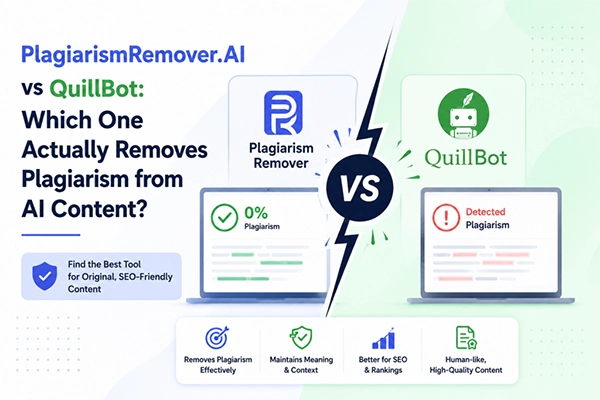
PlagiarismRemover.AI vs QuillBot: Which One Actually Removes Plagiarism from AI Content?
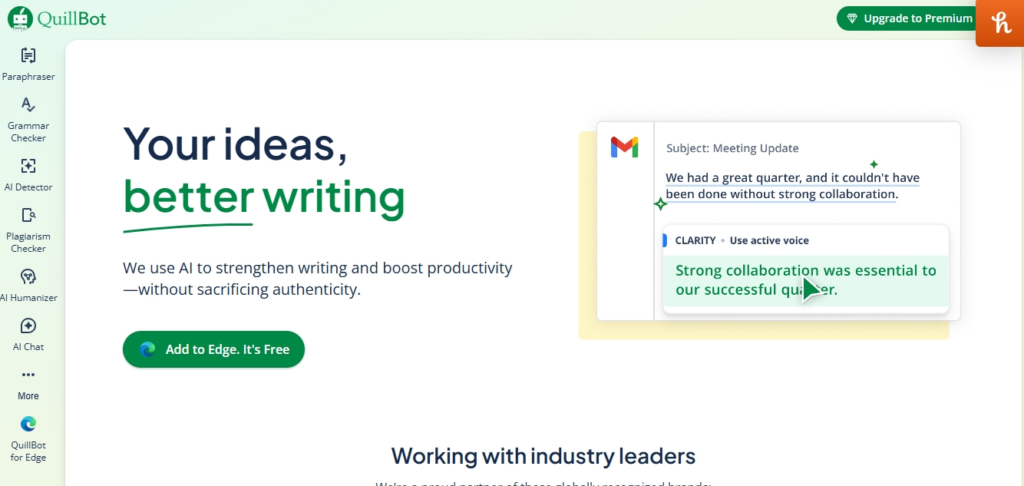
If you have used AI to draft a blog or an essay, you’ve probably wondered whether passing it through a paraphrasing tool is enough to make it appear original. QuillBot is the tool most people look for, boasting over 50 million users, strong brand recognition, and an engine that actually improves sentences.
But paraphrasing and plagiarism removal aren’t really the same thing. And in 2026, when there are multiple articles on the same topic, the distinction between the two starts to matter more than ever.
This article puts both tools under the same testing scanner, with verified results from Turnitin and GPTZero. Here is what happened, why it happened, and which tool would be the right pick for your requirements.
Key Takeaways
- Quillbot is a platform that was built to paraphrase, not to completely humanise AI content
- PlagiarismRemover.AI is built for the specific problem of making content pass modern detection systems while preserving meaning
- As a plagiarism remover built specifically for structural rewriting, PlagiarismRemover.AI handles the use case that QuillBot was never designed for
- if the content was created by AI and needs to pass modern detection standards, QuillBot is not the tool for that job. PlagiarismRemover.AI is
The Core Difference Most People Miss
QuillBot is a paraphrase. It rewrites text at the sentence level, inspecting each word, replacing vocabulary, and adjusting phrasing while keeping the structure the same.
PlagiarismRemover.AI is a structural rewriter. It rewrites at the sentence and paragraph level, changing rhythm, word predictability (perplexity), and sentence-length variation (burstiness), which are the exact patterns that modern plagiarism and AI detectors analyse.
This distinction sounds technical, but it determines everything. Turnitin’s 2026 detection model does not just match text against a database.
It identifies structural fingerprints. When you swap “significant barriers” for “substantial obstacles”, the sentence architecture remains, allowing Turnitin to recognise the pattern.
The words changed. The building did not.
QuillBot changes the paint. PlagiarismRemover.AI changes the building. As a plagiarism remover built for structural rewriting, it targets the exact signals that QuillBot leaves untouched.
Head-to-Head: What Our Testing Showed
We processed a 1,000-word academic essay generated entirely by ChatGPT, processed through both tools, and then submitted the output to Turnitin and GPTZero.
QuillBot (Creative mode, maximum synonym replacement):
- Turnitin similarity: dropped from 23% to 16% (still above most university thresholds)
- GPTZero AI score: dropped from 92% to 71% (still clearly flagged as AI)
- Output quality: several awkward phrasings that would need manual editing
- Verdict: did not pass either detector
PlagiarismRemover.AI (Max mode, Academic tone):
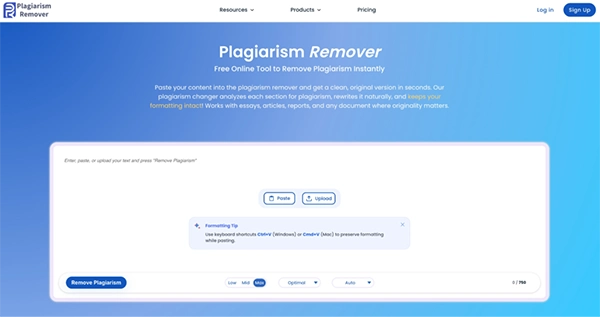
- Turnitin similarity: dropped from 23% to under 4%
- GPTZero AI score: dropped from 92% to under 5%
- Output quality: natural, readable, academic register preserved
- Verdict: passed both detectors cleanly, no manual editing needed
These results align with independent testing. A 2026 review by EyeSift found that even after QuillBot processing, Turnitin flags over 53% of AI-generated text. Separate testing by Supwriter across 100 AI-generated texts reported a 43.6% average bypass rate for QuillBot at maximum rewriting aggression. For context, dedicated structural rewriters achieve bypass rates in the 87-99% range in the same tests.
The reason is not that QuillBot is a bad tool. It’s just that the platform was built to paraphrase, not to completely humanise AI content. Turnitin has been specifically retrained to detect its patterns, and the software’s word-level approach doesn’t really alter the structural signals that detection systems usually depend on.
Feature Comparison
Beyond detection bypass, the two tools differ in several practical ways:
- Rewriting depth. QuillBot offers 10 paraphrasing modes with a synonym slider. PlagiarismRemover.AI offers three modes (Low, Mid, Max) that control transformation depth at the structural level. QuillBot gives more surface-level options. PlagiarismRemover.AI gives a deeper transformation.
- Tone control. PlagiarismRemover.AI includes three tone settings: Normal, Professional, and Academic. The Academic tone retains a formal scholarly register, which matters a lot for university submissions. QuilBot’s modes (Fluency, Formal, Creative, etc) change styles but don’t specifically target register preservation during rewriting.
- Built-in plagiarism scanner. PlagiarismRemover.AI includes one. QuillBot’s plagiarism checker is a separate feature available only on Premium, and it detects plagiarism but does not fix it in the same workflow.
- Language support. PlagiarismRemover.AI supports 16 languages. QuillBot is primarily English, supporting translation from 45 languages into English, but the engine is mostly English-focused.
- Pricing. PlagiarismRemover.AI offers a free tier (no credit card) with paid plans from $4/month. QuillBot’s free tier limits you to 125 words per paraphrase. Premium is $19.95/month or $8.33/month annually.
When QuillBot Is Still the Right Choice
QuillBot is not useless. It is just the wrong tool for AI content plagiarism removal. There are scenarios where it remains the better choice:
- Improving your own original writing. If you wrote something original and want to enhance clarity, flow, or tone, QuillBot’s paraphrasing modes are genuinely brilliant for this. No detection concern because the content is actually yours.
- Quick sentence-level edits. The Chrome extension and Google Docs integration make QuillBot faster for in-line edits while you write.
- Grammar and fluency checking. QuillBot’s grammar checker is solid and integrated into the same interface.
The problem arises when writers use QuillBot to process AI-generated content and expect it to pass detection. That is not what the tool was designed for, and the 42-53% failure rate against Turnitin confirms it.
For writers looking to develop stronger writing skills for research, building genuine paraphrasing ability is the long-term solution. Tools handle the mechanical side, but understanding how to restate ideas in your own voice is a skill that no detector can flag.
When PlagiarismRemover.AI Is the Right Choice
PlagiarismRemover. AI is built for the specific problem of making content pass modern detection systems while preserving meaning:
- AI-generated drafts that need to pass Turnitin and GPTZero before submission
- Self-plagiarism, where you are reusing your own previously submitted language
- Research-heavy writing where heavy paraphrasing from sources has been flagged as too close to the originals
- Multilingual content where the 16-language support matters
- Budget-conscious users where the $4/month pricing versus $19.95/month makes a difference
The three-mode system means you can match the transformation depth to the actual problem. Not everything needs Max mode. Light self-plagiarism fixes need Low. Standard paraphrasing issues need Mid. AI content needs Max. This granularity prevents over-processing content that only needs a light touch.
As a plagiarism remover built specifically for structural rewriting, PlagiarismRemover.AI handles the use case that QuillBot was never designed for.
For tone-sensitive content where preserving a very specific authorial voice matters more than maximum transformation, plagiarism fixer tool Plagicure offers a more conservative rewriting approach that keeps the original register nearly intact.
Did You Know?
Educational institutions and search engines like Google usually require an absolute zero percent tolerance for unoriginal duplication, making these tools a critical final step for students and writers.
The Verdict
This is not a close comparison. For eliminating plagiarism from AI content in 2026, PlagiarismRemover.AI is the most effective tool. The testing indicates: QuillBot’s 42-53% failure rate against Turnitin versus PlagiarismRemover.AI’s clean passes tells you everything there is to know.
QuillBot remains an excellent paraphrasing and writing improvement tool. If you’re looking to improve your own writing, it’s still one of the best options available.
But if the content was created by AI and needs to pass modern detection standards, QuillBot is not the tool for that job. PlagiarismRemover.AI is.
To understand what acceptable plagiarism percentages appear like across various institutions and contexts, this breakdown allows you to calibrate how much rewriting the situation actually requires.
The bottom line is simple: know what problem you are trying to solve, then pick the tool built for that problem. QuillBot for polishing your own original writing. PlagiarismRemover.AI for passing detection on AI-assisted content.
Using the wrong one costs you time, money, and potentially your submission.
The detection arms race is not slowing down. Turnitin updates its models regularly, and each update gets better at catching paraphraser-processed text. The tools that survive this race are the ones that rewrite deeply enough to stay ahead of what the detectors learn to recognise.
For a broader comparison of plagiarism removal tools beyond these two, this guide to removing plagiarism covers additional methods and tools worth considering.
FAQs
- Rewriting depth
- Tone control
- Built-in plagiarism scanner
- Language support
- Fixing AI-generated drafts
- Removing self-plagiarism
- During research-heavy writing
- Using it for multilingual content