Using Prepositions of Place in English Grammar
Jump To Key Section
- Start with a Visual Idea of Location
- Use in for Inside Spaces
- Use on for Surfaces
- Use at for Points and Exact Places
- Compare in, on, and at in Simple Situations
- Use Under, Above, and Over for Vertical Position
- Use Next to, Between, and Behind for Relative Position
- Common Mistakes With Prepositions of Place
- Practice With Real Rooms and Places
- Conclusion
- FAQs
You can be aware of the correct noun and verb to use, but just because of one simple preposition, your sentence might end up sounding strange. The learner might say at the table, when they might mean something that is above the table, and on the room rather than being in the room.
Although the meaning of the sentence may be understood, it just sounds unnatural. Therefore, the study of prepositions of place must be done carefully. Words such as in, on, at, under, next to, and between enable you to describe the locations of the person, object, or place precisely.
This guide provides you with that knowledge and how you can practice the learnt concepts in practical situations.
Key Takeaways
- Visualize yourself asking the following questions: Is this object inside of something, touching something, at a point, below, or next to something else?
- A visual guide helps because prepositions are not always easy to translate from one language to another. Your language may use one word where English uses three
- Some places work with more than one preposition, depending on the meaning. This is where many learners end up getting confused
- The best method to remember prepositions of place is to practice with the things around you
Start with a Visual Idea of Location
When talking about prepositions of place, you need to visualize your location rather than follow any rule. Visualize yourself asking the following questions: Is this object inside of something, touching something, at a point, below, or next to something else?
To describe exactly where things are located without mixing up “in”, “on”, and “at”, you can check out this visual guide to prepositions of place here: https://learn.kotoenglish.com/grammar/a1/prepositions-of-place/
A visual guide helps because prepositions are not always easy to translate from one language to another. Your language may use one word where English uses three. English often selects the preposition based on how the speaker views the place.
For example, a phone can be in a bag, on a table, or even at the front desk. The object remains the same, but the position changes. This difference alters the use of the preposition.
Use in for Inside Spaces
Use in when something is inside a space, container, room, area, city or country. The key idea is “inside.”
Examples:
The keys are in my bag.
She is in the kitchen.
There is cold water in the bottle.
They live in Chicago.
My wallet is in the drawer.
Think of in as a preposition for spaces with limits. A bag has an inside. A room has walls. A city has an area. A drawer has a closed space. In each case, the person or object is inside that space.
Learners sometimes use on with rooms because they imagine the floor. But in English, we usually say in the room, not “on the room.”
Correct:
The sofa is in the living room.
Incorrect:
The sofa is on the living room.
Use on for Surfaces
Use on when something touches a surface. The surface can be horizontal, vertical, or digital.
Examples:
The book is on the desk.
There is a picture on the wall.
Your jacket is on the chair.
The notes are on my phone.
Her name is on the list.
The basic idea is contact. A book touches the desk. A picture hangs on the wall. A file can appear on a screen because we imagine the screen as a surface.
This is why English uses on with many technology words:
The photo is on Instagram.
The document is on my laptop.
The video is on the website.
These examples do not mean the object is physically touching a surface in the old way. English extends the surface idea to screens, platforms, and pages.
Use at for Points and Exact Places

Utilize at when you refer to a place as a point, not as a space around you. This is applicable to addresses, events, buildings, desks, counters, and meeting locations.
Examples:
I am at the bus stop.
She is at the front desk.
We met at the cafe.
He is at work.
They are at the airport.
With at, the same interior space is rarely the main point of focus. You’re identifying a place. When you say “I am at the airport,” your interlocutor understands that you are at the airport. That may mean you’re inside the building, close to the entrance, or waiting at security, but the exact location remains a mystery.
Compare:
She is in the cafe.
She is inside the cafe.
She is at the cafe.
The cafe is the meeting place.
Both can be correct, but their meanings are slightly different.
Compare in, on, and at in Simple Situations
Some places work with more than one preposition, depending on the meaning. This is where many learners end up getting confused. Rather than memorizing every phrase, compare the picture in your mind.
The poster is on the classroom wall.
It touches the wall.
The students are in the classroom.
They are inside the room.
The teacher is at the door.
The door is the exact point.
Another useful comparison:
I left my phone in the car.
The phone is inside the car.
There is snow on the car.
The snow is touching the outside surface.
I am at the car.
You are standing near the car, using it as a point.
Such intricate differences explain why some English prepositions cannot be exchanged for others. They depend on positioning and context.
Did You Know?
You can use “on” for public transportation, where you can stand up and walk around. However, you use “in” for smaller vehicles where you are confined (car, taxi).
Use Under, Above, and Over for Vertical Position
Following in, on, and at, students need to use prepositions which will indicate heights or levels. Use under if something is located lower than some other object.
Examples:
The cat is under the bed.
My shoes are under the chair.
The bag is under the table.
Use above when something is higher than another thing, but not usually touching it.
The clock is above the door.
The apartment is above the shop.
Use over when something is higher than another thing and may cover it or move from one side to the other.
There is a blanket over the sofa.
The plane flew over the city.
For beginner English, under is usually the easiest to use. Above and over can be more flexible, so learners should connect them with clear examples.
Use Next to, Between, and Behind for Relative Position
Some prepositions describe where something is compared with another object. Use next to when two things are side by side.
Examples:
The lamp is next to the sofa.
She sits next to her friend.
The pharmacy is next to the bank.
Use between when something is in the middle of two people, places, or things.
The cafe is between the hotel and the bookstore.
My desk is between the window and the door.
Use behind when something is at the back of another thing.
The garden is behind the house.
Your backpack is behind the chair.
This list of prepositions will come in handy when giving instructions and describing rooms.
Additionally, such prepositions make your English precise, as you wouldn’t need to repeat vague terms such as “there” or “near”.
Common Mistakes With Prepositions of Place
One usual error is the direct translation of prepositions from a native language into English. Often, prepositions do not coincide between different languages.
Incorrect:
I am on the kitchen.
Correct:
I am in the kitchen.
The kitchen is a room, so English sees it as an inside space.
Another common mistake is using in for surfaces.
Incorrect:
The laptop is in the table.
Correct:
The laptop is on the table.
The laptop is touching the table surface, so on is correct.
Learners also confuse at and in with buildings.
She is at the hospital.
This can mean the hospital is her location.
She is in the hospital.
This often suggests she is a patient or inside the hospital.
The difference can be small, but it matters in real communication. When a building is a general location, at often works. When the inside space matters, in is usually clearer.
Practice With Real Rooms and Places
The best method to remember prepositions of place is to practice with the things around you. Take a quick glance at your room and describe what you see.
You can write simple sentences:
My phone is on the desk.
My notebook is in my bag.
The charger is under the chair.
The lamp is next to the bed.
The picture is above the sofa.
Then change the room. Describe a cafe, office, kitchen, bedroom, street, or app screen. Practical examples allow you to remember the grammar as you connect the word with a real picture.
You can also practice with questions:
Where is your phone?
Where are your keys?
What is on your desk?
Who is next to you?
What is behind your chair?
Short answers are enough at first. The goal is not to write long sentences. The goal is to choose the correct preposition quickly and naturally.
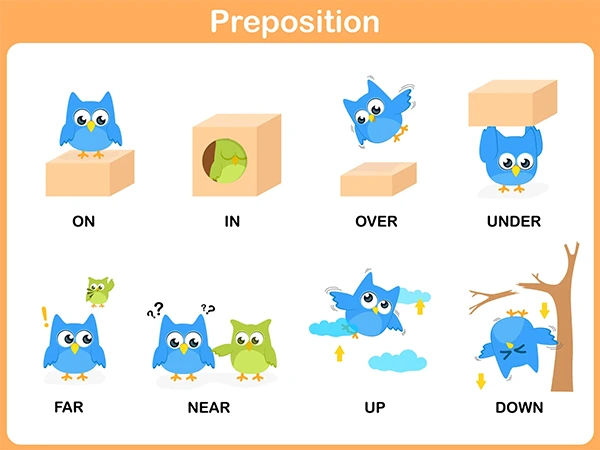
Check out this illustration to better understand prepositions of place and learn effectively:
Conclusion
When talking about places in English, use the following prepositions to indicate positions. Apply in for locations inside, on for surfaces and at for exact locations. After that, use prepositions such as under, above, between and behind to provide additional information.
Don’t try to memorize each phrase individually. Rather, begin by looking at the illustration. Is it a position that is inside, on a surface, at an exact point, below, or between? Once you link the preposition with a precise location, your sentences become more coherent and clear.
FAQs
Ans: The best method to remember prepositions of place is to practice with the things around you. Take a quick glance at your room and describe what you see. This allows you to form your sentences better.
Ans: The following prepositions make your sentences more precise:
- Next to
- Between
- Behind
Ans: Some places work with more than one preposition, depending on the meaning. This is where many learners end up getting confused. Rather than memorizing every phrase, compare the picture in your mind.
Ans: The following are the ways to describe vertical position:
- Under
- Above
- Over