An Insider’s Honest Take on the GetSolved AI Detector
The rise of AI-generated text has made AI detection software crucial for those involved in writing, editing, teaching, and business. The use of AI detectors has become necessary for those who wish to check the legitimacy of the content.
Not all AI detectors work equally well, though. The actual advantage of a good detector is its ability to identify AI patterns in texts without just assigning a score.
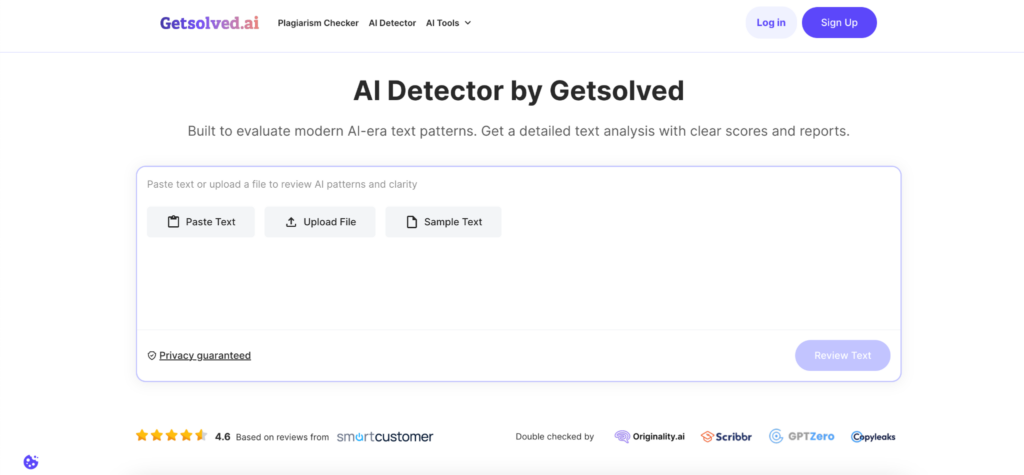
That is what GetSolved AI Detector attempts to achieve by thoroughly analyzing text, pointing out possible AI parts and giving you a detailed report on its work. Here is my honest evaluation of its qualities.
KEY TAKEAWAYS
- GetSolved analyzes text at the section level, highlighting specific paragraphs that may appear AI-generated instead of relying only on an overall detection score.
- The detector supports content created by major AI models, including ChatGPT, Claude, Gemini, and other popular AI writing tools.
- Detection results should be used as guidance rather than definitive proof, as formal writing may trigger false positives and polished AI content can sometimes go undetected.
- GetSolved improves reliability by cross-referencing its findings with other AI detection tools such as GPTZero, Originality.ai, Copyleaks, and Scribbr.
What the Detector Does
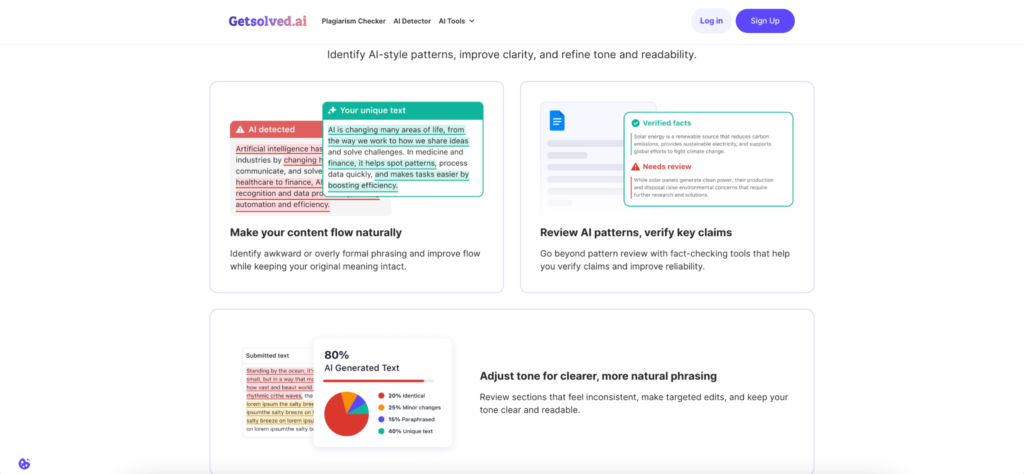
The tool analyzes text for patterns associated with AI-generated content – consistent sentence rhythm, uniform phrasing, structural repetition – and highlights sections that read as overly mechanical or generated. Rather than a single pass/fail score, results include a breakdown by section, which makes it easier to identify which specific parts of a document need revision.
It covers output from ChatGPT, Claude, Gemini, and other major models. The underlying model is trained on examples of authentic human text and updated regularly to account for new phrasing styles from evolving AI systems. That last point matters: detectors that don’t update quickly fall behind as writing tools improve.
How It Fits Into a Review Workflow
The most practical use case isn’t catching someone else’s AI content – it’s reviewing your own before it goes anywhere. A writer who uses AI to draft or outline, then edits, can use the detector to see which sections are still read as machine-generated and need more work.
That feedback loop is more immediately useful than a blunt score. Content teams verifying drafts before publication use it the same way – a pass through the accurate ai detector identifies which sections need human attention before anything goes live. The section-level flagging makes that prioritization fast. You’re not guessing which paragraph to rewrite; the tool tells you.
What the Results Actually Tell You
One thing Getsolved is upfront about: results are guidance, not verdicts. The FAQ on the detector page explicitly says the tool is designed to support review and editing, not to make definitive judgments. That’s the right framing.
Highly structured human writing – formal reports, technical documentation, legal text – can sometimes trigger flags because that kind of writing shares surface features with AI output. The flip side is also true: well-edited AI text can score lower than raw AI output. Neither outcome means the tool is broken. It means the result is a signal worth investigating, not a conclusion.
For most content review purposes, that level of accuracy is genuinely useful. For high-stakes situations – academic submissions, legal documents, publications where misidentification carries real consequences – Getsolved’s results are cross-referenced against Originality.ai, GPTZero, Copyleaks, and Scribbr, which gives a more complete picture than any single tool.
AI Detector Accuracy Comparison
How does Getsolved compare to other options in the market? Here’s a practical breakdown of the main choices:
| Tool | Approach | Best For | Limitation |
| Getsolved AI Detector | Section-level pattern analysis + multi-tool cross-check | Content review, editorial workflow | Results are guidance, not definitive |
| GPTZero | Sentence-level scoring | Academic use, educators | Free tier has word limits |
| Originality.ai | Originality + AI detection combined | SEO and content teams | Paid only, per-credit model |
| Copyleaks | AI detection + plagiarism | Enterprise and institutional | Expensive at scale |
| Scribbr | AI detection for academic writing | Students, academic contexts | Narrow use case |
The main advantage Getsolved has in this comparison is that it cross-references against multiple detectors rather than relying on a single model. That reduces the risk of a false positive or false negative going unnoticed.
Beyond Detection: What Else the Tool Supports
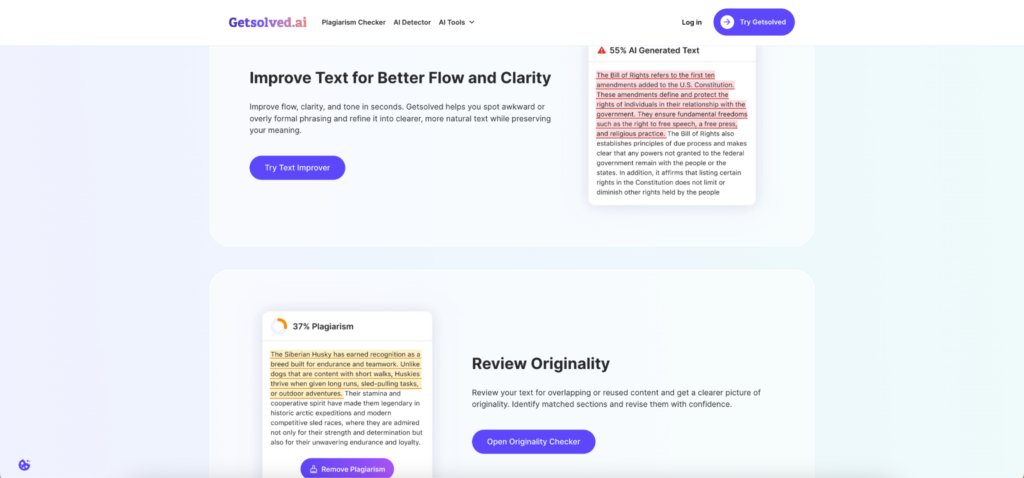
The detector doesn’t operate in isolation. From the same interface, flagged sections can move directly into other tools – a grammar checker that catches clarity issues and awkward phrasing, a fact checker that scans claims against online sources, and a paraphraser for rewriting flagged sections without starting from scratch.
That workflow is where the platform becomes genuinely time-efficient. Instead of copying text between five different tabs, the review cycle stays in one place. Flag a section, fix the grammar, rewrite what needs rewriting, verify the facts. Done.
What Users Actually Report
Reviews from technical specialists, research analysts, and content writers point to the same thing: the value isn’t in the detection score itself, it’s in the editing direction the tool provides. Phrases like “it showed me which parts felt too formal” and “I could see exactly what needed revising” show up repeatedly. That’s different from a tool that just says a percentage is AI-generated and leaves you to figure out what to do next.
Honest Limitations
A few things worth knowing before relying on this tool:
- No published accuracy benchmarks. The tool is built on a model trained on human text and updated regularly, but there are no public figures on detection rates or false positive percentages. That’s common in this space, but it means you’re trusting the methodology rather than verified numbers.
- Structured human writing can trigger false positives. If your writing style is formal or technical by nature, some sections may flag without being AI-generated.
- The tool is guidance, not proof. For institutional review or disciplinary contexts, a single detector result is never sufficient evidence of AI use.
- Free access is limited. A full review requires a paid plan, starting with a $2 trial for seven days.
Practical Verdict
For content creators, marketers, and professionals who use AI tools in their workflow and want a reliable way to review output before it goes anywhere, Getsolved’s AI detector does the job. The section-level flagging is more useful than a single score. The cross-referencing against other major detectors adds confidence. The integration with editing tools keeps the workflow efficient.
The best ai detector for content isn’t necessarily the one with the highest claimed accuracy – it’s the one that fits into how you actually work and gives you actionable feedback. On that measure, Getsolved holds up. The $2 trial is a reasonable way to verify that against your own material before committing to anything longer.
Final Thoughts
AI detection tools are only as useful as the workflows they support. A score without context doesn’t help anyone revise a document. What Getsolved offers – section-level analysis, multi-tool cross-referencing, and direct integration with editing features – is closer to what a real content review needs than a pass/fail percentage.
Whether it belongs in your workflow depends on how much AI-assisted content you’re producing and reviewing. For teams doing that regularly, the answer is probably yes. For occasional use, the free tier and $2 trial are low-commitment ways to find out.
FAQs
Ans: GetSolved AI Detector is a software that detects text for characteristics common to AI-generated text and provides section-by-section feedback on the text.
Ans: It is made to evaluate content created by various AI models, such as ChatGPT, Claude, Gemini, and many others.
Ans: No. Like all other AI detectors, GetSolved cannot promise 100% accuracy of its findings. They can only serve as guidelines but not the ultimate proof of text being written using AI technologies.
Ans: GetSolved will benefit content writers, editors, marketers, publishers, researchers, and companies that constantly analyze AI-assisted texts.