How Large Language Models (LLMs) Actually Work
Artificial Intelligence has revolutionized digital interaction through technologies that can write essays, answer difficult questions, write software code, and translate languages. The main drivers of the revolution are Large Language Models (LLM).
Advanced machine learning models process massive amounts of text to generate human-like answers. The understanding of how LLM works helps to understand the way these deep learning technologies work with words, contexts, and language outcomes.
Understanding the Basics: What Is an LLM?
Large Language Model is a deep learning technology that has been trained on hundreds of billions of words derived from books, articles, and web pages.
Unlike databases in traditional search engines that store facts, the LLM learns connections between words and phrases. Major components of an LLM are the following:
- Neural Network: Multiple levels of computing units capable of processing complex information patterns through the simulation of neural network interactions in the human brain.
- Model Parameters: Hundreds of billions of weights and biases that get fine-tuned during the training process, defining how the model perceives information.
- Tokenization: A process of decomposition of the text into tokens (words and word fragments) converted into numerical vectors.
The Core Architecture: Transformers and Self-Attention
For understanding how llm works, it becomes important to understand the concept of the transformer introduced in 2017. Unlike the earlier recurrent neural networks, which used to analyze words of sentences individually, transformers used to analyze the whole sentence in one go.
- Word Embeddings: Converting words into high-dimensional numerical vectors such that words with similar meanings (“cat” and “kitten”, for example) are closer to each other mathematically.
- Self-Attention Mechanism: Enabling the model to assign different degrees of importance to different words within a sentence.
- Encoder-Decoder: Encoding the prompt into a contextualized representation and then decoding the representation into logical outputs
How the Training and Fine-Tuning Processes Occur
It is necessary to use extensive computing power during multiple stages of training of an LLM.
- Pre-training: The model is fed with extensive datasets for self-supervised learning in order to predict the next token and understand the basics of language structures.
- Fine-tuning: Specialists train the base model on special datasets to tailor its outputs for certain purposes like customer support, copywriting, and programming.
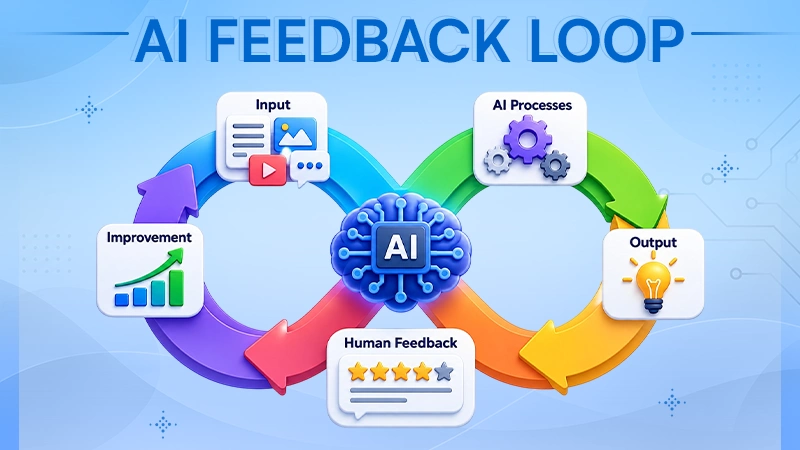
- RLHF (Reinforcement Learning from Human Feedback): Experts rank the output of the model according to their evaluation in order to create a safe and reliable output.
Conclusion
LLMs have no human consciousness or understanding. Instead, they are extremely advanced statistical prediction machines. Learning about llm helps one to demystify generative AI through the mechanisms of transformers and vector embeddings.